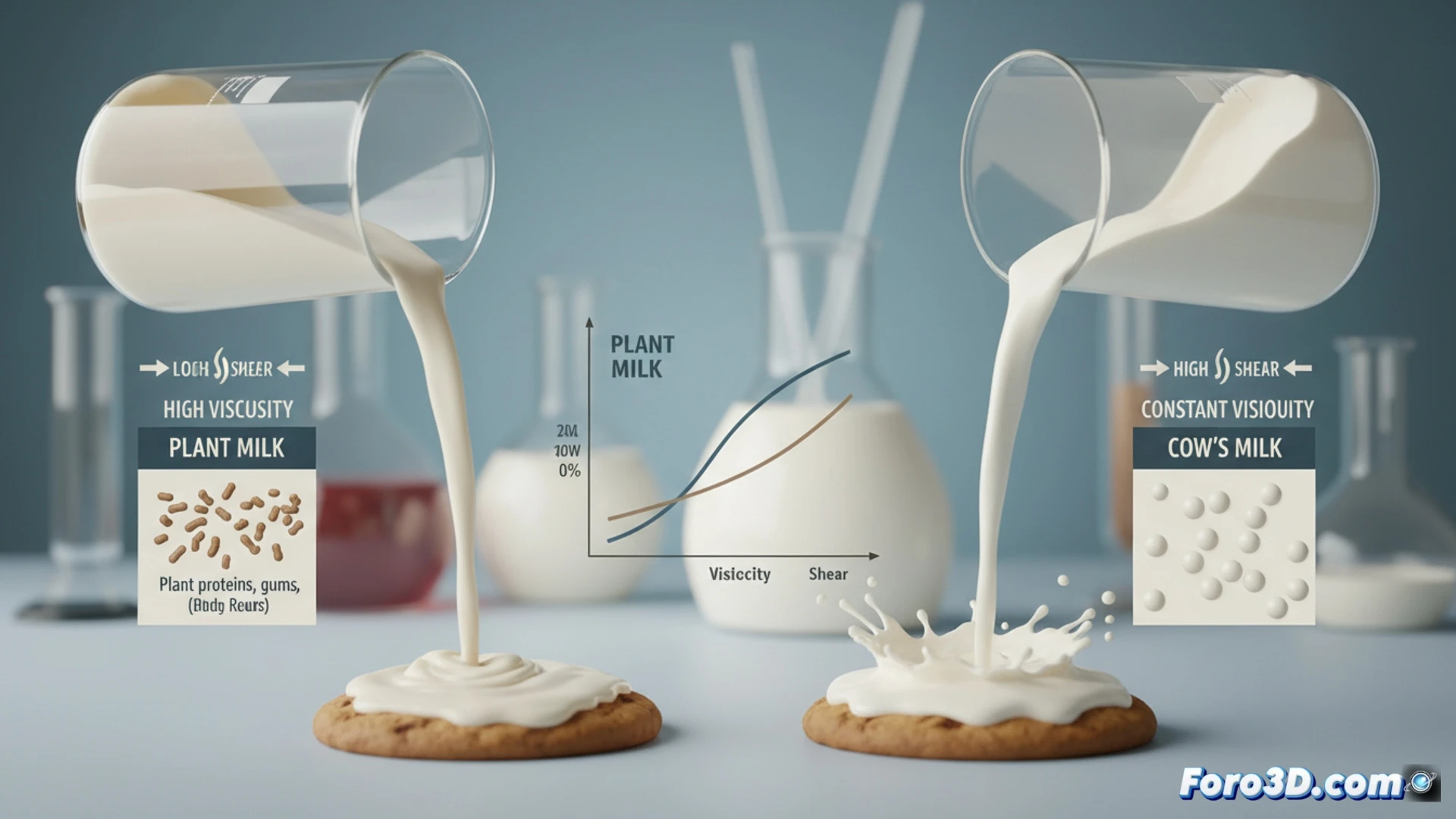
Have you ever noticed that almond or oat milk behaves strangely when pouring or shaking it? It's not your imagination. Recent research reveals that most plant-based milks are non-Newtonian fluids, a physical phenomenon they share with ketchup or honey. Their viscosity changes under force: they become more fluid when shaken or pressed, an effect called shear thinning. This behavior, dictated by small particles in suspension, defines how they spread or coat foods.
Rheology and design: from gums to texture 🧪
The key to this behavior lies in stabilizers, such as guar or xanthan gums, added in minimal amounts. These molecules form a colloidal network that traps water, giving stability to the product. Under shear, these structures align or break temporarily, reducing viscosity. Understanding this link between microstructure and macroscopic properties is pure materials science applied. Here, 3D simulation and computational visualization are crucial for modeling how particles interact, allowing prediction and design of the final texture without relying solely on empirical trial and error.
Modeling to innovate: the future of food 🚀
This approach marks a shift in food engineering. By combining rigorous physical models with traditional knowledge, it is possible to advance toward rational design of beverages and foods. Understanding the fluid physics behind plant-based milk allows optimizing its behavior in everyday situations, from its flow in the package to its interaction with cereals. It is a clear example of how materials science, supported by digital tools, is transforming industries seemingly far from high technology.
How do rheological models of non-Newtonian fluids explain the shear behavior and apparent viscosity of plant-based milks during common processes such as pouring, shaking, or digestion?
(P.S.: Visualizing materials at the molecular level is like looking at a sandstorm through a magnifying glass.)