The search for life in the universe has just become more complex. Researchers have identified a chemical Goldilocks zone for planetary habitability. In addition to the right distance from its star, a planet needs bioelements like phosphorus and nitrogen on its surface. New simulations reveal that less than 10% of exoplanets would have abundances similar to Earth's. This finding is a perfect case study for 3D scientific visualization, allowing complex astrobiological concepts to be represented intuitively and accessibly.
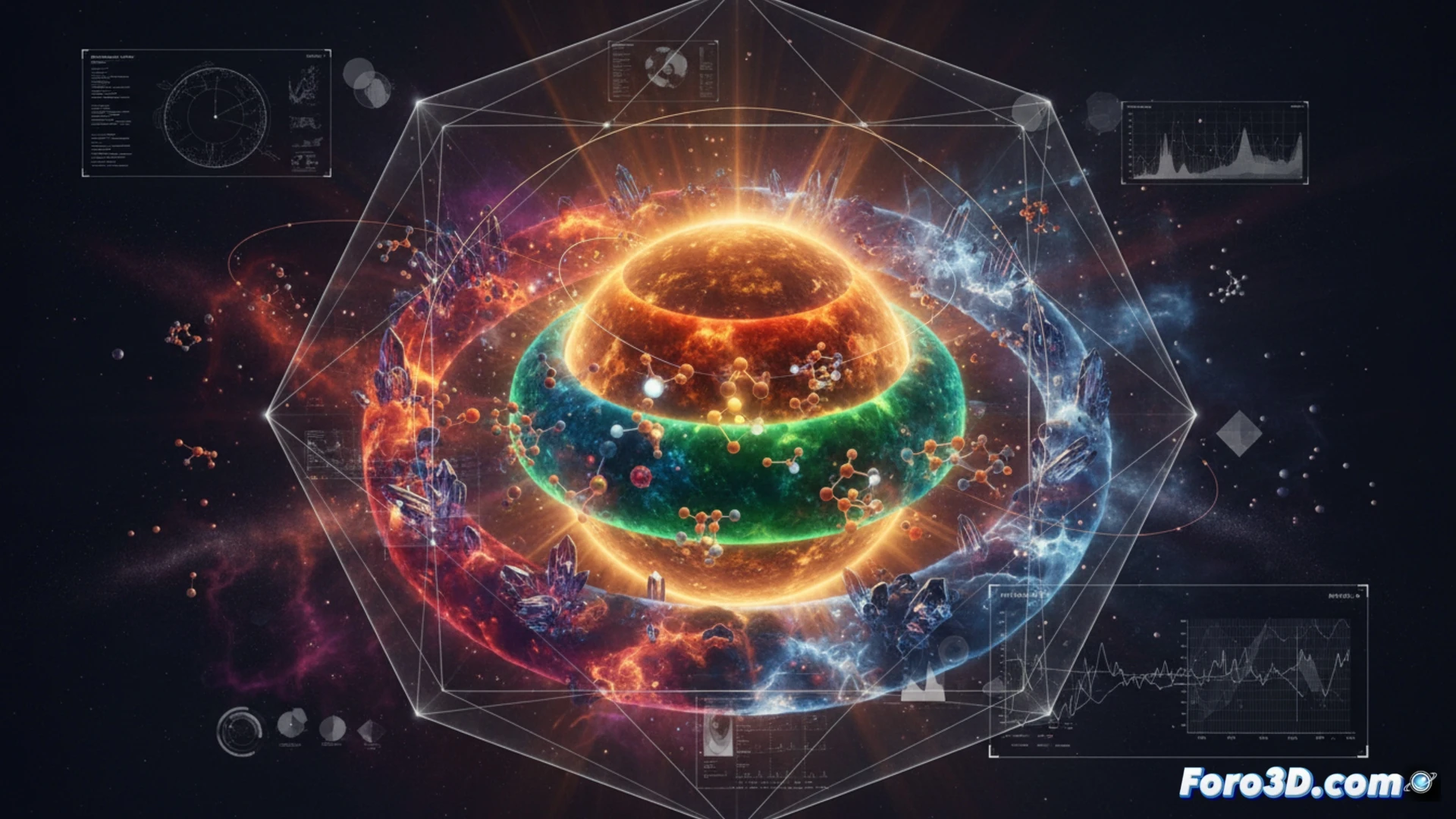
Visualizing chemical equilibrium in the planetary interior 🔬
The core of the discovery is the role of reactive oxygen in the mantle during planetary formation. This element determines whether phosphorus and nitrogen react with iron and sink into the core, becoming inaccessible to life. A very high or very low level of oxygen causes the loss of one of these two crucial elements. Here, 3D visualization is key. Interactive models of a sectioned planet can be created, showing animations of chemical flows and how mantle oxygen acts as a switch that directs elements to the core or retains them in the crust, illustrating the delicate balance required.
Representing Earth's rarity in the cosmos 🌍
The research concludes that only an extremely narrow chemical zone allows both bioelements to be available. This could explain why complex life is so rare. To communicate this idea, a visualization of the optimal chemical zone as a very reduced 3D parameter space, with Earth as a bright point in a vast universe of chemically uninhabitable planets, would be powerful. A multidimensional graph positioning exoplanets according to their composition would visually show our uniqueness, transforming complex data into a striking visual narrative about our place in the cosmos.
How can the complex spatial and thermodynamic relationships of the chemical Goldilocks zone be visualized in 3D to identify potentially habitable exoplanets?
(P.S.: modeling manta rays is easy, the hard part is making them not look like floating plastic bags)