Africa harbors great nuclear aspirations, but the reality is just one operational power plant: Koeberg, in South Africa. A recent study classifies the viability of these projects, highlighting Egypt as the strongest case, with its plant under construction by the Russian Rosatom. At the other extreme, the ambitions of Sahel countries like Niger are considered unrealistic, where signed agreements often have more political than practical value. The continent thus becomes a chessboard of technological and financial dependence.
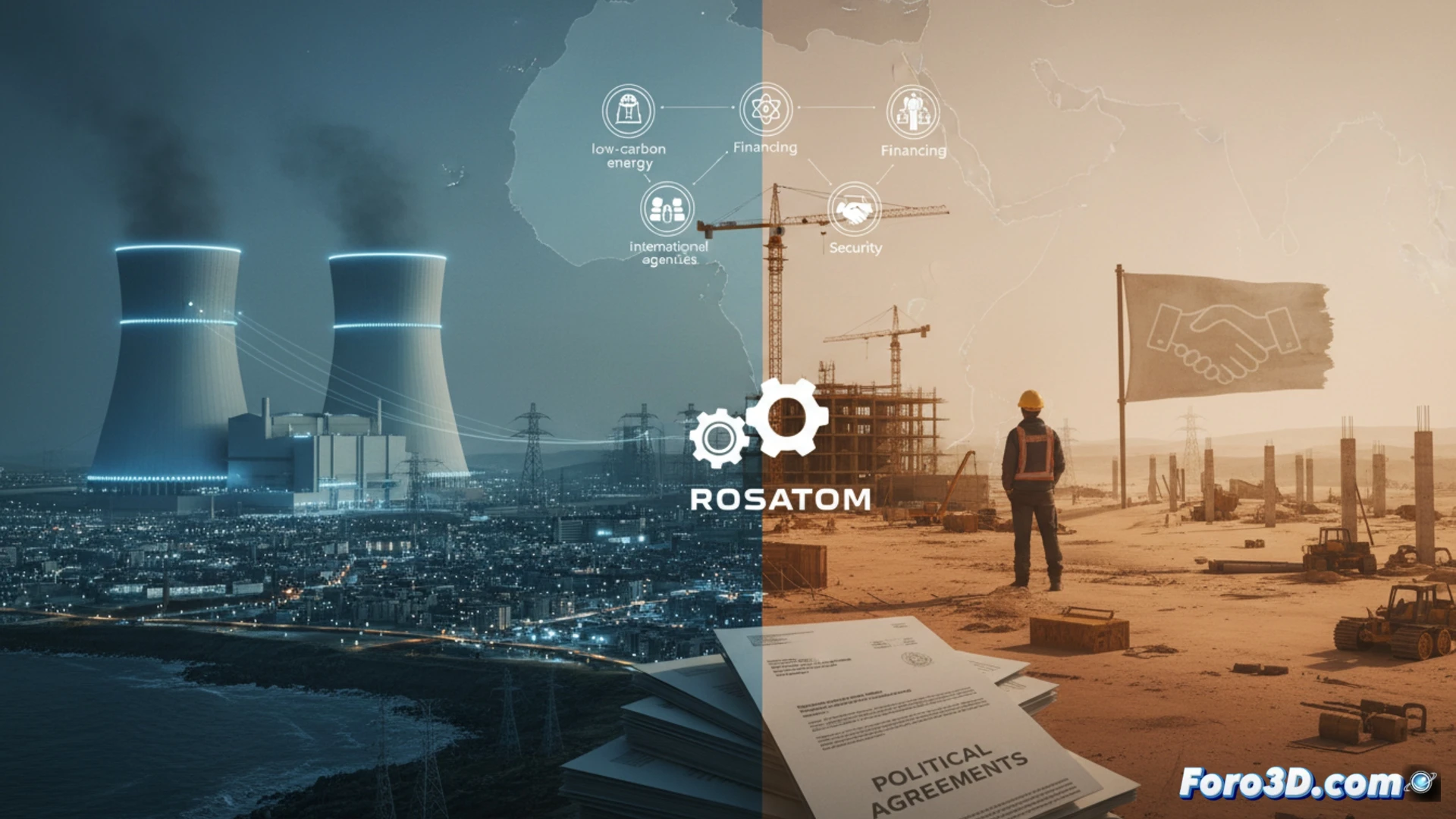
Visualizing the Supply Chain and Geopolitical Risk 🗺️
To understand this complex network, a 3D visualization would be key. An interactive map could model financing routes and international actors, such as Russia, the United States, or the IAEA, linking them to each project. The tool would allow classifying the geopolitical risk of each initiative based on the host country's stability, its technical capacity, and the bidding process transparency. Thus, the fragile supply chain would be clearly visible, where technology, fuel, and financing depend almost entirely on foreign powers, creating new strategic dependencies.
Energy Sovereignty or New Dependence? ⚖️
The African nuclear promise is debated between decarbonization and autonomy. Although presented as a low-carbon solution, its current development may be exchanging one dependence for another. Agreements with political weight but dubious technical viability could generate costly white elephants or tie countries to external partners for decades. The real challenge is not signing memorandums, but building local management capacity for projects of extreme complexity, where geopolitics often outweighs engineering.
How is global geopolitics reconfiguring the race for nuclear energy development in Africa and what implications does it have for future uranium and nuclear technology supply chains?
(P.S.: at Foro3D we know that a chip travels more than a backpacker on a sabbatical year)