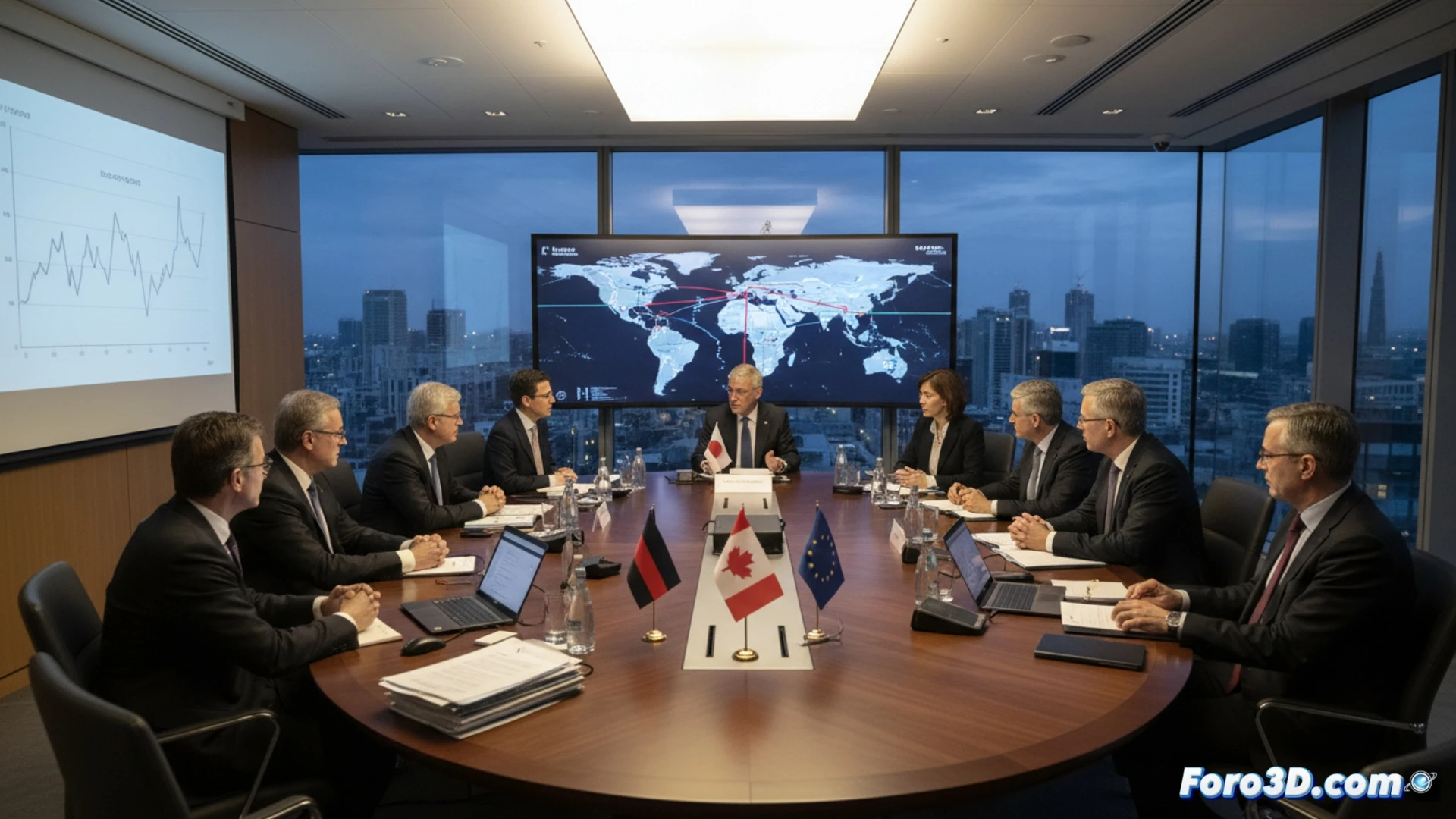
The recent G7 declaration, committing to stabilize energy markets amid tensions in the Middle East, is a political response to a concrete logistical and geographical challenge. Beyond the words, the true vulnerability lies in the maps: in the narrow sea lanes and pipelines that are the arteries of the global economy. To understand the real scope of this potential crisis, we must translate the declaration into the realm of geography and simulation, analyzing not only the what, but the where and how of a possible disruption.
3D Modeling of Critical Points and Flow Simulation 🗺️
A technical analysis requires visualizing strategic bottlenecks in three dimensions. The Strait of Hormuz, through which nearly 20% of global oil consumption passes, is the prime candidate for a detailed model. An interactive 3D map would allow overlaying data layers: real-time ship flows, channel depths, port infrastructure, and air defense ranges. By simulating a disruption scenario, the model would project the cascading impact on alternative routes, such as the Bab el-Mandeb Strait or the Suez Canal, revealing pressure on other infrastructures and diversion times, quantifying the delay and added cost for each consumer region.
From Political Coordination to Logistical Resilience ⚙️
The G7 declaration gains practical dimension when contrasted with these models. The coordination of measures translates, in the simulated space, into the redistribution of strategic reserves and the optimization of secondary routes to relieve congestion points. 3D visualization thus transforms a political principle into a global supply chain management exercise, making energy interdependence tangible. True preparedness lies not only in words, but in the ability to foresee, through spatial analysis, the concrete effects of a crisis and act on the logistical map before the crisis worsens.
How will the G7's new strategy to stabilize energy markets affect critical oil routes and the resilience of global supply chains?
(P.S.: geopolitics in 3D looks so good that it makes you want to invade countries just to see it rendered)