For the first time, astronomers have documented a comet reversing its direction of rotation. The 41P/Tuttle-Giacobini-Kresák, just one kilometer wide, slowed its spin until it stopped and then began rotating in the opposite direction between April and December 2017. This event, the fastest rotation change ever seen in a comet, was captured by telescopes such as Hubble and Swift. Scientific visualization is presented as the key tool to unravel and communicate the dynamics of this extraordinary process.
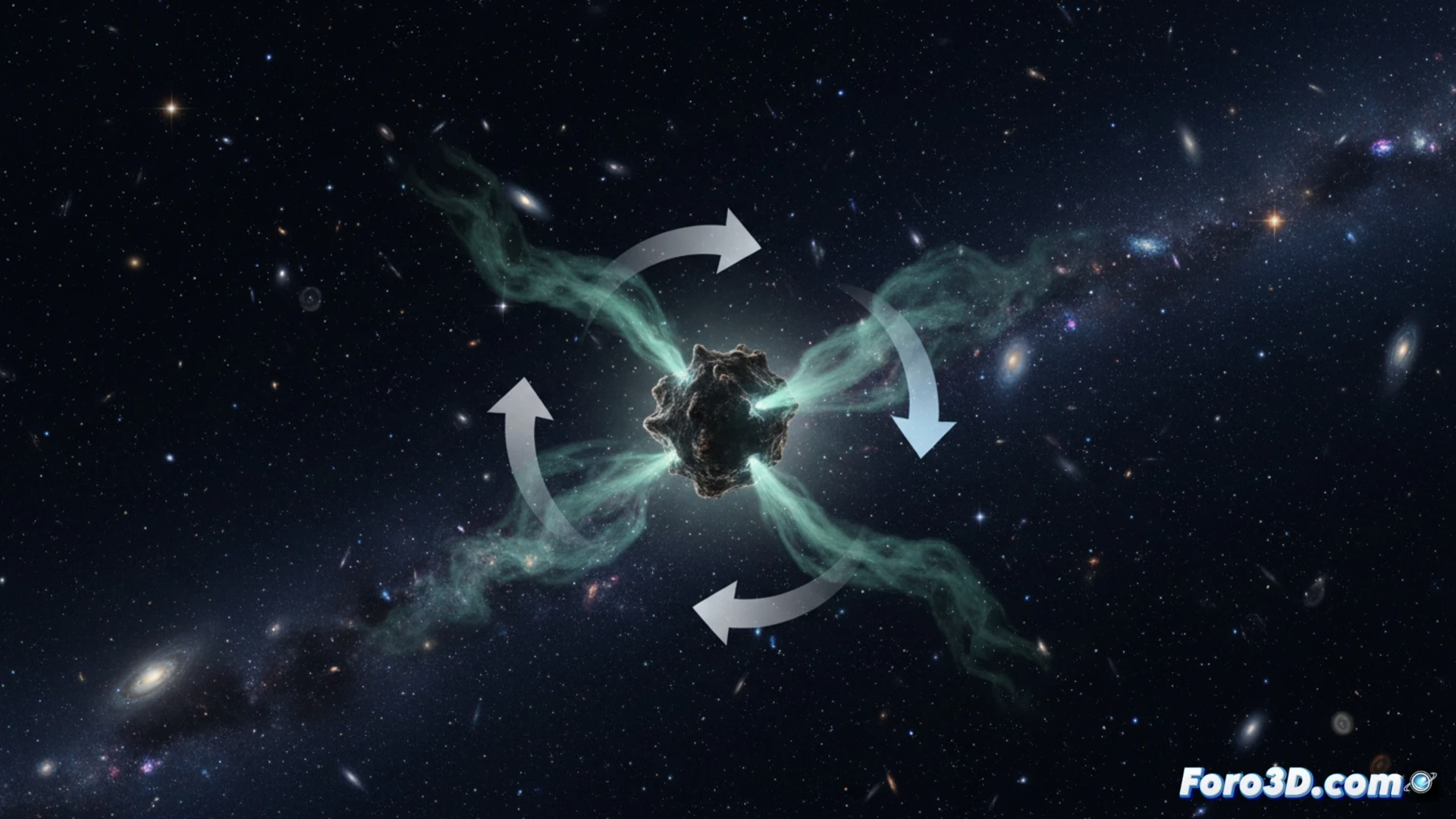
3D Modeling of Rotational Reversal: From Observation to Simulation 🌀
The physical explanation of the phenomenon lies in the asymmetric gas jets escaping from the cometary nucleus, acting as thrusters that first slow down and then accelerate the spin in the opposite direction. This is where 3D visualization proves its value. An interactive model of comet 41P, integrating Hubble's position and brightness data with Swift's gas observations, would allow simulating the initial rotation, progressive slowdown, zero spin point, and acceleration in the new direction. Visualizing the distribution and strength of these jets in the 3D model would make the torsion mechanism tangible, transforming complex data into an understandable narrative.
Beyond Observation: Prediction and Outreach through Models 🔮
This case opens the door to predictive simulation. Astronomer David Jewitt suggests that the comet, now in its new rotation, could accelerate until it disintegrates due to centrifugal forces in decades. A dynamic 3D model, fed with physical parameters, could visually project this final fate, illustrating why small comets are scarce. These visualizations are not only research tools but also powerful assets for planetariums and museums, where they would make an otherwise abstract and time-accelerated astronomical process palpable.
Is it worth creating a complete underwater environment or are the specimens enough?