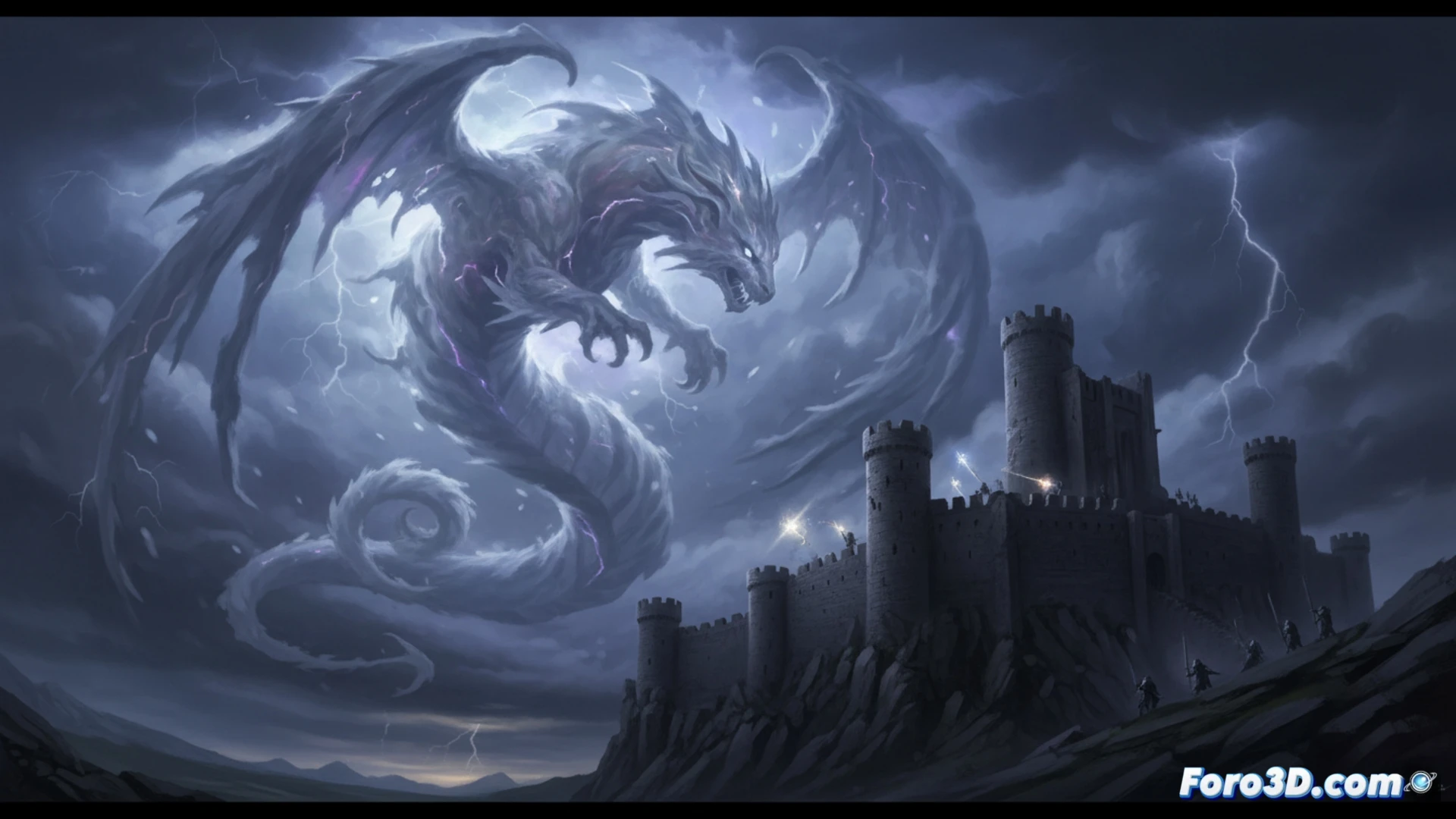
In the movie Kaamelott Deuxième Volet, the studio Rodeo FX faced a particularly complex visual effects task: bringing to life a majestic creature composed entirely of clouds. The artistic and technical challenge was not only to simulate the atmosphere, but to maintain the legibility of a recognizable face and form while the being constantly dissolved and reformed. This work, along with the creation of other magical effects and a warrior creature, drove the team to refine their tools to combine digital creatures with stylized effects.
Simulation, animation, and artistic control in a volatile being ⚙️
The creation of the cloud creature required a precise balance between physical simulation and artistic direction. The team could not rely solely on automatic fluid simulations, as they needed absolute control over the silhouette and, especially, over the facial features. They worked with layers of vapor and armor-shaped elements that blended organically. Lighting was key to giving volume and legibility, playing with internal light and reflections to define the structure within the moving mist. The animation involved guiding the simulations so that the dissipation and coalescence of the clouds followed the character's performance and dramatic intent, a process that demanded constant iteration.
The evolution of tools in hybrid VFX projects 🛠️
Projects like this, which fuse creature animation with simulated and stylized effects, act as catalysts for a studio's technical evolution. Rodeo FX mentions that this work drove them to refine their workflows and internal tools. The need for such specific control over a dynamic element like an animated cloud reveals the limitations of standard pipelines, leading to the development of more integrated solutions that allow artists and technicians to collaborate more efficiently on the boundary between realistic simulation and pure artistic expression.
How is the creation and animation of a realistic volumetric creature, like the cloud in Kaamelott, approached to integrate it credibly with actors and natural environments?
(P.S.: VFX are like magic: when they work, no one asks how; when they fail, everyone sees it.)