The conflict in Ukraine has accelerated a military revolution: the transition to AI-guided autonomous drones. This turning point, where robotic swarms operate independently, redefines the battlefield. To analyze this complex phenomenon, 3D technologies become indispensable. Simulation, digital twins, and data visualization are now key tools for understanding, planning, and representing this new era of autonomous warfare, beyond mere news.
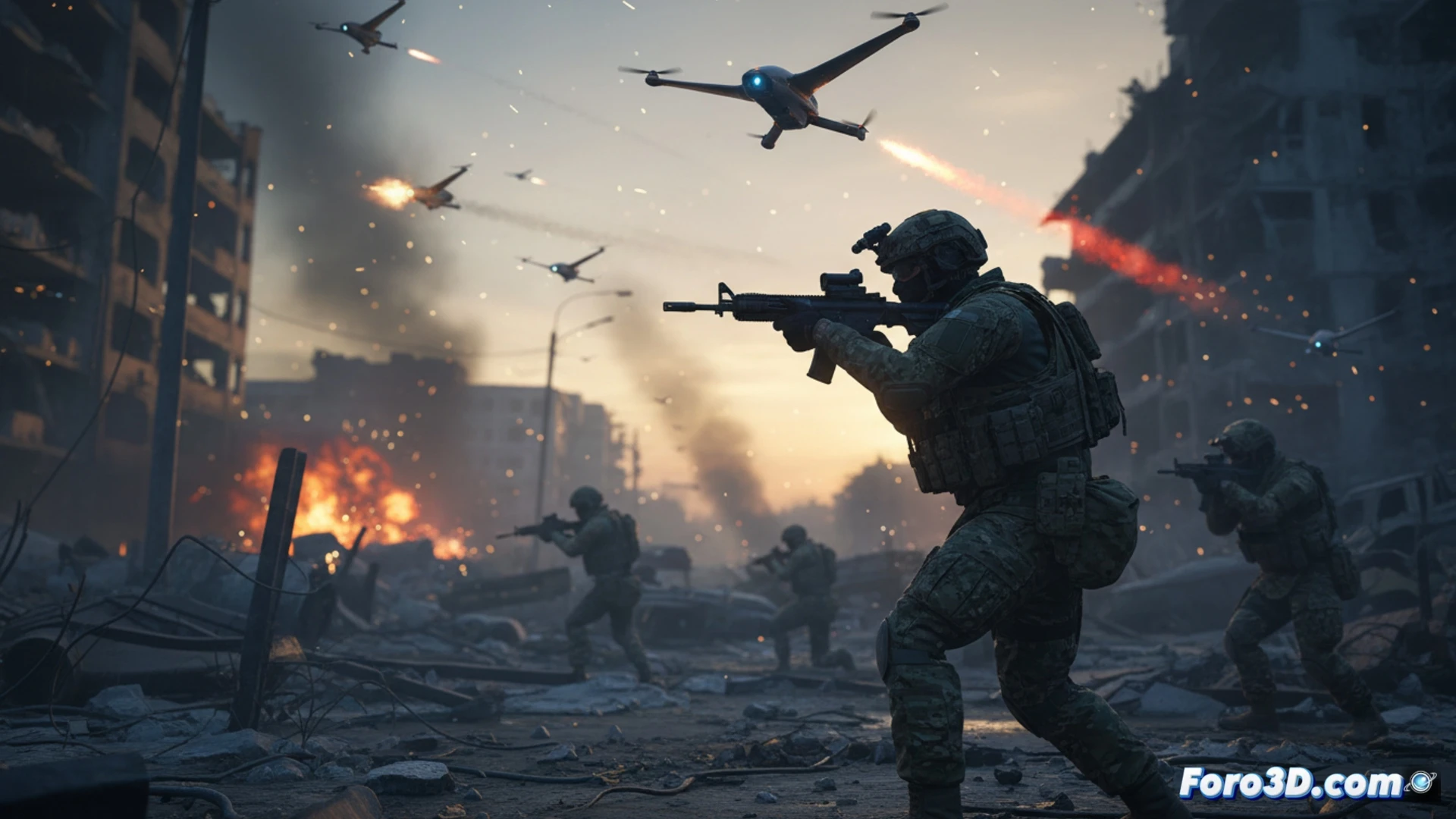
Digital Twins and Swarm Simulation: The Virtual War Laboratory 🧪
Before deploying an autonomous swarm in combat, its tactics are tested and refined in 3D virtual environments. Digital twins allow recreating exact battle scenarios, modeling terrain, enemy defenses, and atmospheric conditions. In this simulated space, AI algorithms train to coordinate hundreds of drones, optimizing routes, assigning targets, and responding to threats. The 3D visualization of this data is crucial: it allows strategists to observe attack patterns, identify weaknesses in coordination, and visually understand the overwhelming effect of a swarm attack, something impossible to analyze with raw data.
3D Reconstruction: Post-Engagement Analysis and Critical Disclosure 🔍
After an action, 3D technology enables a forensic reconstruction of the event. Using photogrammetry with drone or satellite images, a precise 3D model of the post-attack scenario is generated. This model is a powerful analytical tool for assessing damage, verifying the effectiveness of autonomous tactics, and understanding the interaction between drones and defenses. Additionally, these 3D reconstructions are fundamental for disclosure, offering the public an objective and deeply informative visual representation of how conflicts unfold in this new robotic era.
What software do you recommend for simulating the impact of projectiles on infrastructure?