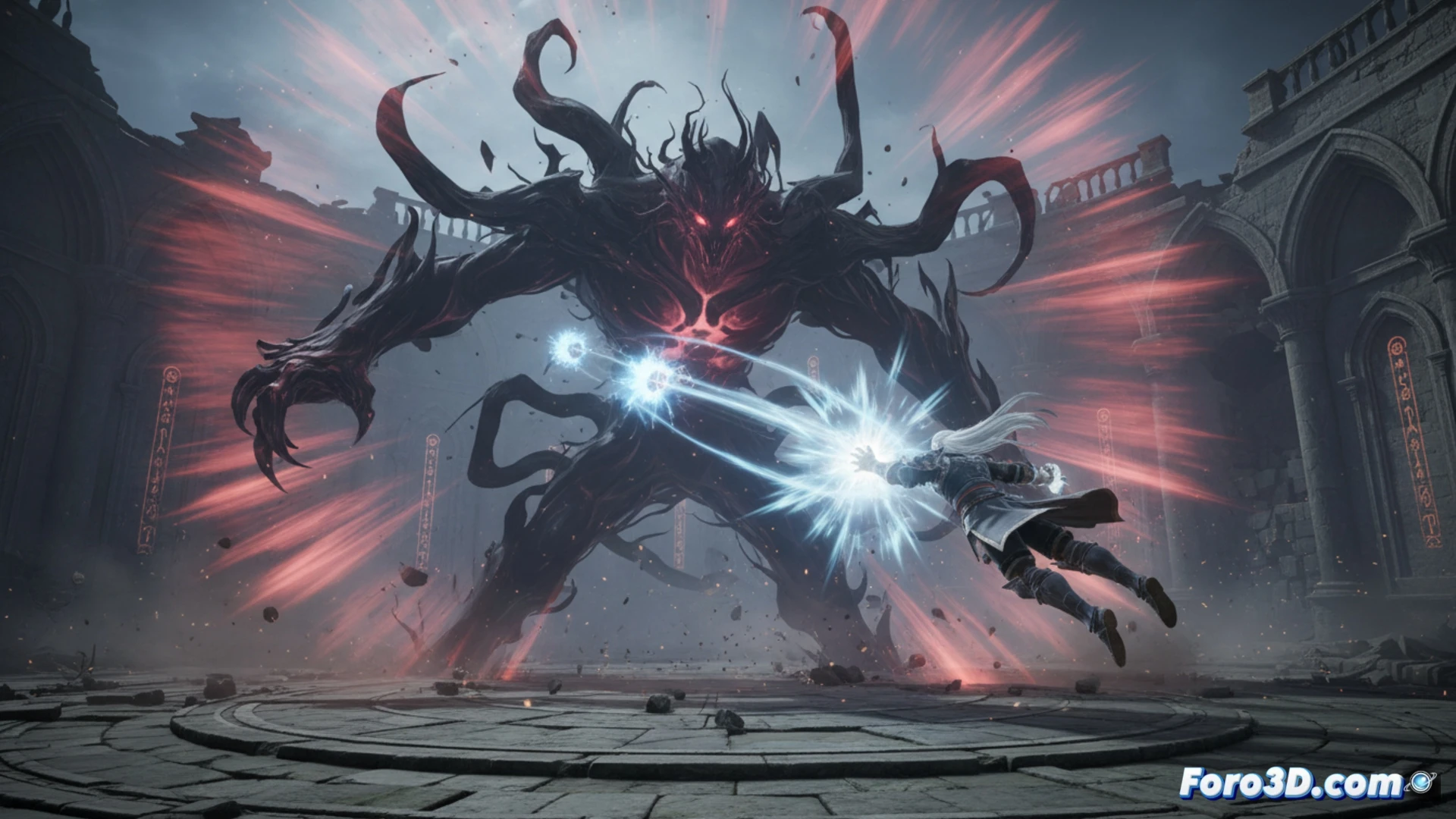
At the Scholarstone Institute in Crimson Desert, the confrontation against the boss Tenebrum features a unique and mandatory combat mechanic. This dark being is invulnerable to conventional attacks, requiring the player to specifically use the Palm Force skill executed from the air. The key is not brute force, but understanding vertical movement and leveraging the battle environment generated by the boss itself, turning the encounter into a real-time action puzzle.
Execution Mechanic: Gliding, Positioning, and Timing 🎯
To activate the damage window, you must elevate yourself using your flight or gliding ability. Tenebrum itself generates upward wind currents during the combat, which are essential for gaining height without spending resources. Once in the air and near the boss, activate the Palm Force skill while gliding. It is critical to execute it in this state, as using it while diving will direct the projectile to the ground. The gliding attack launches it in a horizontal trajectory, ensuring impact. Connecting three of these aerial hits consecutively, repeating the elevation and directed gliding cycle, is enough to end the combat phase and defeat it.
Analysis of a Mechanics-Oriented Boss Design 🧠
This boss design stands out for its pedagogical approach. Instead of being a test of stats, it forces the player to master a movement and skill mechanic in a high-pressure context. It reinforces the importance of mastering the game's flight system, integrating the environment as an active tool. Encounters like this, where the solution is unique and well-defined, demonstrate how design can guide the experience toward a memorable moment of overcoming based on understanding the established rules.
How can the implementation of the Aerial Palm Force mechanic be optimized in a game engine to ensure hitbox precision and smoothness in combats against bosses with evasive phases like Tenebrum?
(P.S.: game jams are like weddings: everyone happy, no one sleeps, and you end up crying)