Once Human, NetEase's survival shooter, stands out for its unique visual identity called New Weird, where the mundane fuses with the supernatural, creating a disturbing and fascinating world. This analysis focuses on the technology behind its aesthetic, exploring how its proprietary engine, NeoX Engine, and a specific software pipeline bring to life organic creatures and environmental effects that define the experience. The combination of tools like ZBrush, Substance Painter, and Maya is key to materializing this artistic vision.
NeoX Engine: The technical foundation of a corrupted world 🧪
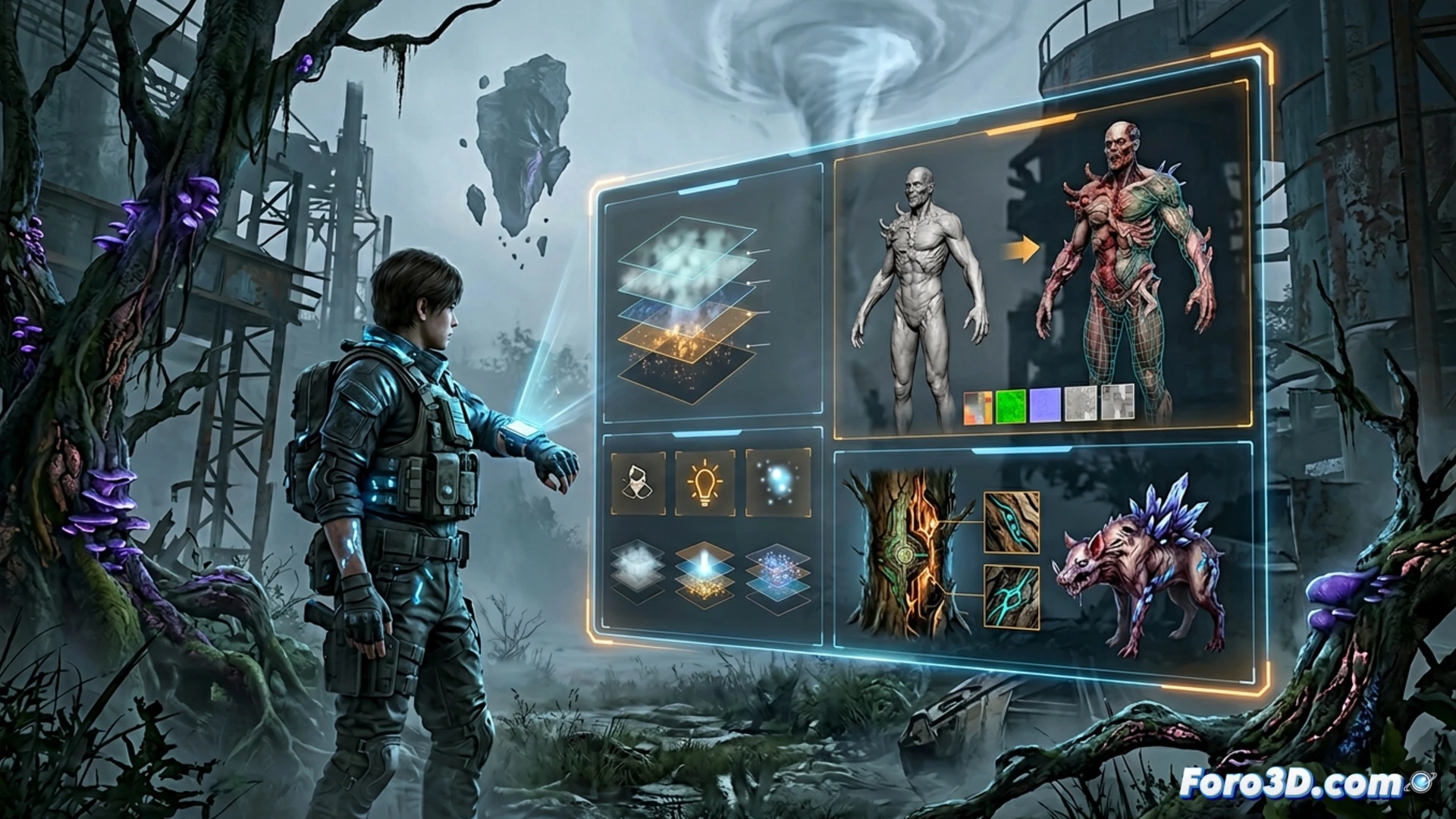
NetEase's NeoX Engine demonstrates its specialization in rendering dense environments and complex effects. Its greatest achievement in Once Human lies in handling shaders for organic creatures and particle systems. The shaders simulate wet surfaces, translucent membranes, and corrupted flesh with convincing physicality, integrating dynamic deformations. The particle effects are not just decorative; they are narrative, representing spores, supernatural essences, and environmental corruption. Unlike generalist engines like Unreal Engine, NeoX appears optimized for this particular aesthetic, prioritizing fluidity in the real-time manipulation of these organic textures and effects.
Artistic pipeline: From concept to real-time corruption 🎨
Asset production follows a methodical flow. High-poly sculpting in ZBrush defines the grotesque shapes of the monsters. Then, in Maya, the topology is optimized and prepared for animation. The crucial stage is Substance Painter, where textures that define the New Weird are applied: dirt, rust, and aberrant biological materials on everyday objects. The final integration in NeoX allows the engine's shaders to unify everything, adding moisture effects and light reaction. This pipeline, though common, serves a total aesthetic cohesion where each tool enhances the vision of a world where the familiar and the monstrous are inseparable.
How does Once Human implement shader techniques and environment design to create its New Weird aesthetic, and what lessons can an indie game developer extract?
(P.S.: 90% of development time is polishing, the other 90% is fixing bugs)