The announcement of Mario & Luigi: Brothership has surprised with its visual proposal. Abandoning the classic 2D perspective of the saga, the game bets on a completely three-dimensional environment that, however, faithfully emulates the art and spirit of its predecessors. This achievement is not accidental, but the result of a careful application of rendering techniques and a proprietary graphics engine that Nintendo has been perfecting, possibly inherited from the one used in the remake of The Legend of Zelda: Link's Awakening for Nintendo Switch.
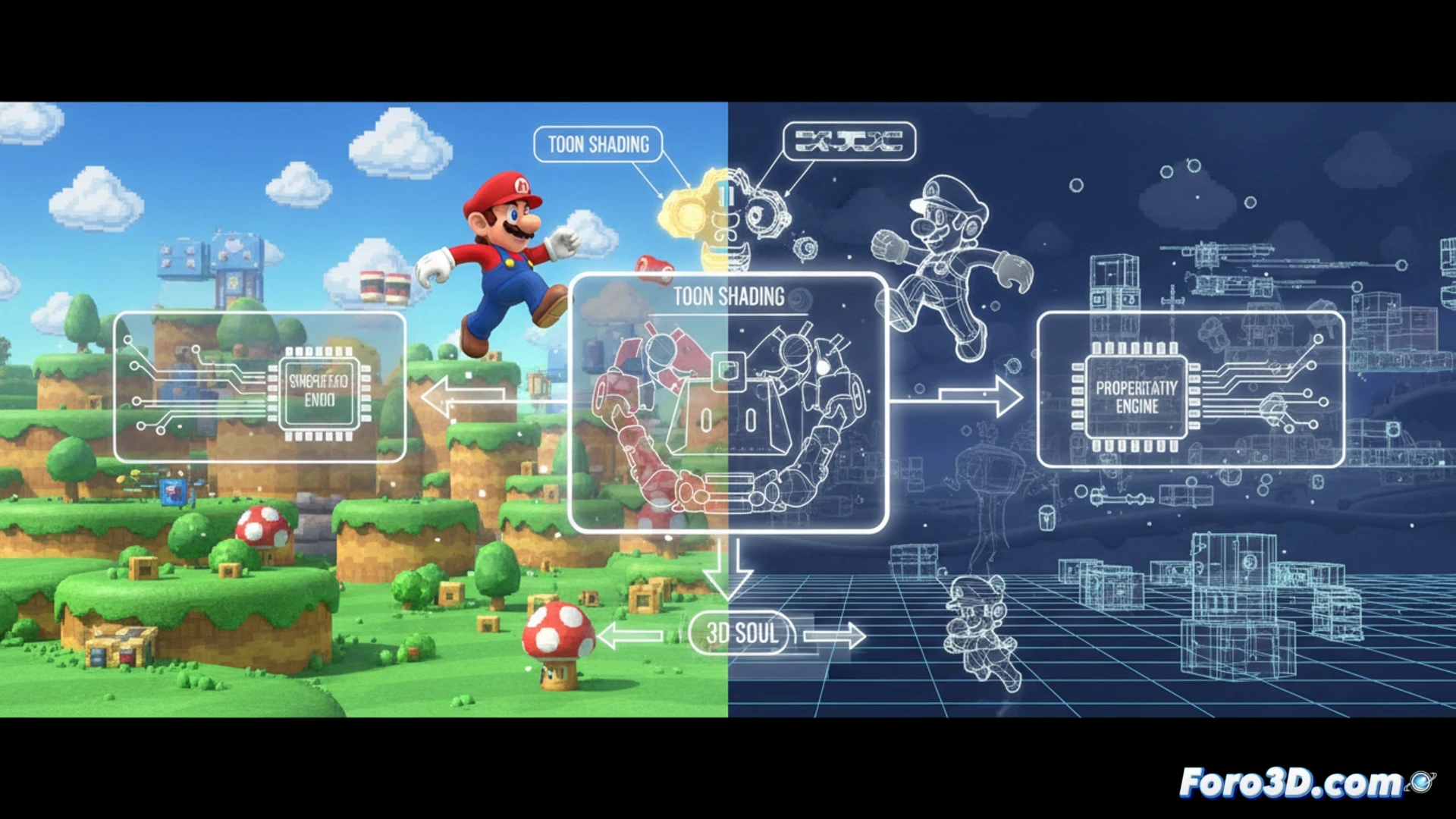
Engine and graphics techniques: Toon Shading and expressive outlines 🎨
The key to Brothership's aesthetic lies in its implementation of Toon Shading or cel shading. This technique replaces smooth light and shadow gradations with flat and defined color bands, creating that cartoon drawing look. A crucial element is the outline shading, which borders the models with a black or dark line, isolating the characters and elements from the scenario to maintain 2D legibility. The engine, although internal, is managed with standard tools like Autodesk 3ds Max for modeling, integrated into Nintendo's development pipeline. This suggests a robust and flexible technical base, capable of rendering dynamic worlds in 3D while preserving a deliberately flat and vibrant graphic identity.
Technical evolution at the service of design ⚙️
This technical approach is not mere visual boasting, but a coherent design decision. By migrating to 3D, the game gains depth, more cinematic camera angles, and animation possibilities, but without betraying the recognizable essence of the saga. The challenge for the developers has been to balance the technical complexity of a modern 3D engine with the apparent simplicity of the final art. Brothership demonstrates that the most advanced technology can and should be at the service of artistic identity, an essential principle in video game development where every technical choice defines the player's experience.
How has the Mario & Luigi: Brothership development team managed to recreate the essence and legibility of traditional 2D turn-based combat in a completely 3D environment, and what technical challenges does this transition pose for animation and gameplay design?
(P.S.: 90% of development time is polishing, the other 90% is fixing bugs)