Soft robotics seeks to imitate the adaptability of natural organisms, but often relies on complex external actuation systems. An advance from the Korean KRICT Institute could radically simplify this. They have created a sulfur-based polymer, an industrial waste, specifically for 4D printing. This material not only prints easily and recycles indefinitely, but also enables the manufacture of robots that change shape autonomously in response to stimuli like heat, without motors or wires.
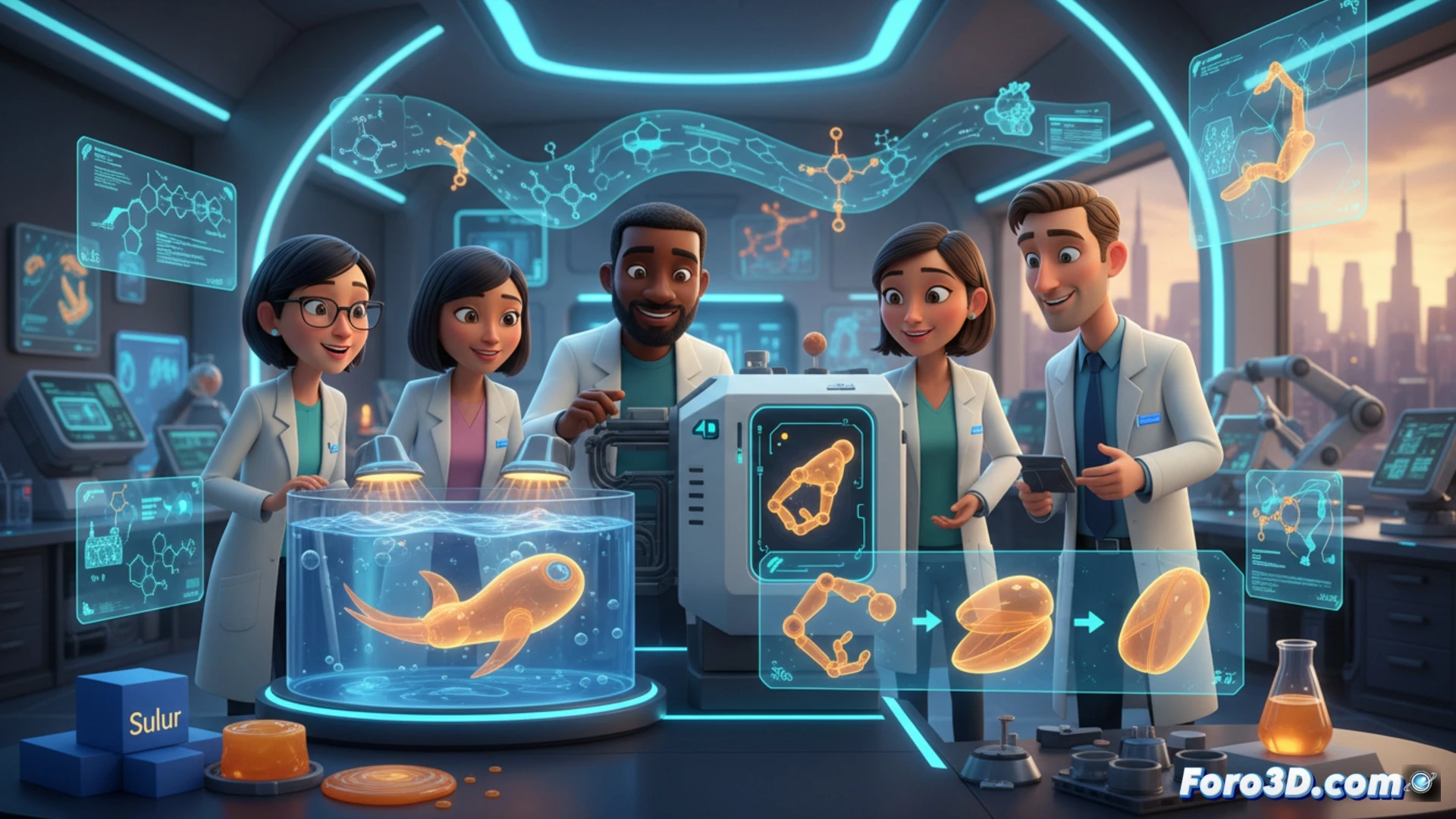
From waste to robot: the cycle of the dynamic polymer 🤖
The innovation lies in the chemistry of dynamic bonds of the polymer. In a hot state, it is malleable and allows conventional 3D printing. When cooled, it solidifies while maintaining the printed shape. The magic of the fourth dimension (time) appears with the programmable shape memory. When heated again to a specific temperature, the material recovers a predefined shape. Researchers demonstrated structures with multiple responses, where different parts activate sequentially at different temperatures. This enables complex functions: a swimming robot that flaps "fins," a prehensile arm that closes when heated, or capsules that self-assemble.
Towards truly sustainable and simple robotics ♻️
This development goes beyond mere novelty. It represents a crucial convergence: sustainability, by valorizing a waste and enabling complete robot recycling; structural simplicity, by eliminating external actuators; and intelligent autonomy, through programmable materials. The future could see deployable soft robots that activate with sunlight or tools that adapt on their own. It is a firm step towards robotics where intelligence is not only in the code, but inherent to the material.
How can the combination of recycled sulfur and 4D structures overcome actuation and sustainability limitations in the next generation of autonomous soft robots?
(P.S.: Simulating robots is fun, until they decide not to follow your orders.)