The exhibition Vapore sul vetro by Daniele Radini Tedeschi is presented in Rome, immersing the viewer in an existential realism. His series, such as Periferie e Ecomostri, depict desolate urban landscapes and dehumanizing architectures, capturing sensations of uprootedness. However, amid this desolation, the artist finds small everyday miracles, gestures of love that persist. His painting, rooted in expressionism, shows both the fears and hopes of a stripped humanity.
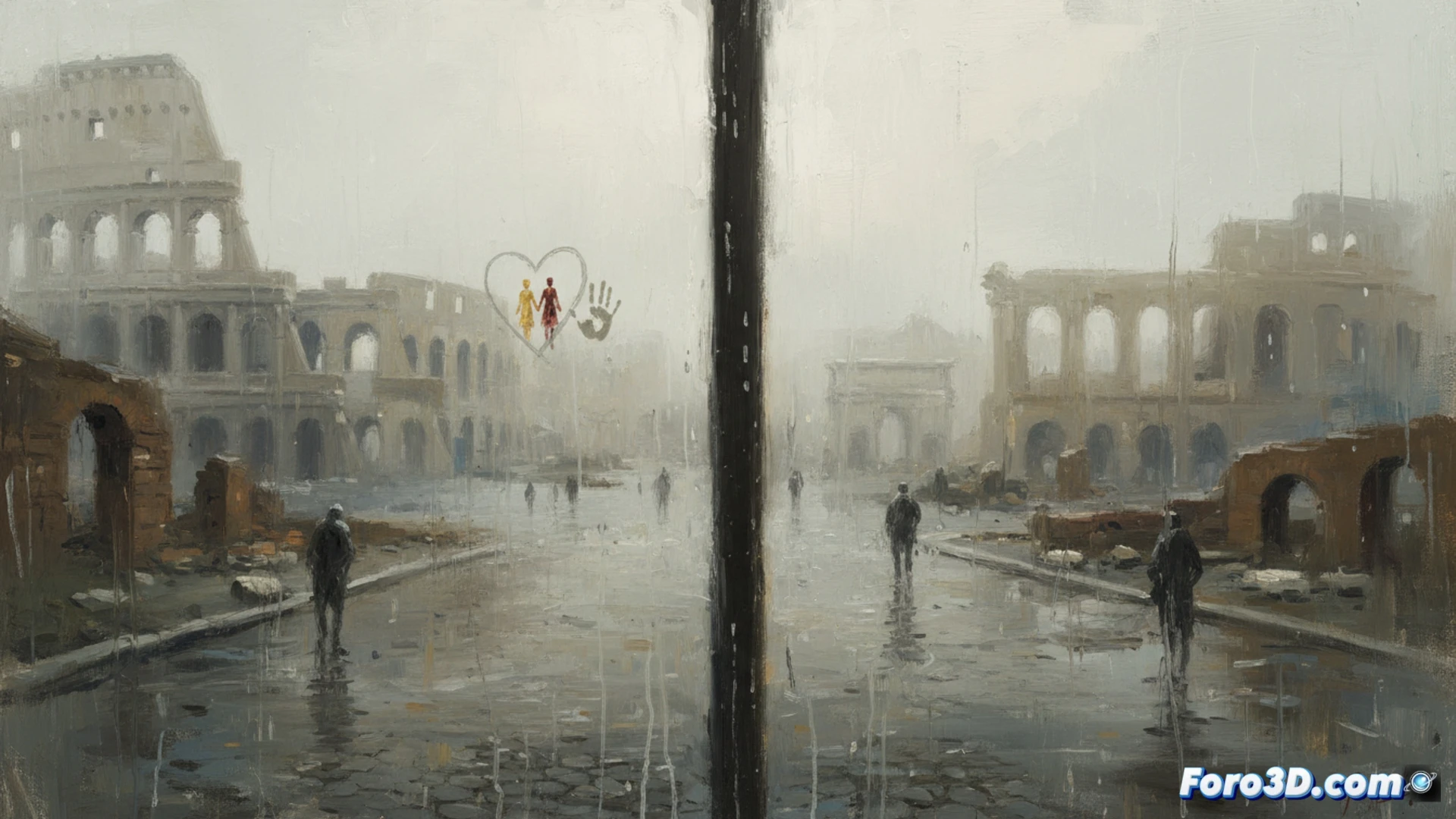
Emotional Rendering: the texture of uprootedness in digital painting 🎨
Although his work is pictorial, Radini Tedeschi's process dialogues with digital development concepts. The construction of his scenes recalls 3D modeling of environments, where each architectural element weighs in the composition like a placed asset. The texture of the painting, that vapor on the glass, acts as a post-production filter that unifies the scene and gives it a specific atmosphere. His method, layer upon layer, is analogous to non-destructive editing, allowing faint lights (the miracles) to emerge in later revisions, like an HDR lighting effect adjusted to highlight details in the shadows.
Can't your shader load the hopes? Try this artistic patch 🐛
After seeing so many renders of perfect architectures and futuristic cities, Radini Tedeschi's paintings are like opening a poorly optimized city project. Where you expect clean textures, you find the rawness of Corviale; the LOD reduces to solitary figures and global illumination only calculates a couple of rays of hope. It's a reminder that, sometimes, the most persistent bug is not in the code, but in the social approach. Perhaps the solution is not a new graphics engine, but allowing, every now and then, a couple of pixels of humanity to sneak in among so much concrete polygon.