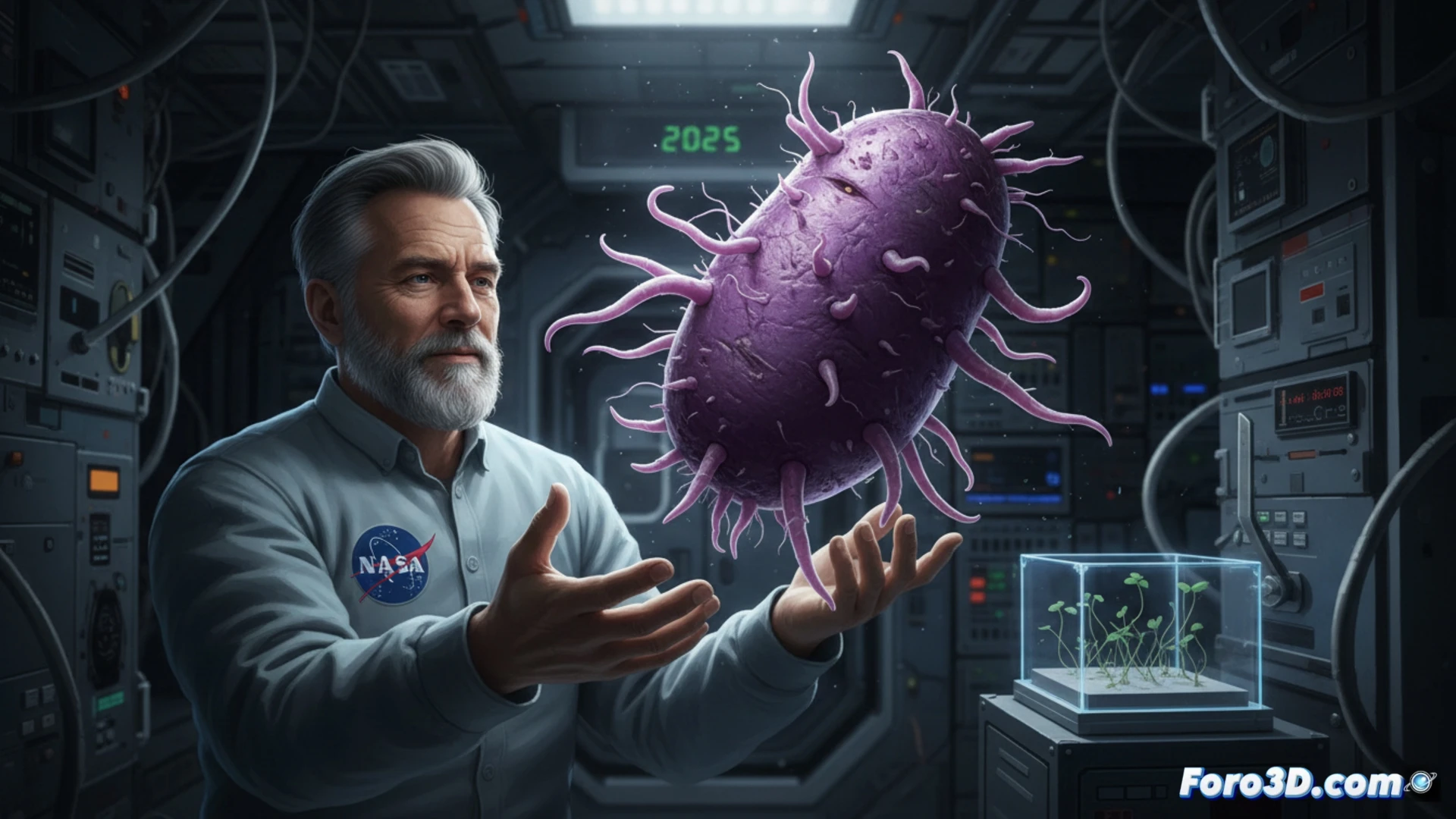
An image of astronaut Donald Pettit of a strange purple tentacled organism on the ISS caused a stir. The mystery was solved: it was a purple potato tuber with sprouts, grown in microgravity and nicknamed Spudnik-1. This case exemplifies how a scientific phenomenon in a unique environment, initially documented with photography, can transcend into a deeper analysis through scientific visualization techniques and 3D modeling.
From Photography to 3D Model: An Analytical Leap 🧪
Pettit's photo is valuable 2D data, but limited. Scientific visualization can go further. Through multi-angle photogrammetry, a precise 3D model of Spudnik-1 could be generated. This model would allow accurate measurement of the length and orientation of the sprouts in weightlessness, analyze their spatial distribution, and compare it, overlaid, with a 3D model of an Earth tuber. Scientific rendering could map variables like density or growth time onto the geometry, transforming observation into a quantitative and interactive study object.
Communicating Science with Immersive Depth 🚀
3D visualization is not only an analysis tool but also a dissemination one. An interactive model of Spudnik-1, accessible online or in augmented reality, would allow the scientific community and the public to explore the experiment firsthand. This immersion fosters an intuitive understanding of the effects of microgravity on plant growth, demonstrating that the frontier of space exploration is also cultivated and, now, can be visualized in three dimensions.
What level of anatomical detail would you need to faithfully represent this species?