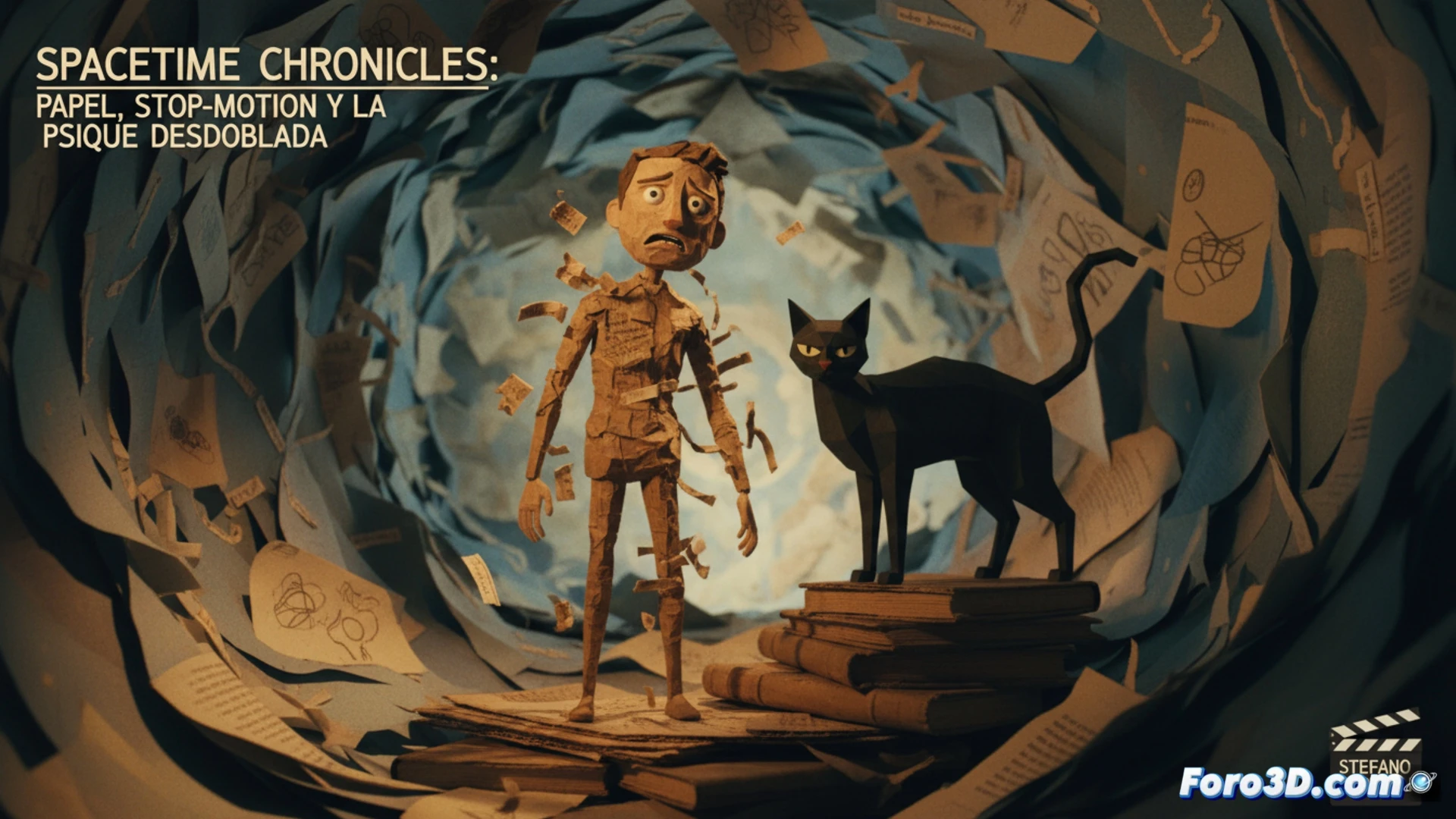
The film Spacetime Chronicles, directed by Stefano Bertelli, stands as a fascinating case study on how the materiality of a technique defines a narrative. Crafted artisanally with paper stop-motion animation, the film follows Fred in a liminal space between dream and wakefulness. His introspective journey is externalized through Freud, a cat that personifies his unconscious, establishing a powerful visual metaphor of the human psyche that only this artisanal medium could convey with such raw poetic intensity.
The Fragility of the Medium as Visual Narrative 🎞️
The choice of paper is not merely aesthetic, but a fundamental narrative pillar. Bertelli deliberately embraces the fragility, imperfections, and mutable nature of the material. Every wrinkle and fold in the sets and characters ceases to be a technical flaw to become a visual language that reinforces the film's central themes: the instability of memory and liquid identity. This decision turns the medium itself into another character, where the physical precariousness of the paper world reflects the protagonist's psychological instability. The stop-motion process, frame by frame, grants a tangible texture and unique presence that digital cannot replicate, making the emotional journey palpable.
From Short Film to Extended Emotional Universe 🌀
The project's evolution, from a short to a unified feature-length narrative, underscores the importance of pre-production and visual planning in cinema. Bertelli needed time not only to build the sets, but to weave a continuous and coherent emotional experience. This scaling demonstrates how a powerful visual idea requires thoughtful development to sustain a complete dramatic arc, maintaining the artisanal essence and symbolic depth, such as the autonomy of the cat Freud, in every frame.
How does 'Spacetime Chronicles' explore the relationship between artisanal materiality (paper and stop-motion) and the representation of fragmented psychological states in contemporary animation cinema?
(P.S.: Previz in cinema is like the storyboard, but with more chances for the director to change their mind.)