The Sonic saga presents one of the greatest technical challenges in development: rendering detailed and sharp worlds at speeds that far exceed those of any other platformer. Sonic X Shadow Generations tackles this challenge with an evolution of the well-known Hedgehog Engine 2. This analysis focuses on how its implementation of precomputed global illumination and a specific post-processing pipeline seek to maintain visual clarity without sacrificing frames per second, a crucial balance for gameplay.
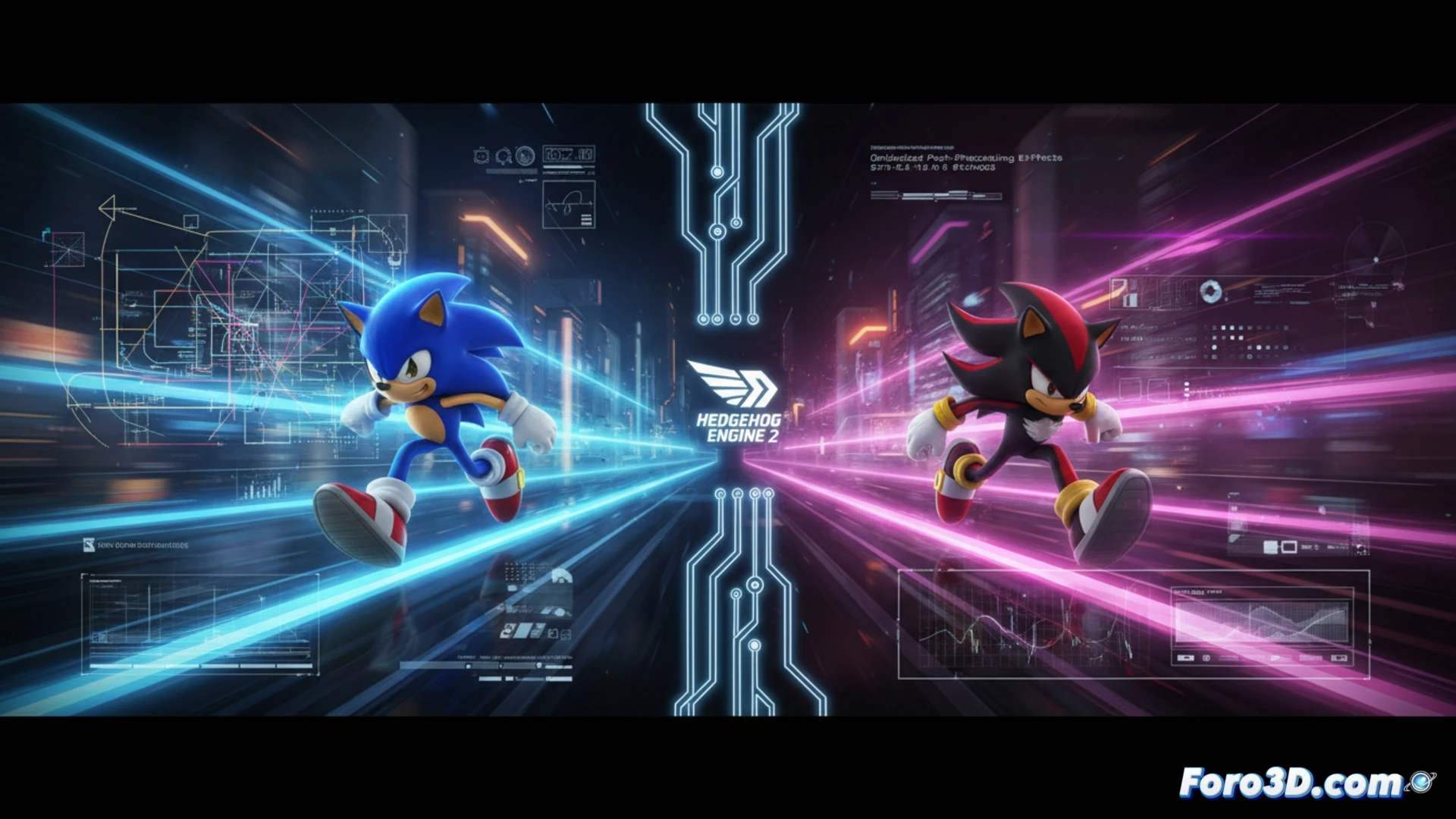
The Hedgehog Engine 2: Precomputing Light for Speed 🚀
The graphical key lies in the extensive use of high-quality precomputed global illumination. By baking the light and shadow information directly into the environments, the engine eliminates costly real-time calculations of dynamic GI. This frees up GPU resources to maintain a stable frame rate during speed bursts. The post-processing, including motion effects and blur, is finely tuned to enhance the sense of speed without blurring critical scene details that the player must identify at high speed. Tools like Autodesk 3ds Max for assets and Havok Physics for robust collisions complete a pipeline oriented toward precision and optimization.
Lessons for Fast Environment Design 💡
This technical approach prioritizes environment readability over real-time physical realism. It offers a vital lesson for high-speed game developers: artistic fidelity must be served by predictable technical execution. It contrasts with techniques like aggressive dynamic LOD or real-time ray tracing, which can introduce pop-in or instability. In Sonic, visual clarity is a gameplay mechanic, and its solution lies in careful and precomputed production that ensures on-screen chaos is always controlled and playable.
How are level streaming systems and asset management implemented and optimized to maintain a stable frame rate when the character moves at extreme speeds, as in Sonic X Shadow Generations?
(P.S.: optimizing for mobile is like trying to fit an elephant into a Mini Cooper)