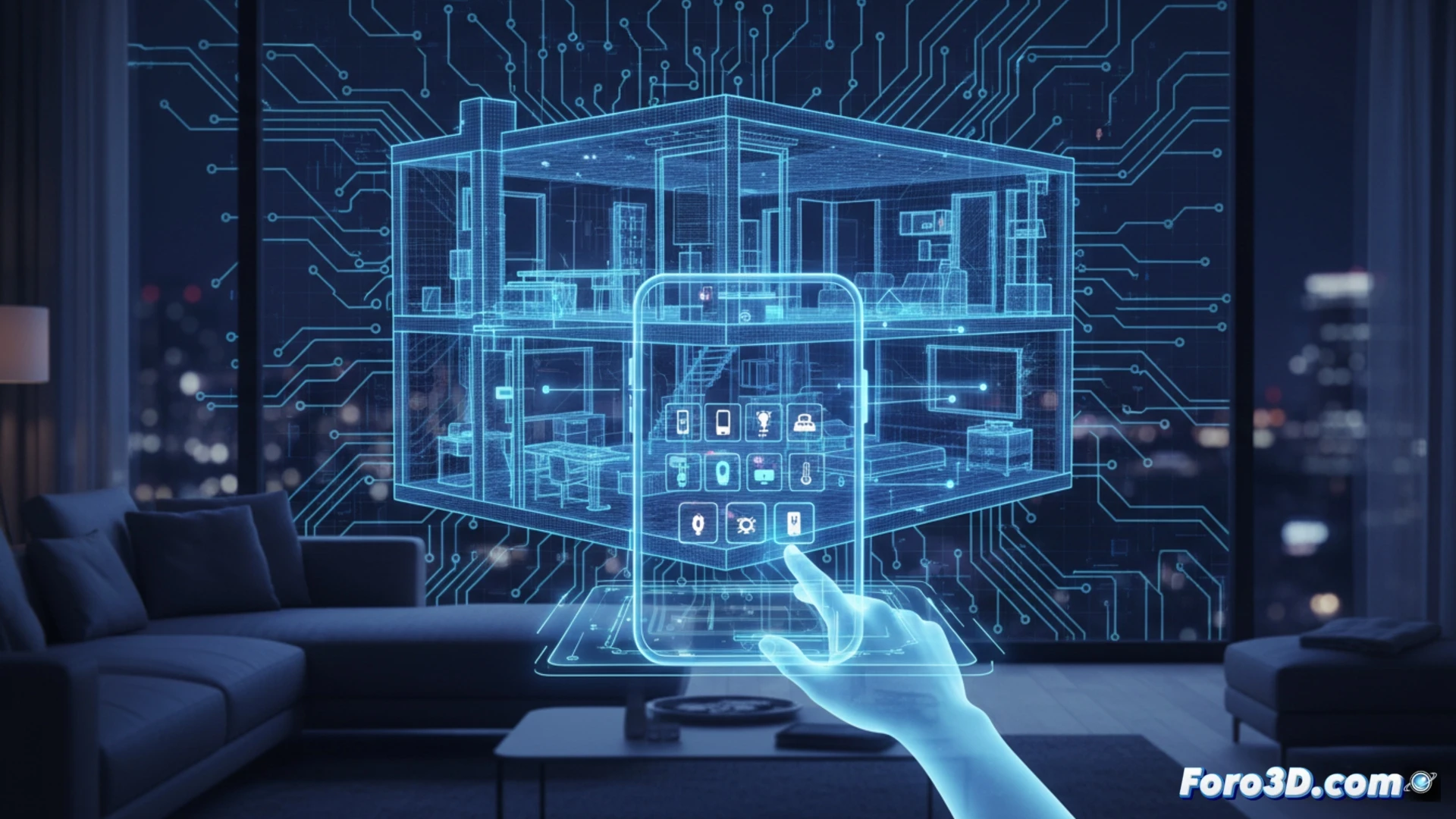
Samsung SmartThings takes a qualitative leap in home automation with its 3D Map feature, bringing the industrial concept of digital twin to the home. This tool allows you to generate an exact virtual replica of your home, not just to visualize it, but to interact with it. By positioning each connected device, such as lights or sensors, in its real location within the 3D model, a spatial and intuitive control panel is created. The smartphone thus becomes the command center of a physically replicated digital system, where every action in the model has an immediate effect in reality.
From Scanning to Control: Architecture of the Personal Digital Twin 🏗️
The construction of the twin begins with the creation of the floor plan. You can draw it manually or, in a more advanced way, use your Galaxy camera to scan the rooms and automatically generate the 3D structure. The next step is the precise placement of the virtual devices. Here, precision is key: you drag the icons of your SmartThings devices and place them in the correct room and position within the model. This exact spatial correspondence is what enables bidirectional interaction. Subsequently, by touching a lamp on the 3D map, you turn it on or off in the real world. Similarly, a physical motion sensor that activates will update its status in the virtual model, closing the real-time feedback loop that defines an operational digital twin.
Beyond Visualization: The Future of Contextual Control 🧠
This technology transcends mere pretty visualization to become an essential context layer. By understanding the spatial layout, the system can offer smarter and more natural automations. For example, a good night routine could turn off only the lights in the model that are on the upper floor. The 3D Map lays the foundation for home control where location is the main parameter, bringing us closer to an interaction with our environment that is as intuitive as pointing to an object in the real world, but with the power of automation and remote control.
How does the implementation of domestic digital twins, like SmartThings' 3D Map, redefine the management of energy efficiency and predictive maintenance in the smart home?
(P.S.: don't forget to update the digital twin, or your real twin will complain)