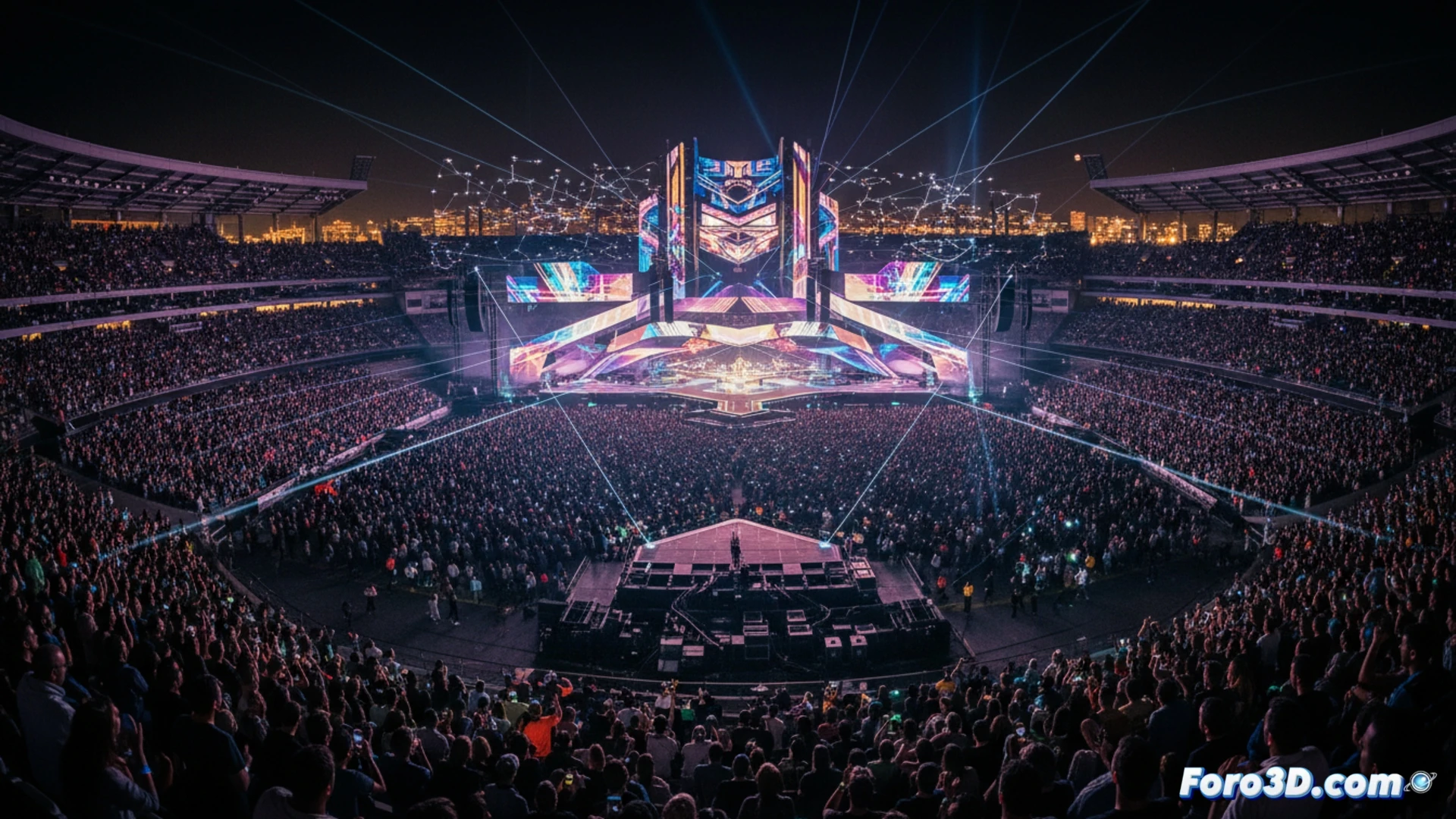
Shakira announces six concerts in Madrid, with a unique residency at the Iberdrola Music de Villaverde. The event, named Estadio Shakira, poses a monumental challenge for 3D scenography and show technicians: designing an immersive experience of twelve hours daily for 50,000 people. This framework demands innovative solutions in modeling, flows, lighting, and acoustics, transforming a temporary venue into a high-performance technical and safety space.
3D Modeling and Simulation: the key to an ephemeral venue 🏗️
The first challenge is the integral 3D modeling of the temporary venue. Unlike a festival like Mad Cool, with multiple stages, here everything is centralized in a unique long-duration experience. Modelers must recreate the structure, main stage, video mapping screens, and service areas to plan every detail. Public flow simulation is critical for safety, anticipating massive movements over twelve hours. Additionally, acoustics require advanced simulations to ensure uniform sound quality in a large open space, considering environmental condition variations from midday to midnight.
Lighting and Video: from sunlight to night 💡
Lighting and video mapping face their greatest test: a twelve-hour transition. The lighting design must be effective under intense sunlight and completely transform for the night, creating distinct atmospheres. Screens and projectors must have adaptable brightness and contrast, while video content must be designed to be legible in any condition. This pre-planning in 3D environments is what will allow the Es Latina experience to maintain its visual impact from start to finish.
How are temporary scenic structures modeled and optimized in 3D for a macro-concert, ensuring visibility and safety for 50,000 spectators in a non-conventional venue?
(P.S.: designing a stage in 3D is easy, the tricky part is making sure the musicians don't fall off it)