Rushing Beat X is not just an exercise in nostalgia. This revival of a 90s arcade saga stands out for implementing a surprisingly deep combat system, challenging the usual simplicity of the genre. Its mechanical design, centered on chainable combos, cancellations, and counterattacks, transforms fights into a strategic and technical dance. This approach turns the game into an interesting case study on how to modernize a classic formula through an additional layer of playable depth, although its overall execution reveals typical development issues.
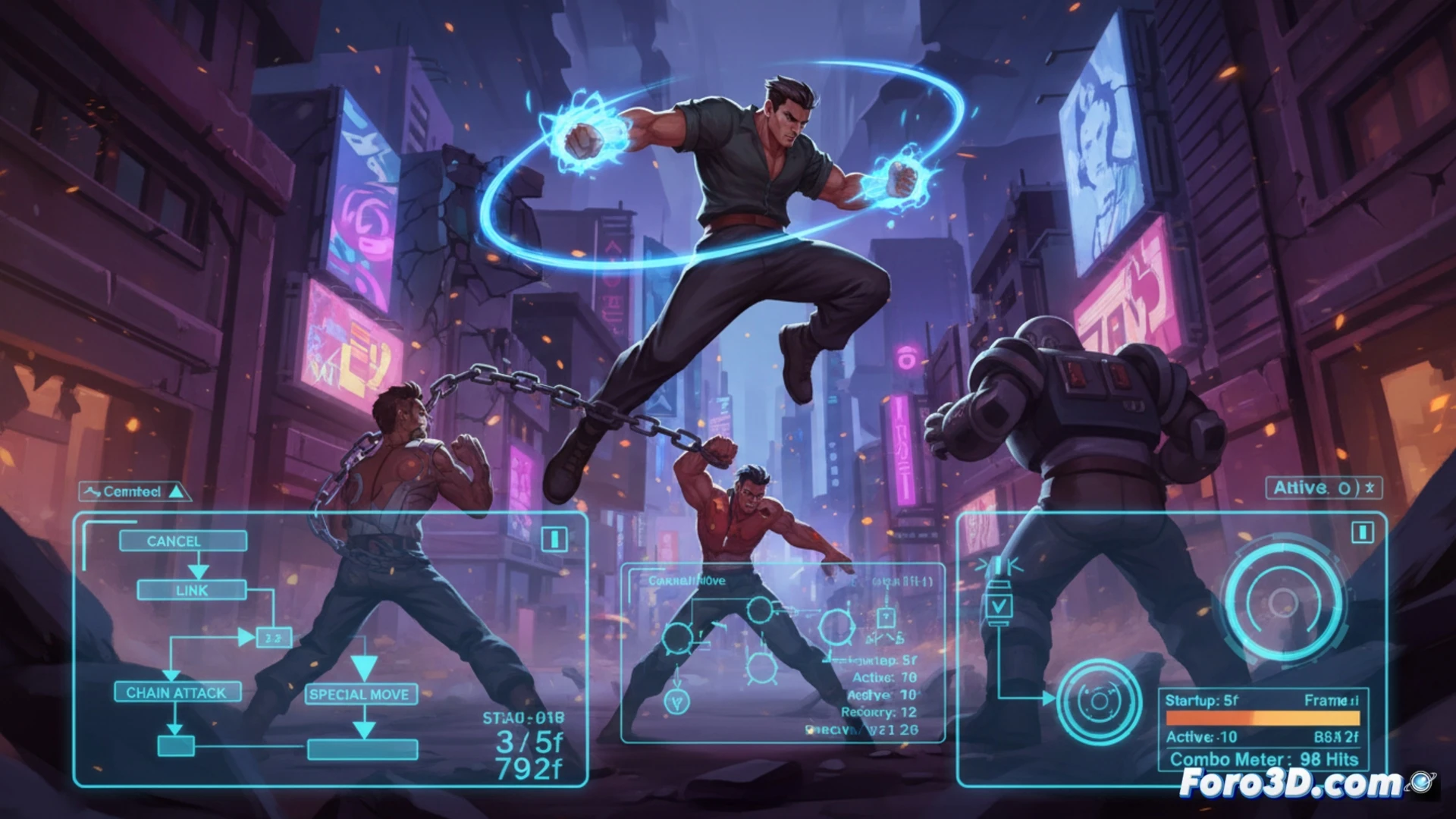
Deep Combat Design vs. Production Inconsistencies 🎭
The core of the game is a solid combat framework. Each character functions as a distinct toolkit, with movement properties, animation frames, and attack sets designed to allow expressiveness. The programming of cancellations between normals and specials, and the parry system, require millimeter-tuned timing and hit priority to feel responsive and fair. However, this good work clashes with other areas. The visual inconsistency suggests unbalanced asset management or a fragmented art pipeline, where some scenarios and sprites lack the same resolution. The scarce content, with few levels and modes, points to planning issues or limited resources, prioritizing combat polish over quantity, a design decision with clear pros and cons.
The Challenge of Reviving a Classic Saga ⚖️
Rushing Beat X encapsulates the difficult equation of reviving an old IP. Its success lies in identifying and expanding a key element of the original essence, eccentricity and chaos, through a modern and technical combat system. This satisfies genre fans seeking more depth. However, development stumbles by not maintaining a homogeneous standard across all its layers, evidencing scope and coherence challenges in projects with possibly tight budgets. It demonstrates that a brilliant mechanic can give personality, but a cohesive production is needed for the whole to shine.
How does Rushing Beat X implement modern combat mechanics in a classic beat 'em up engine to appeal to both purists and new players?
(P.S.: 90% of development time is polishing, the other 90% is fixing bugs)