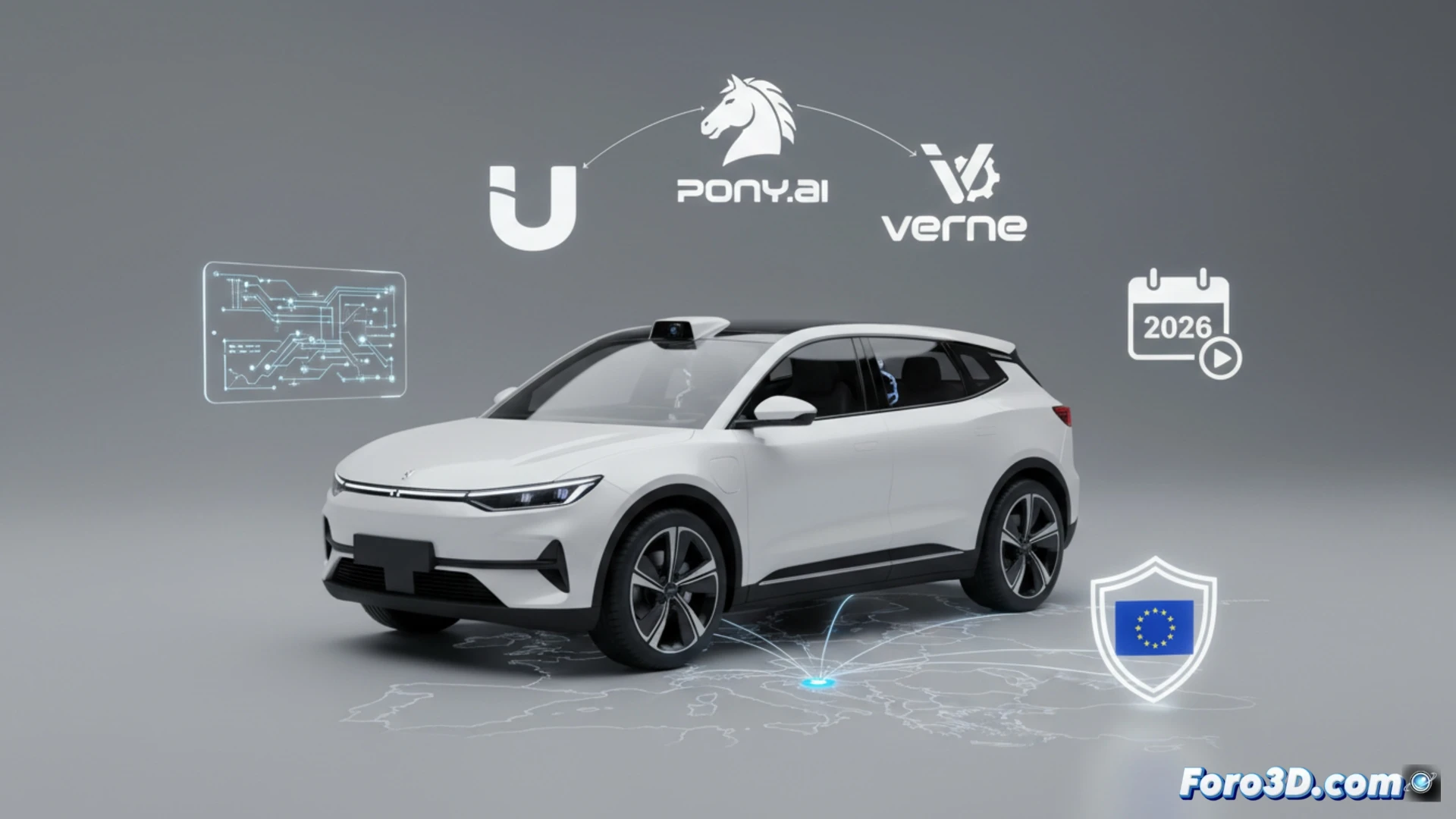
Europe could see its first commercial robotaxis in 2026, thanks to an alliance between Uber, Pony.ai, and Verne, with Zagreb as the pioneering city. This milestone depends on EU regulatory approval and will use Arcfox Alpha T5 vehicles with Pony.ai technology. Beyond the news, its success is based on advanced 3D technologies. Simulation, digital twins, and sensor modeling are the invisible pillars that make it possible to develop, test, and validate these level 4 autonomous driving systems safely.
3D Simulation and Digital Twins: Training AI in Virtual Environments 🧠
Before rolling through Zagreb, these robotaxis will have traveled millions of kilometers in virtual worlds. 3D modeling is crucial for creating photorealistic and physically accurate simulation environments of the city, where Pony.ai's algorithms are trained. Complex and extremely risky scenarios are tested without endangering anyone. Additionally, a digital twin of the Arcfox Alpha T5 is developed, integrating the 3D modeling of all its LiDAR, cameras, and radars sensors. This allows optimizing their placement, calibrating their data fusion, and simulating their behavior in case of failures, ensuring robust perception of the real environment.
3D Modeling: Key to Certification and Safe Expansion ⚙️
EU regulatory approval will require demonstrating exceptional safety. Here, 3D modeling becomes a validation and certification tool. Authorities will be able to audit the systems through reproducible simulations of edge cases. The detailed 3D architecture of the vehicle and its autonomous driving system facilitates the verification of regulatory compliance. This data-based approach with precise models not only seeks the license to operate in Zagreb, but establishes the scalable framework for expansion to other cities, efficiently adapting the simulation models to each new urban environment.
How are digital twins and 3D scanning of cities transforming the safety and efficiency of future robotaxis in complex European urban environments?
(P.S.: modeling a car is easy, the hard part is that it doesn't turn into a cube with wheels)