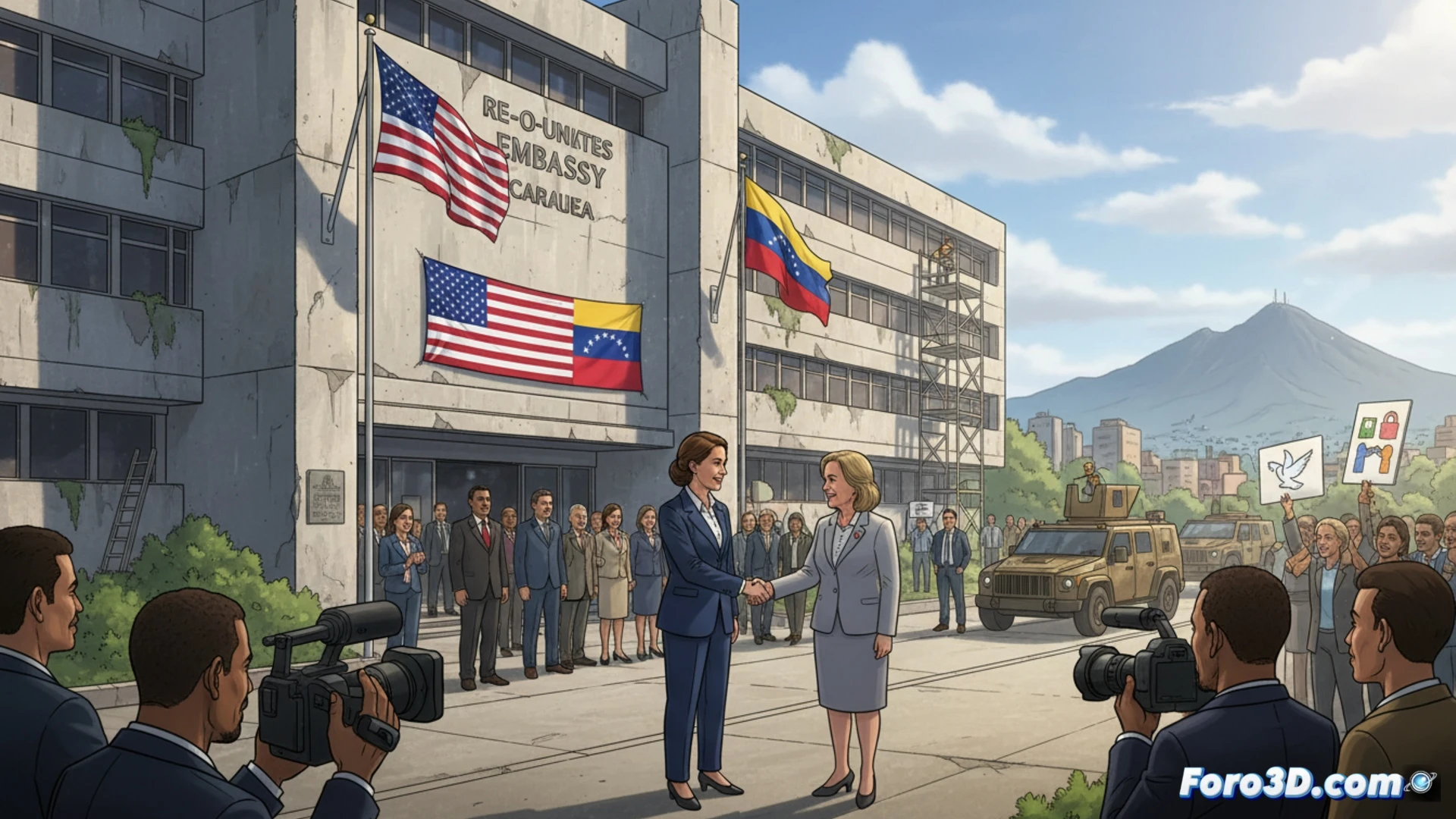
The formal reopening of the US embassy in Caracas, closed since 2019, marks a geopolitical turning point. This act, led by diplomat Laura F. Dogu, follows the government change after Maduro's extradition and the recognition of Delcy Rodríguez's interim government. We will visually analyze the evolution of Washington's political narrative, contrasting official statements with key milestones to deconstruct its strategic objectives in the region.
Visual Deconstruction of the Diplomatic Narrative: Timelines and 3D Maps 🗺️
To understand this milestone, we propose an analysis through 3D infographics and data visualization. An interactive timeline would contrast statements from Secretary of State Marco Rubio on stability and democratic transition with events such as the 2026 operation and the reopening. A 3D map of diplomatic reach would show Caracas's reinstallation in the embassy network. Discourse analysis models could compare Rubio's language with Dogu's, identifying emphasis on narcotrafficking, governability, or economic potential in their narratives.
Visualization as a Tool to Anticipate Political Scenarios 📊
This case demonstrates how visual analysis transcends event description. By modeling the official narrative, we can identify key patterns and omissions, such as the concrete definition of democratic transition or tacit deadlines. These tools allow projecting future scenarios, evaluating the coherence between the US's declared objectives and the political evolution on the ground in Venezuela, beyond the symbolic act of reopening an embassy.
How does the visual analysis of the official photograph and media coverage of the reopening of the US embassy in Caracas reveal the narratives of power and political legitimation of both governments?
(P.S.: deepfakes are like polygons: the closer you look, the more imperfections you find)