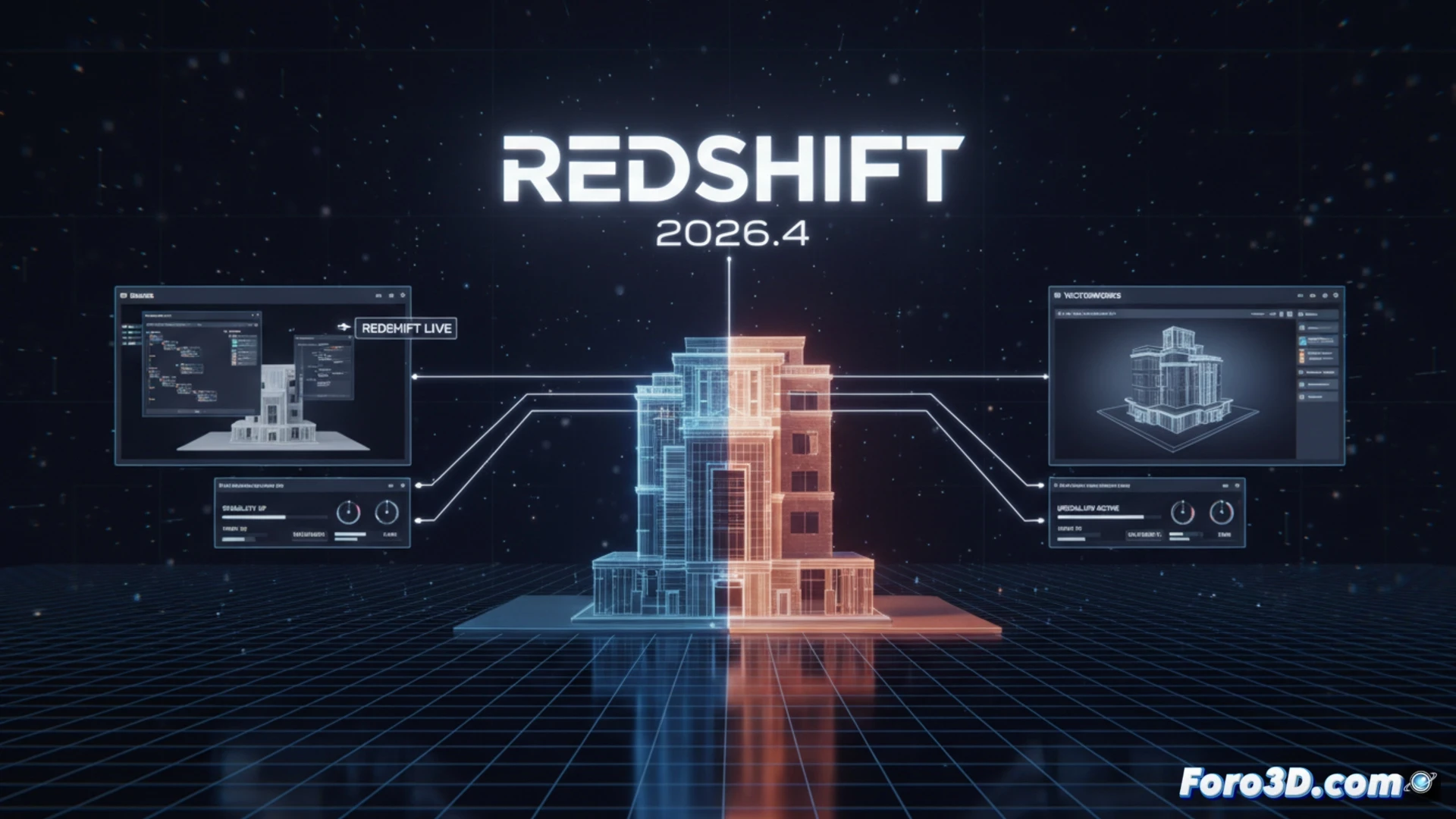
Maxon has released Redshift 2026.4, an update that redefines its offering for the AEC sector. The star is Redshift Live, a new real-time rendering engine that replaces Redshift RT, specifically designed for appearance development and architectural visualization. Although in its initial phase, it promises greater stability and integrates key technologies such as upscaling and denoising. Additionally, the official arrival of Redshift in Vectorworks is announced, expanding its integration into BIM workflows.
Redshift Live and new tools for the AEC workflow 🚀
Redshift Live positions itself as a tool for rapid iteration of materials and interactive project presentation. Its integration of MetalFX, Open Image Denoise, and DLSS allows maintaining a smooth and high-quality preview even on complex scenes. For architects and visualizers, two key new features stand out: the ability to use shaders with Dome Light, enabling the creation of dynamic and realistic ambient lighting, and a new procedural night sky system in Cinema 4D. These features streamline the creation of daytime and nighttime lighting variants, essential in project presentations.
Integration in BIM and the future of real-time rendering for architecture 🏗️
The launch of Redshift for Vectorworks underscores Maxon's strategy to establish itself in the BIM market. The promise of future convergence between Redshift Live and the final production engine suggests a unified pipeline, where rapid iterations maintain fidelity with the final result. Although Redshift Live starts with limitations compared to established solutions, its evolution could offer an integrated and powerful alternative for studios already using Redshift, closing the cycle between design, visualization, and presentation within AEC environments.
How can the native integration of Redshift 2026.4 in BIM environments transform the architectural visualization workflow from conceptual design to final presentation?
(PS: BIM is like having a building in Excel, but with pretty windows.)