For any 3D professional, data management is a constant challenge. Projects with thousands of assets, 4K/8K renders, high-resolution laser scans, and simulations generate petabytes that must be backed up and archived. Current solutions, from hard drives to LTO tapes, have limitations in density, durability, and long-term cost. This is where Microsoft's Project Silica emerges as a potential revolution: storing data in quartz crystal with lasers, promising extreme density and stability for thousands of years.
Technology: laser writing in glass and AI reading 🔬
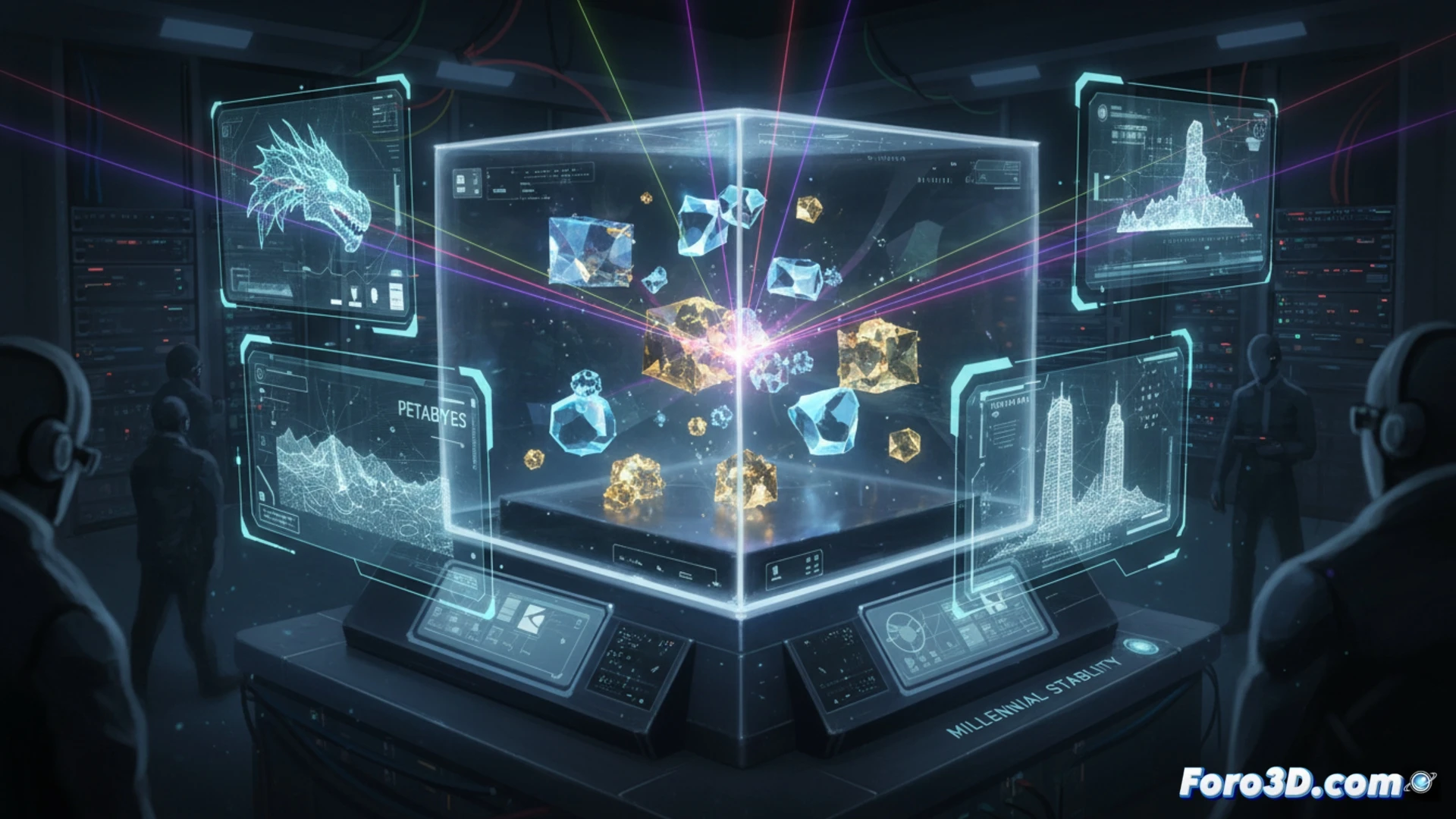
Project Silica does not use magnetic surfaces or chemical layers. It employs an ultra-precise femtosecond laser to create layers of microscopic deformations (voxels) inside a disk of pure quartz glass. Each plate can store multiple layers of data, reaching densities of terabytes and even petabytes per disk. To read the information, a polarization optics system and artificial intelligence algorithms decode the images of the deformations. The key is passivity: the medium does not degrade over time, humidity, magnetic fields, or temperature, being immune to reading hardware obsolescence.
Implications for studios and long-term 3D archiving 🗃️
Its impact on the 3D sector would be transformative. Imagine archiving a complete project, with all its source files, textures, final renders, and scans, on a single indestructible glass plate for centuries. This would change the preservation of digital assets, material libraries, and historical projects. However, today it is a write-once (WORM) technology, slow and with expensive reading infrastructure, oriented toward cold archiving. Its viability will depend on costs decreasing and speed increasing, competing with the cloud and tapes. Even so, it represents the ultimate promise of preservation for 3D digital heritage.
Could Microsoft's Project Silica revolutionize 3D project management and archiving by offering massive, durable, and passive storage for terabytes of assets, renders, and scans?
(P.S.: Your CPU heats up more than the debate between Blender and Maya)