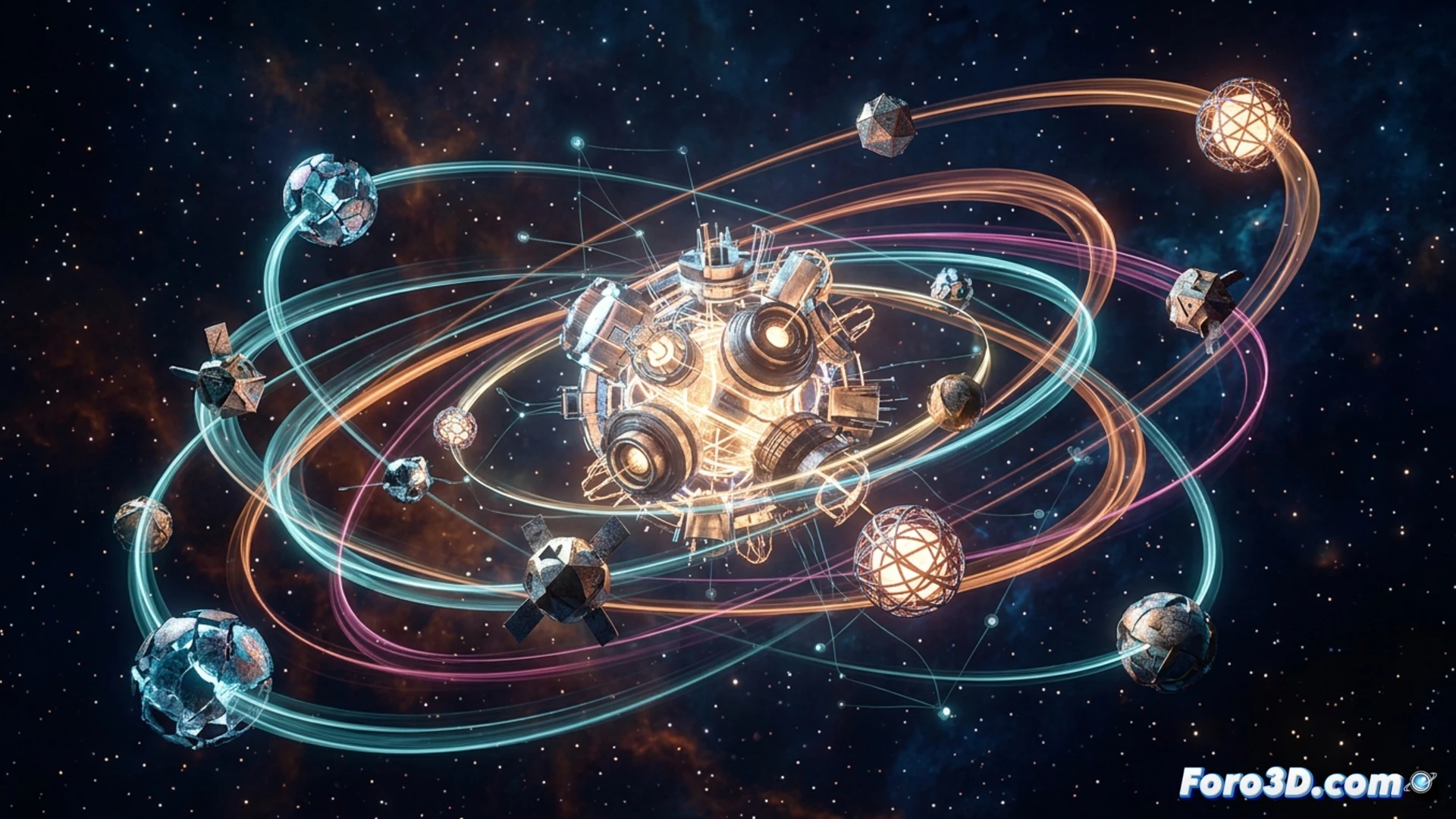
Geometry Nodes in Blender is consolidating as a fundamental tool for generative art, allowing the creation of complex animated systems procedurally. TiFi Design's tutorial breaks down the creation of a hypnotic orbital animation, starting from simple curves. This method transcends manual animation, establishing a set of parametric rules that automatically generate organic and cyclic movement. It is a perfect technique for designing dynamic abstract backgrounds or visual elements for motion graphics, demonstrating how nodal logic can produce visually captivating results.
Nodal Architecture: Curves, Instances, and Mathematics 🧩
The technical process begins with two key elements: a base curve that defines the orbital trajectory and a primitive curve that will be instanced. The points for instancing are generated on the base curve. The magic happens with nodes like Sample Curve and Set Position. By sampling the base curve with a controlled factor, each instance is positioned. The rotation aligns with the curve's tangent for natural movement. The animation emerges by animating that sampling factor, causing the instances to move. Using math nodes, this value is distributed and offset across the points, creating a sequential effect where the spheres follow one another. Additionally, the scale can be controlled using the same logic, adding dynamic variation to the system.
Beyond the Orbit: The Potential of Parametric Design 🚀
This tutorial is an excellent starting point for understanding the philosophy of generative art in Blender. It's not just about animating spheres, but about learning to build an autonomous system governed by parameters. By altering the base curve, the instanced geometry, or the mathematical functions, infinite variations of complex and fluid movement can be generated without manual rework. Geometry Nodes thus reveals itself as a canvas for parametric design, where the artist defines the rules and the tool explores the possibilities, opening up a vast field for the creation of abstract visuals and sophisticated procedural animations.
How can procedural orbital particle systems be designed and controlled in Blender Geometry Nodes to create generative animations of astronomical complexity and artistic value?
(P.S.: Generative art is like having a child who paints by itself. And you don't even have to buy it paints.)