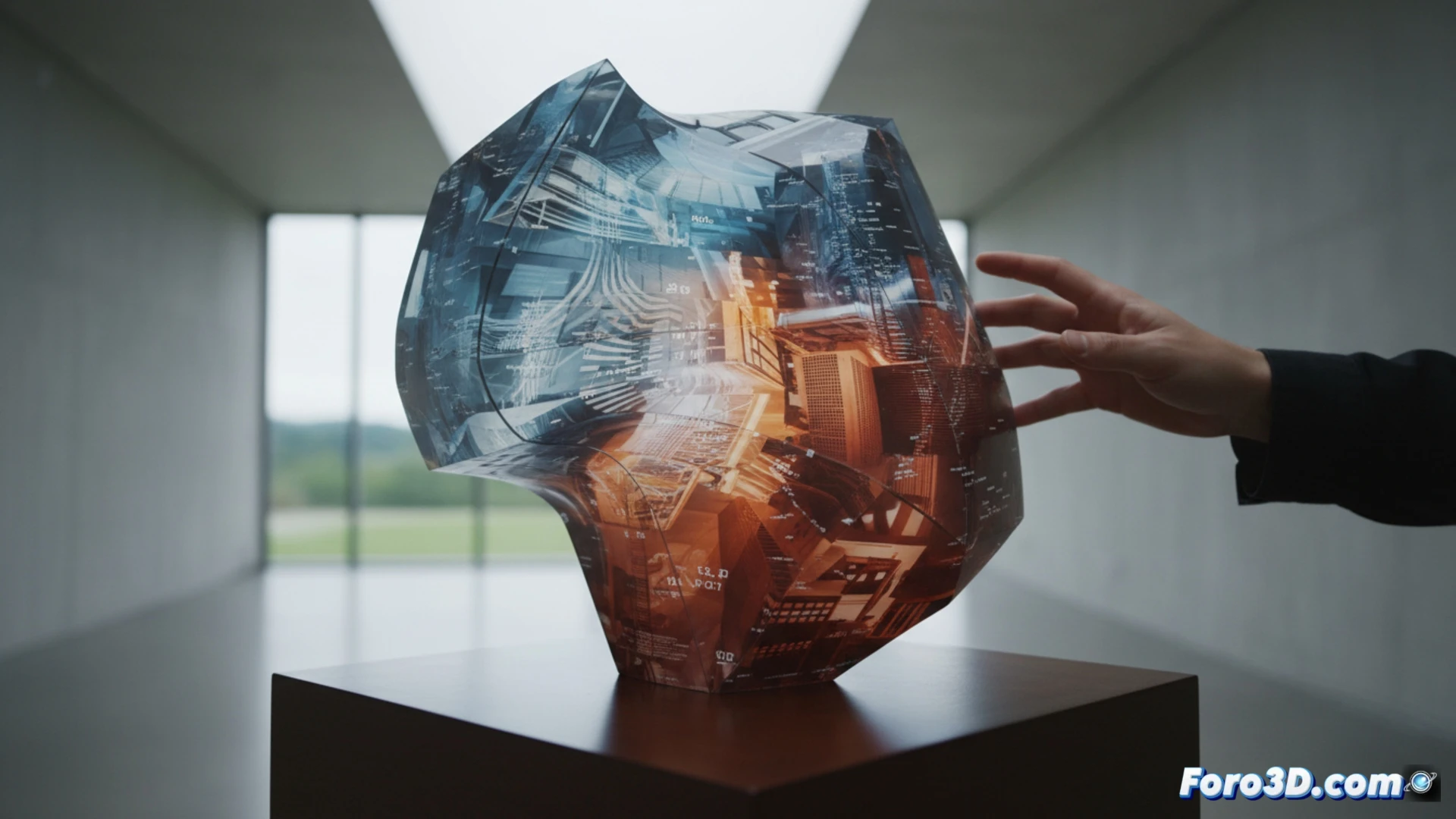
The boundary between the digital and the physical in generative art blurs with an advancement from the Bauhaus University of Weimar. They have fused 3D printing with lenticular technique, allowing the creation of objects whose surfaces display images or animations that change with the viewing angle. This system democratizes a complex optical effect, transforming a design algorithm into a tangible physical microstructure. No screen is needed anymore: the artwork generates its own visual narrative through direct interaction with the viewer.
The Algorithm in the Microstructure: How the Technique Works 🧠
The process begins in 3D modeling, where the artist defines the visual algorithm. Two or more motifs and a surface with precise microscopic cylindrical lenses are designed. This lens grid, analogous to a classic lenticular postcard, is calculated to direct light from each image to specific angles. The 3D printer materializes this design layer by layer, fabricating the optical microstructure directly on the object. The result is a physical generative system: the rules encoded in the surface geometry dictate the final visual experience, which is only fully revealed by moving around the object.
Beyond the Screen: Tangible Interaction and Perception ✨
This technique takes generative art to a deeply interactive and tactile plane. It invites physical exploration, where the viewer becomes an active part of the system by moving the object or changing their perspective. For artists and designers, it opens a field to explore perception, optical illusionism, and non-linear narrative integrated into everyday or sculptural objects. It represents a leap toward radical personalization and a new dimension of expression where code and manufacturing unite to create unique and surprising visual experiences.
How is Weimar's 3D lenticular printing technique revolutionizing the materialization of generative art by integrating digital visual dynamics into a static physical object? 🎨
(P.S.: Generative art is like having a child that paints by itself. And you don't even have to buy it paints.)