New PCIe 5.0 SSDs promise impressive transfer rates, doubling the bandwidth of the previous generation. However, many users wonder if this power is really noticeable when gaming. The reality is that, as of today, the difference with a good PCIe 4.0 SSD or even a fast PCIe 3.0 is minimal in the gaming experience. The main reason is that the software has not yet caught up with the hardware.
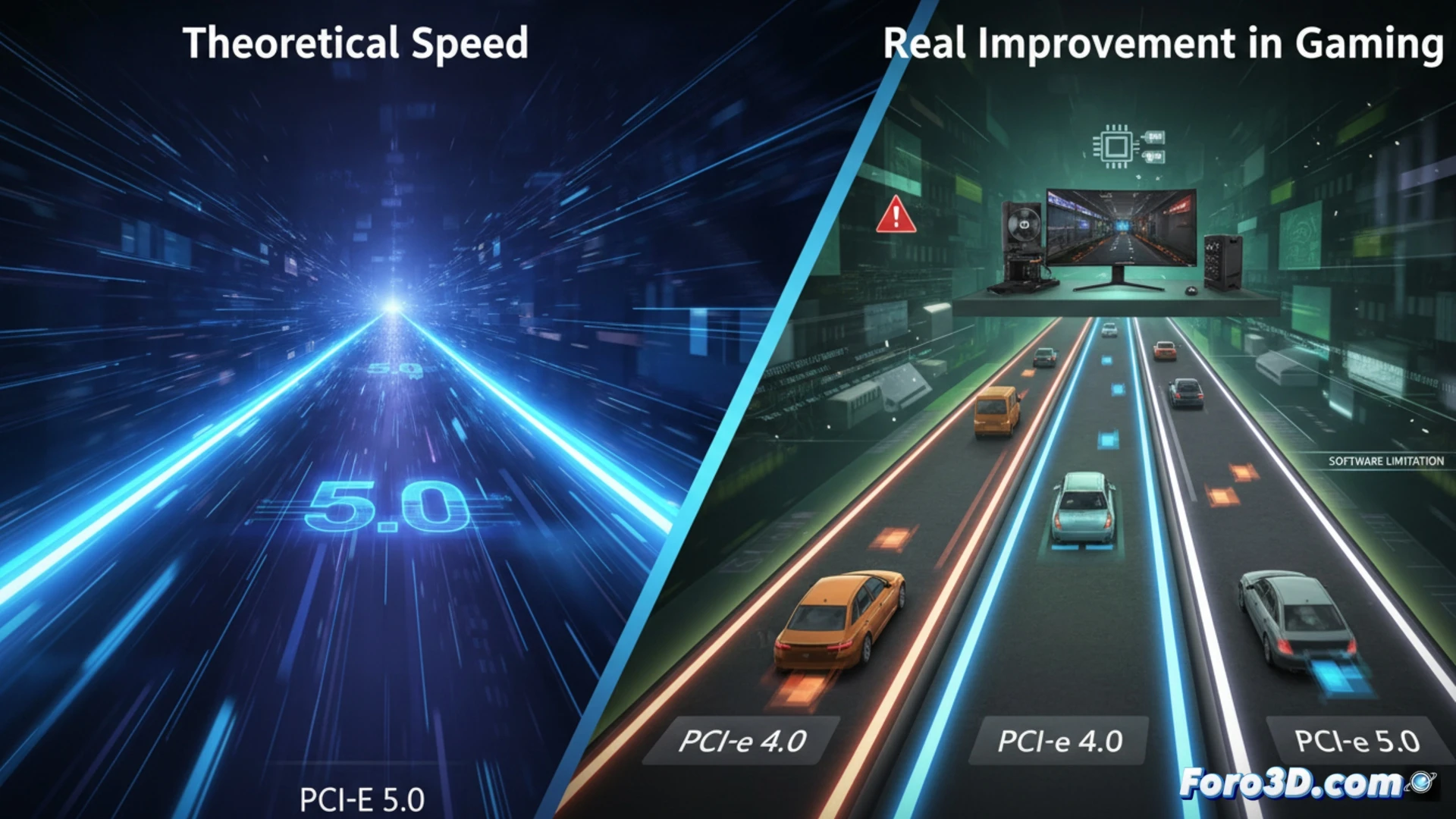
The bottleneck has shifted: engines and technologies 🧠
Current game engines were designed to load data from slower drives, so they do not request information at the speed that a PCIe 5.0 can deliver. The limit now is in the CPU, which processes those calls, or in the RAM. Technologies like Microsoft's DirectStorage aim to reduce this bottleneck by allowing the GPU to access the SSD directly, but their adoption is still minimal. Additionally, random access latency, key for games, does not improve in the same proportion as sequential speed.
Your latest-generation SSD is patiently waiting its turn 😴
It's like having a Ferrari in the center of Madrid at 6 p.m.: the potential is there, but the traffic (the game engine) doesn't let it show. While your brand-new PCIe 5.0 SSD could transfer an entire library in seconds, the game only asks it to pass a few texture files every certain time. So, for now, that elite component spends more time idle than a plumber on a Tuesday afternoon, waiting for the rest of the system to call it to do something.