For the first time, orcas hunting and taking down an adult blue whale have been documented and filmed. This event, recorded in Australia, confirms their role as superpredators and offers a unique opportunity for scientific visualization. In our niche, this is not just news, it is the perfect database for a 3D recreation project that allows analyzing and disseminating the scale and strategy of this epic ocean interaction.
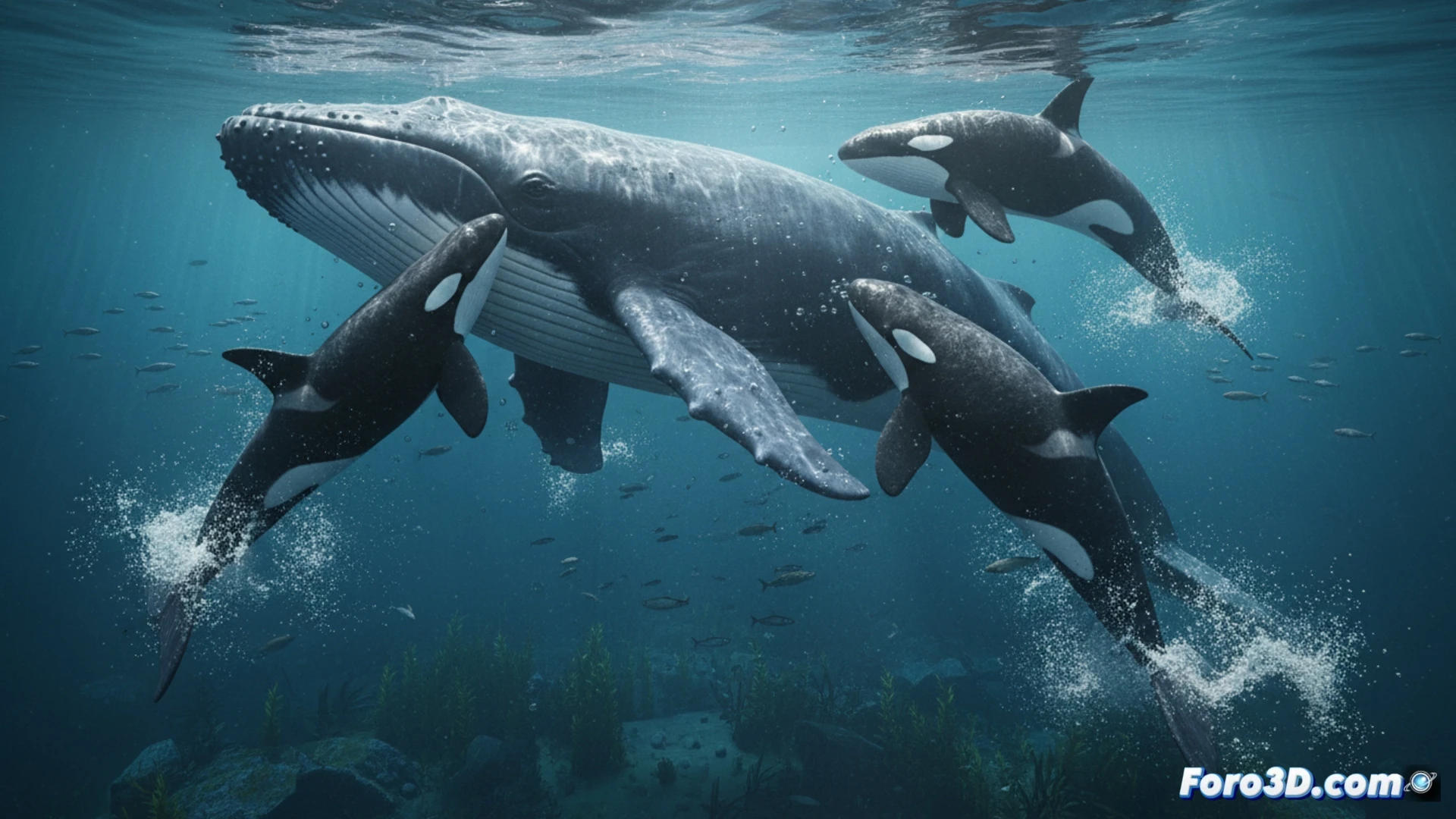
From Observation to Simulation: Pipeline for an Etological 3D Model 🛠️
The faithful recreation of this event requires a specific technical pipeline. First, the species would be modeled with precise biometrics, using real scans and morphological data to achieve correct scale. Second, group dynamics would be animated based on etological analysis of the videos: attack coordination, grip points, and drowning strategy. Tools like simulated fluid dynamics could visualize resistance and movements in the water. The result would be an interactive animated model, useful for both marine ecology research and immersive outreach experiences.
Beyond Animation: Visualization as a Tool for Awareness 🌊
This project transcends the creation of a simple video. A detailed 3D model allows researchers to measure attack angles, calculate forces, and test hypotheses non-invasively. For the public, visualizing the true scale of a blue whale alongside its predators generates a profound impact, fostering understanding of marine dynamics. It is a perfect example of how our discipline can translate raw data into tangible and accessible knowledge for everyone.
How can the scale, dynamics, and biomechanics of a confrontation between an adult blue whale and a pod of orcas be accurately recreated in 3D for use in scientific visualization?
(P.S.: modeling manta rays is easy, the hard part is making them not look like plastic bags floating)