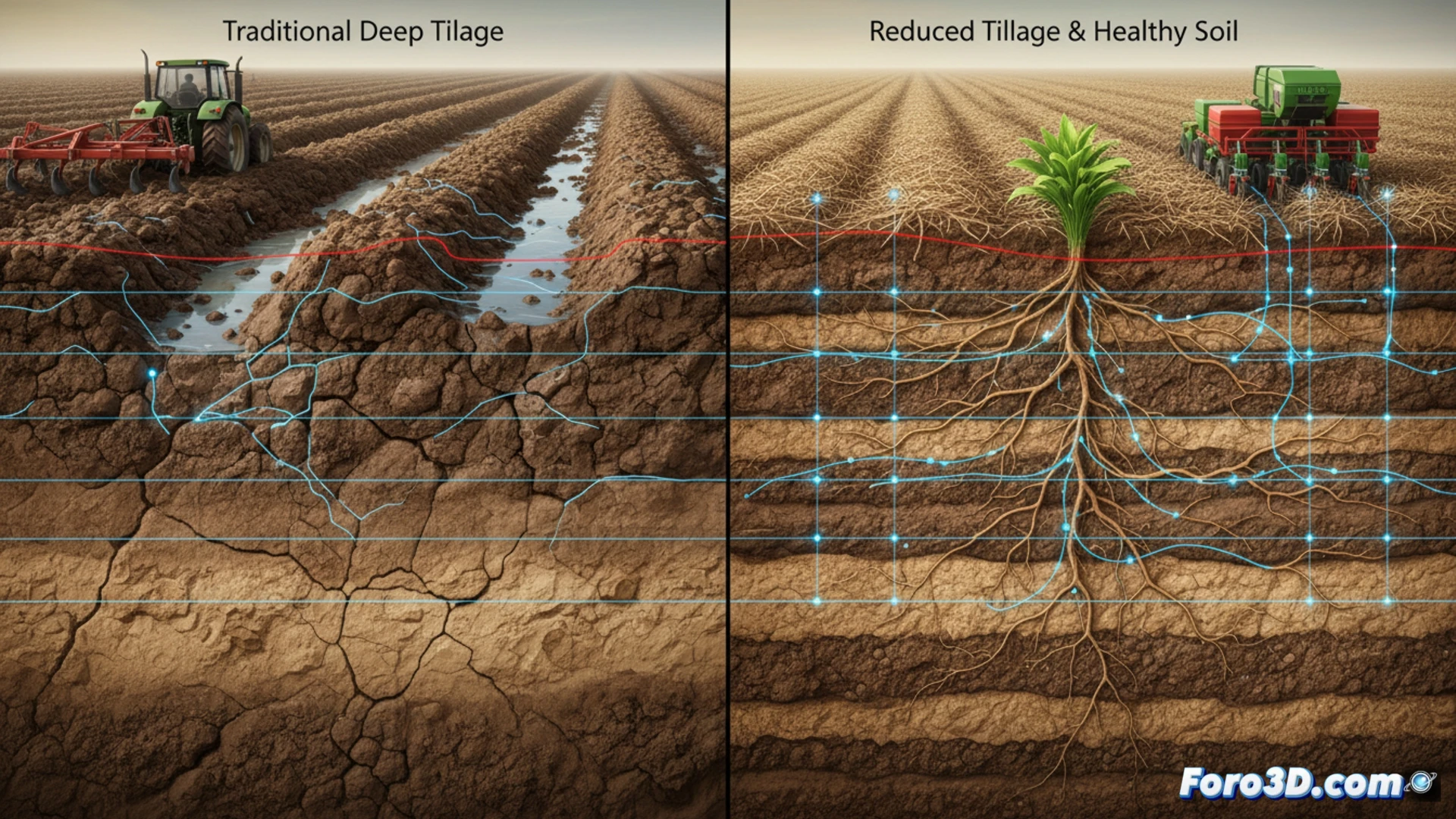
A study published in Science reveals the negative impact of intensive tillage using an innovative sensing technique. Researchers used fiber optic cables as distributed seismic sensors to analyze water infiltration in the soil. The data show that deeply plowed and compacted soils retain surface water, which evaporates, reducing their resilience to droughts and floods. This geomatics technology enables precise and scalable diagnosis.
DAS Sensors and 3D Subsurface Modeling: Principles and Application 🔬
The technique used is based on Distributed Acoustic Sensing (DAS). A buried fiber optic cable acts as a continuous network of thousands of seismic sensors. By monitoring the vibrations generated by infiltrating water, its movement can be tracked in real time and a dynamic subsurface model can be created. This allows visualizing in 3D how the soil structure, altered by heavy machinery, affects hydrology. Compaction destroys natural pores and channels, forcing water to move by capillarity in fine pores near the surface, where it becomes trapped.
Geomatics for Resilient and Sustainable Agriculture 🌱
This study exemplifies the transition to precision agriculture based on objective data. Geomatics, integrating sensors like DAS, LiDAR, or drones, goes beyond surface topography to model critical subsurface properties. Visualizing infiltration in 3D allows optimizing tillage, avoiding compaction, and managing water efficiently. It is a key tool for designing practices that improve soil health, increasing its resilience to extreme weather events.
How can fiber optic DTS sensing revolutionize the analysis of soil structure and health in precision 3D topographic models for agriculture?
(P.S.: 3D topography is like making a treasure map, but the treasure is a precise model.)