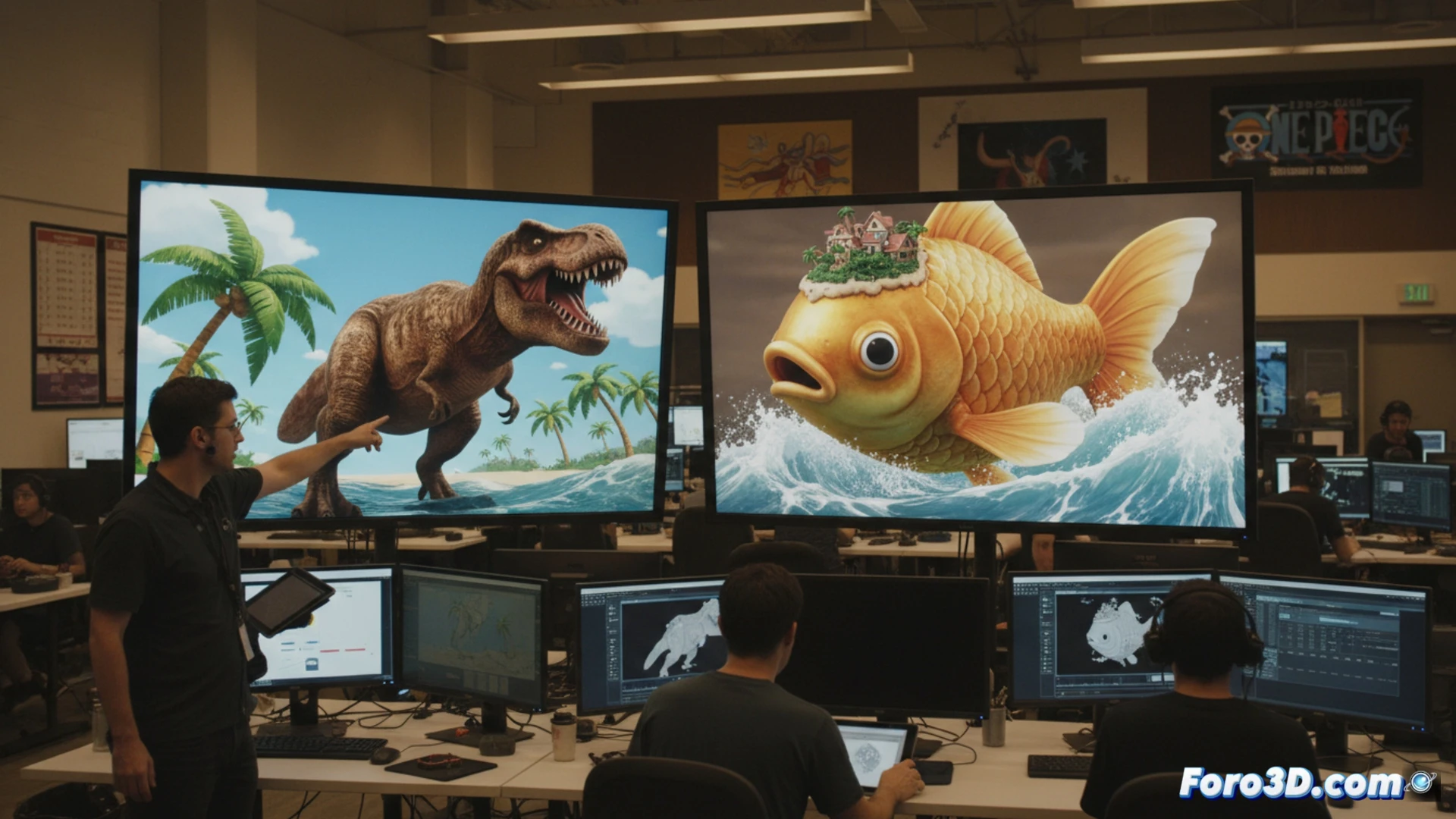
The second season of One Piece on Netflix presents a major visual effects challenge: translating the anime's iconic and absurd creatures into credible live-action. Derek Spears, VFX supervisor at Eyeline Studios, details the process of balancing the original caricatured tone with a level of realism that works in live-action. The studio, part of Netflix since 2021, was key to maintaining the production's unique visual identity, working on assets like the Tyrannosaurus Rex and the massive goldfish known as the Island Eater.
Hyperrealistic techniques for fantastic creatures 🐋
The design of the Island Eater, a goldfish the size of an island, required a specific technical approach. To convey its overwhelming scale and weight, Eyeline artists used hyperrealistic skin textures and complex water and foam simulations around its body. Every movement had to feel the inertia of a colossal creature. On the other hand, dinosaurs like the T-Rex underwent an evolution following creative feedback, expanding their on-screen presence and refining their anatomy so that, despite their stylized base, they integrated convincingly into the live-action environment.
The balance between art and technology in VFX ⚖️
Eyeline Studios' work on One Piece exemplifies the synthesis between artistic direction and technical execution. The greatest challenge was not just modeling fantastic creatures, but endowing them with credible physics and materiality that respected the original spirit. This project underscores the advantage of having an in-house specialized studio within an ecosystem like Netflix, allowing close collaboration and rapid iteration to achieve a visually cohesive universe full of personality.
How do you balance fidelity to the anime's caricatured design with the need for physical and textural credibility in the live-action adaptation of VFX creatures like Tony Tony Chopper?
(P.S.: VFX are like magic: when they work, no one asks how; when they fail, everyone sees it.)