NVIDIA presents the RTX PRO 6000 Blackwell, a professional GPU that redefines performance in workstations. Based on the Blackwell architecture, this card is not intended only for AI, but as a comprehensive accelerator for professional 3D workflows. It promises to transform rendering, simulation, and real-time visualization tasks, offering artists and technicians a tool to iterate and create without bottlenecks. We analyze its real potential in production environments.
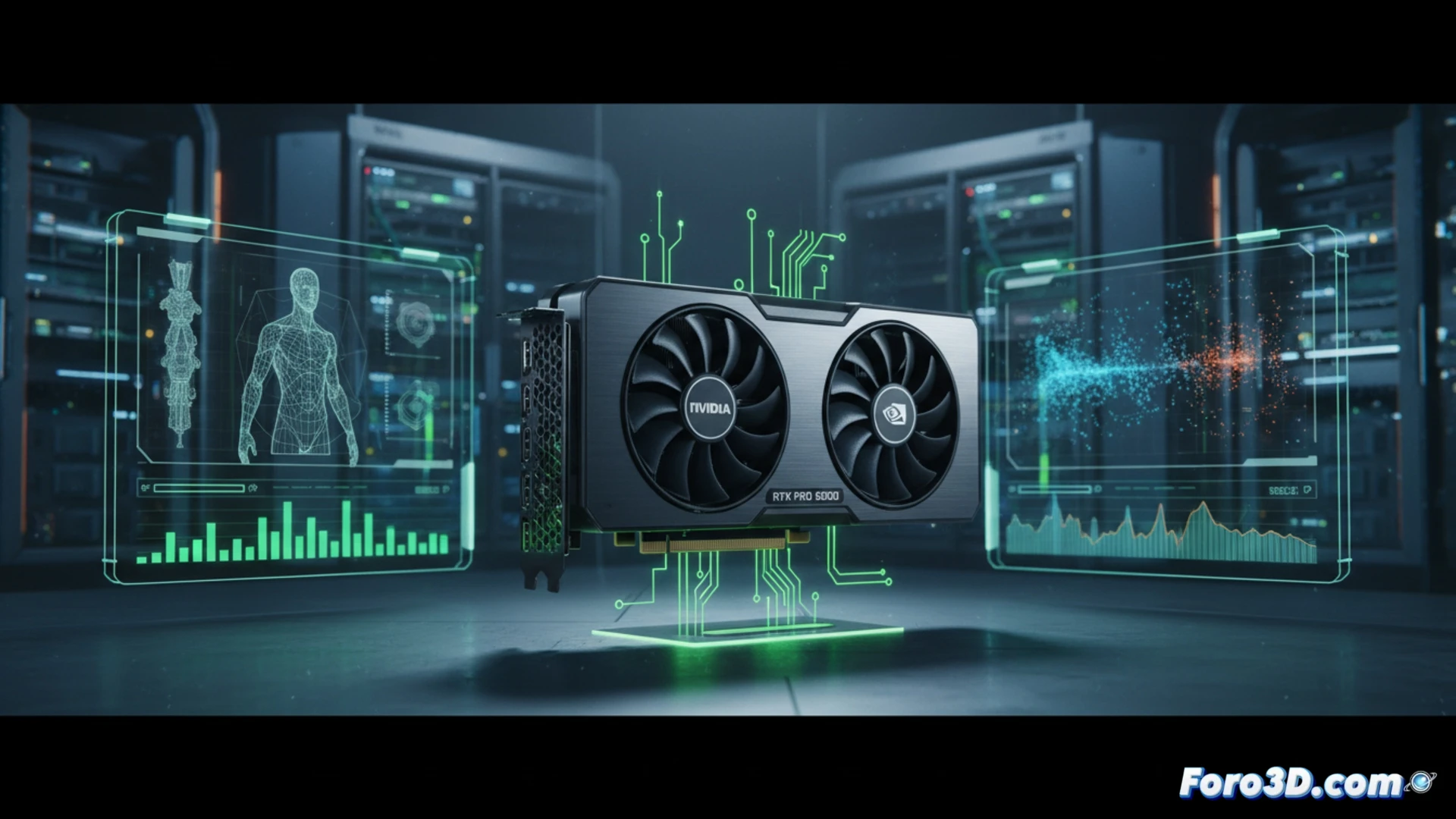
Blackwell Architecture and Performance in 3D Applications 🚀
The Blackwell architecture introduces key advances for professional graphics. With more RT and third-generation Tensor cores, along with GDDR6 memory with ECC, it offers substantial gains in viewport performance in complex scenes and ray tracing. Compared to the Ada Lovelace generation, Blackwell focuses on efficiency in FP64 precision, crucial for physical simulations and CFD. In renderers like V-Ray or Redshift, the reduction in times will be notable, especially in multi-GPU configurations. Its ability to handle massive geometry and high-resolution textures makes it ideal for architectural and automotive modeling.
Justified Investment for the Professional Studio? ⚖️
The price-performance ratio is the decisive factor. The RTX PRO 6000 Blackwell is not a card for everyone, but a solution for studios where render time is direct cost. For intensive photorealistic render workflows or dynamic simulation, the investment pays off quickly. However, for general modeling and visualization, an RTX 4090 or a mid-range PRO Ada might offer better value. Its true potential is unleashed in integrated pipelines where a single GPU handles simulation, render, and preview, consolidating the workstation as a complete production node.
How does the Blackwell architecture and the 96 GB memory of the RTX PRO 6000 impact the ability to handle complex 3D scenes and large-scale simulations compared to its predecessor?
(PD: RAM is never enough, like coffees on a Monday morning)