NVIDIA has unveiled a unique PC inspired by Resident Evil, equipped with an RTX 5080 and emphasizing extreme visual detail. At the same time, it announces improvements in DLSS for engines like Unreal Engine 5.7.2. This conjunction is not just for gaming, but points the way to forensic recreation: cutting-edge gaming hardware and software become ideal tools for reconstructing complex and ruined environments with unprecedented physical and visual fidelity, transcending pure entertainment.
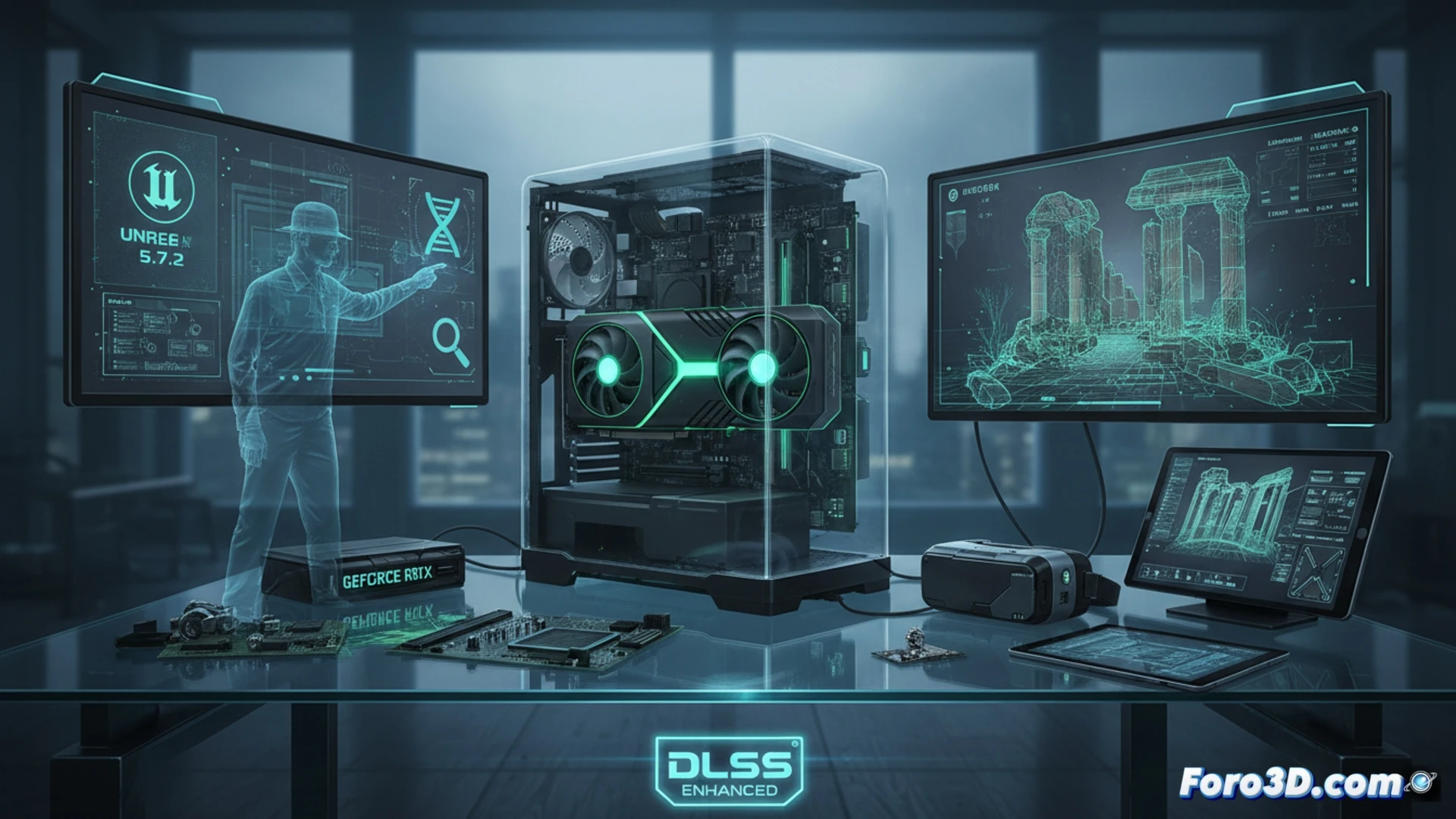
The RTX 5080 and DLSS 3: Foundations for Critical Visual Fidelity 🔍
The heart of this advancement is the next generation of graphics hardware, embodied in the RTX 5080, and technologies like DLSS 3. For forensic recreation, it's not just about raw power, but precision. Accelerated ray tracing enables physically accurate lighting and shadows, crucial for analyzing scenes. DLSS, by generating sharp images from lower-resolution renders, enables real-time interaction with scenes of geometric and lighting complexity previously reserved for offline renders. This shortens workflows and allows immersive explorations of reconstructed environments, like a ruined police station, with forensically valid detail.
Unreal Engine 5: The Engine for Building Forensic Virtual Reality 🏗️
Unreal Engine 5, with Nanite and Lumen, is the perfect software complement. Its ability to handle billions of polygons and dynamic global illumination allows importing high-resolution 3D scans of real places or, as shown by NVIDIA's PC, recreating fictional architectures with forensic rigor. The update to version 5.7.2 with native DLSS support solidifies this ecosystem. The result is a platform where investigators can build and navigate virtual recreations that are visually, luminously, and geometrically credible, transforming data into analyzable environments.
Can the extreme visual fidelity of the RTX 5080 in Unreal Engine 5 become the definitive tool for the forensic reconstruction of crime scenes?
(P.S.: If you use Unreal to recreate a crime, don't forget to disable the power-ups.)