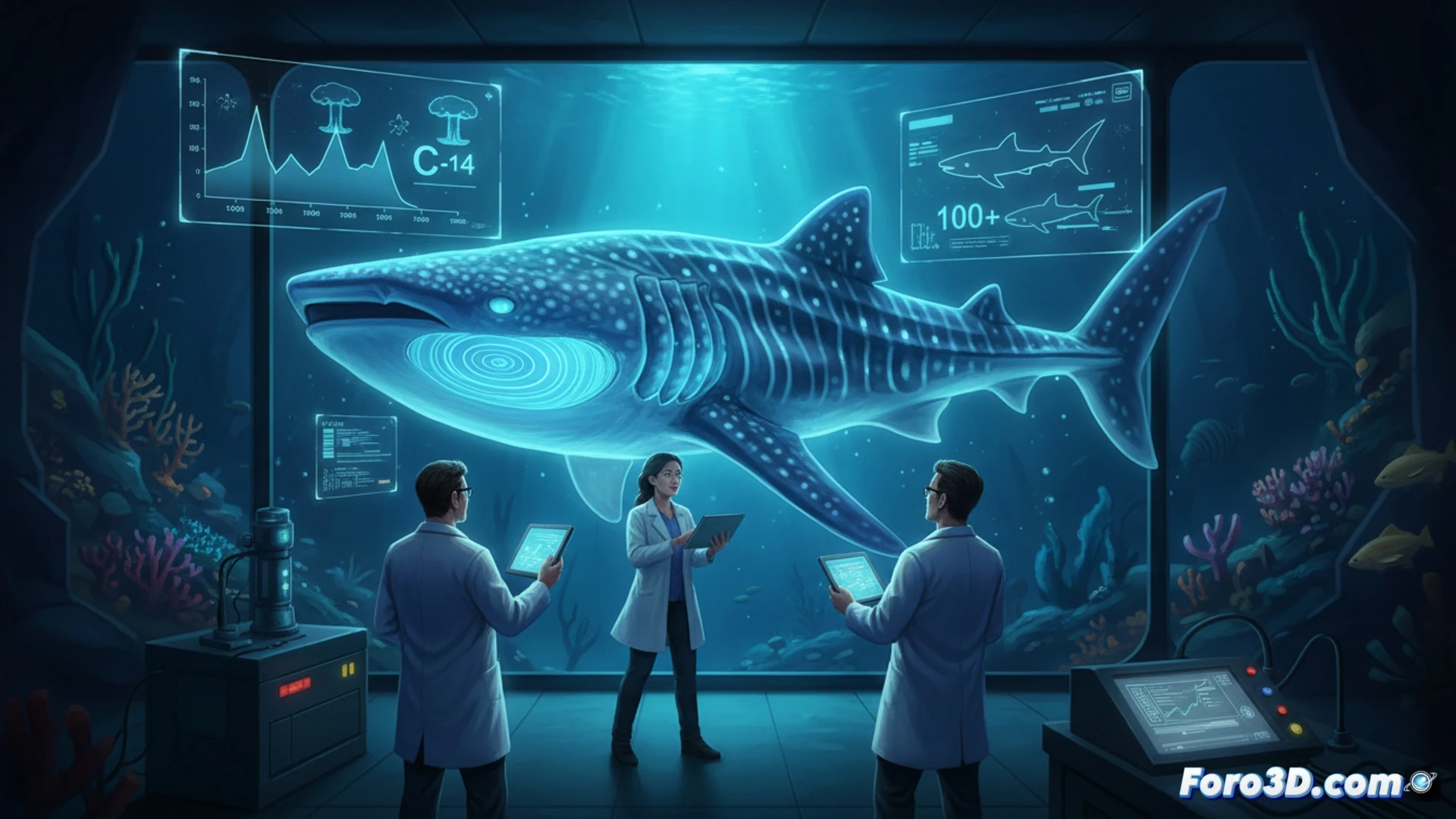
In a fascinating crossroads between contemporary history and marine biology, scientists have used the radioactive legacy of Cold War nuclear tests to unveil one of the ocean's great mysteries: the age of the whale shark. By analyzing carbon-14 isotopes deposited in the oceans during the 1960s, present in the tissues of these giants, it has been confirmed that they can exceed a century of life. This technique acts as a natural forensic clock, embedded in the animals themselves by human activity.
The isotope as a temporal scanner: parallels with conservation 🔬
The methodology employed is analogous to non-destructive analysis techniques used in cultural heritage conservation. Just as a 3D scanner or X-ray fluorescence spectrometry reveals layers of paint, repairs, or the elemental composition of a sculpture without damaging it, carbon-14 dating of growth rings in the whale shark's vertebrae allows reading its life history without harm to the specimen. Both disciplines rely on capturing physical or chemical signals, whether electromagnetic radiation or isotopes, to extract hidden and crucial information for preservation, whether of an artifact or a species.
Conservation of natural heritage with cutting-edge technology 🛡️
This discovery transcends mere scientific curiosity. Confirming such extreme longevity has profound implications for the conservation of this vulnerable species. An animal that takes decades to reach maturity is exceptionally sensitive to overfishing and disturbances. Just as in restoration, where understanding the materials and history of an object guides its protection, knowing the fundamental biology of the whale shark through these high-tech forensic tools is the first step to designing effective protection strategies and ensuring that these giants continue to roam the oceans.
What do you think about this breakthrough?