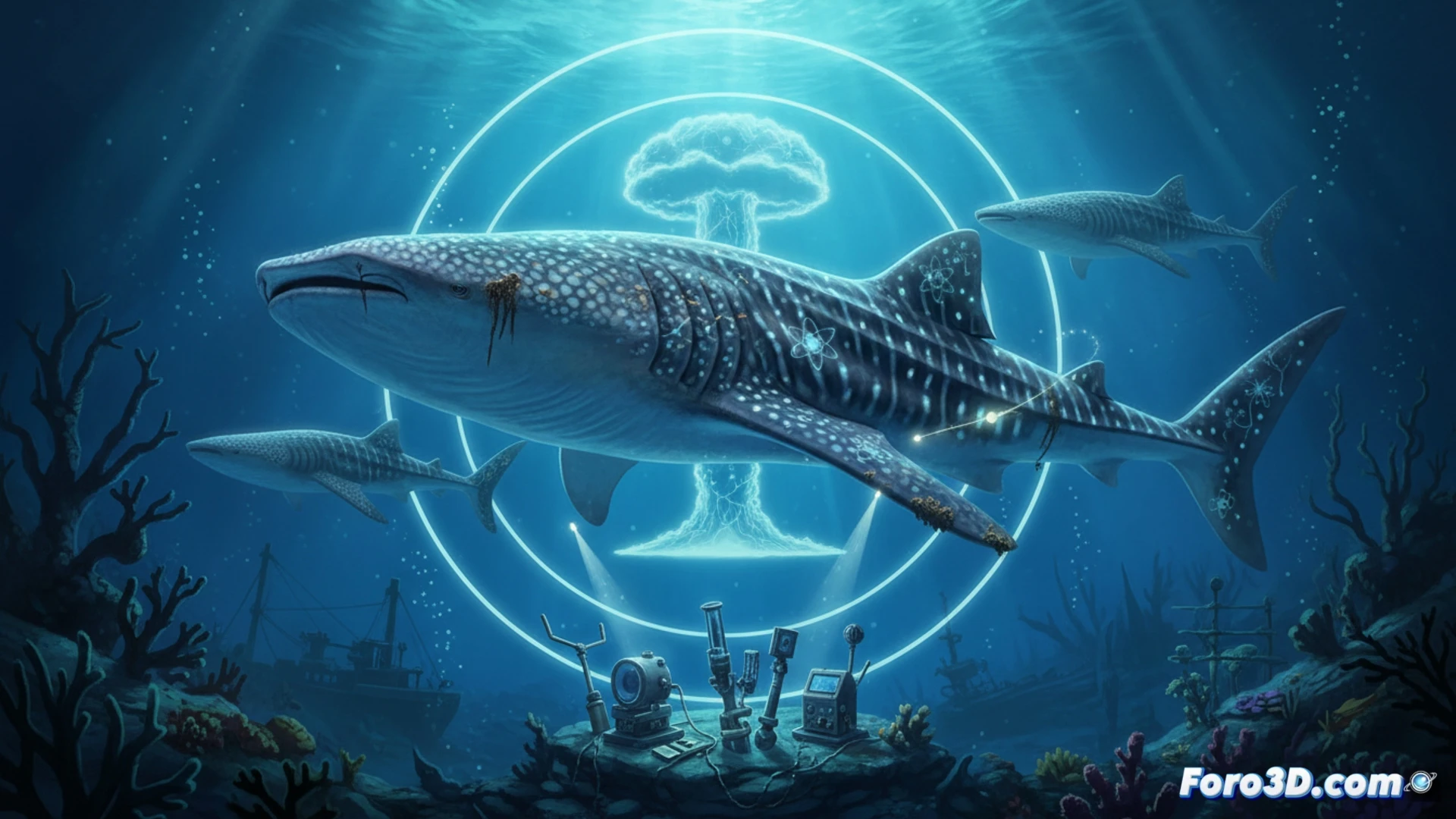
A scientific study has employed an unexpected technique to unveil one of the great mysteries of marine biology: the age of the whale shark. Using the global carbon-14 peak released by atmospheric nuclear tests during the Cold War as a temporal marker, researchers have confirmed that these peaceful giants can live beyond a century. This finding transforms our understanding of their life cycle and underscores their extreme vulnerability.
The isotope that acts as an archaeological layer 🔬
The method is based on the atomic bomb carbon-14, a unique isotopic pulse that contaminated the oceans in the mid-20th century and was recorded in all trophic chains. By analyzing the cores of vertebral cartilage from deceased whale sharks, scientists searched for that distinctive peak. Its position within the growth bands, analogous to tree rings, allows for absolute dating. Thus, a forensic technique born from destruction becomes a conservation tool, offering precision impossible with traditional methods for slow-growing species.
Lessons for the conservation of the living 🛡️
This approach demonstrates how analytical methodologies from heritage sciences, designed to date artifacts, are crucial for preserving living natural heritage. Confirming extreme longevity implies that these populations recover slowly from threats like fishing or collisions. Nuclear isotope dating not only solves a biological enigma but provides the fundamental data for designing effective long-term protection strategies, treating each centenarian individual as an irreplaceable asset.
What do you think about this breakthrough?