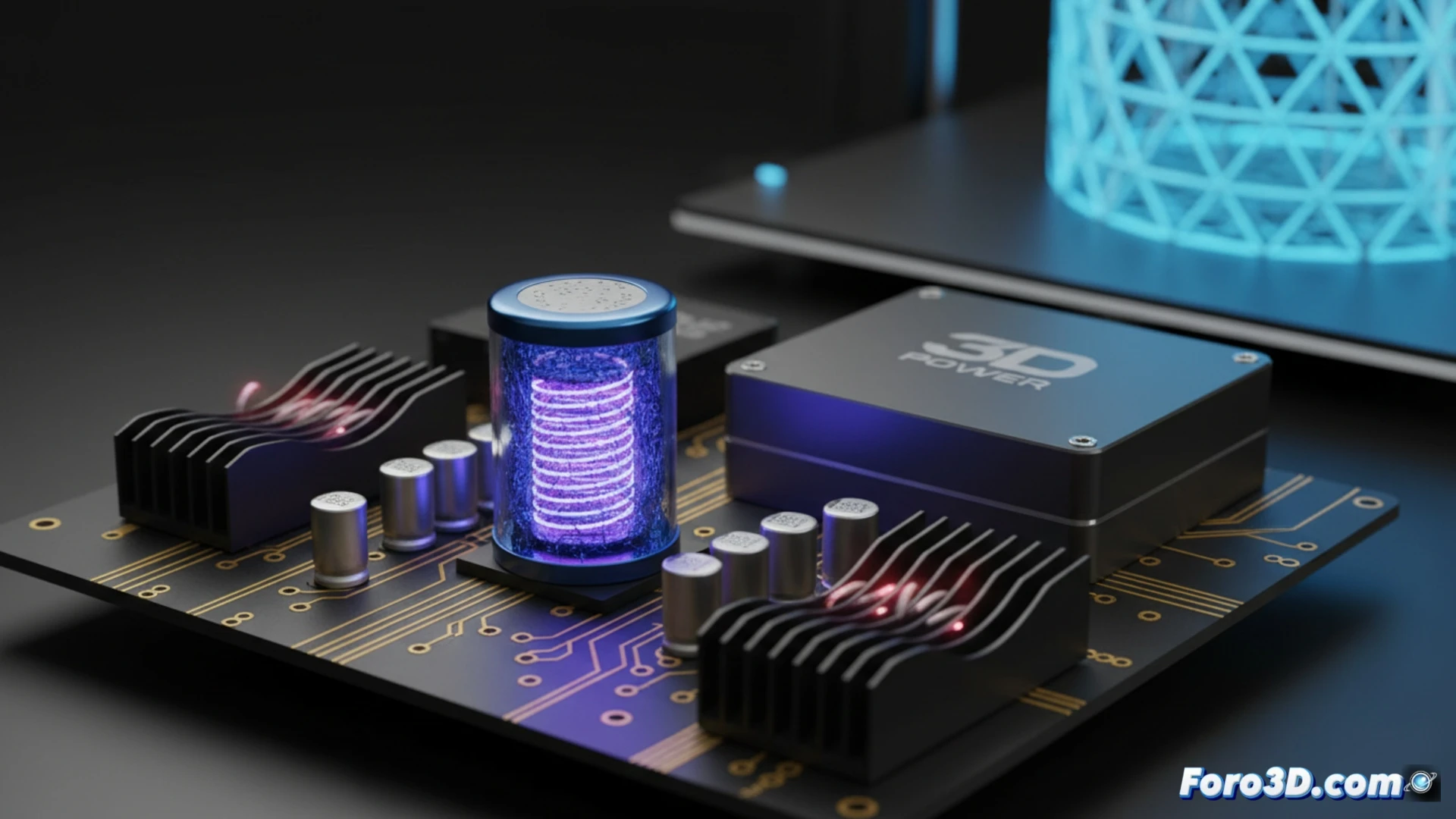
A Penn State research has developed a composite polymer capacitor that stores four times more energy and withstands heat better than conventional ones. Made with commercial and inexpensive plastics, this breakthrough has enormous potential for energy storage. In our niche, this translates directly into a possible revolution for the power supplies of 3D workstations, where efficiency, power density, and reliability are critical.
From capacitor to PSU: the foundation of a stable 3D system 🔋
A capacitor is an essential component in any power supply, acting as a small reservoir that stores and releases electrical energy quickly to smooth the current received by the CPU and, especially, the GPUs. In a workstation with multiple graphics cards for rendering, the energy demand is brutal with sudden peaks. Denser and more heat-resistant capacitors would allow designing more compact, efficient PSUs with greater capacity to respond to those extreme demands without degrading, also reducing the internal thermal stress of the equipment.
The future: smaller PSUs and cooler systems? ❄️
Imagine a case for multiple GPUs where the power supply takes up less space, freeing up area for better airflow or more components. This capacitor could bring us closer to that scenario. By generating less residual heat and being more robust, it would reduce one of the failure points in high-performance PSUs. For rendering studios or simulation stations that run 24/7, this means potentially greater long-term stability and possibly less aggressive cooling requirements, a quiet but fundamental advancement.
Could this new polymer capacitor be the key to more compact, efficient, and stable PSUs in high-consumption 3D rendering workstations? ⚡
(P.S.: RAM is never enough, like coffee on a Monday morning)