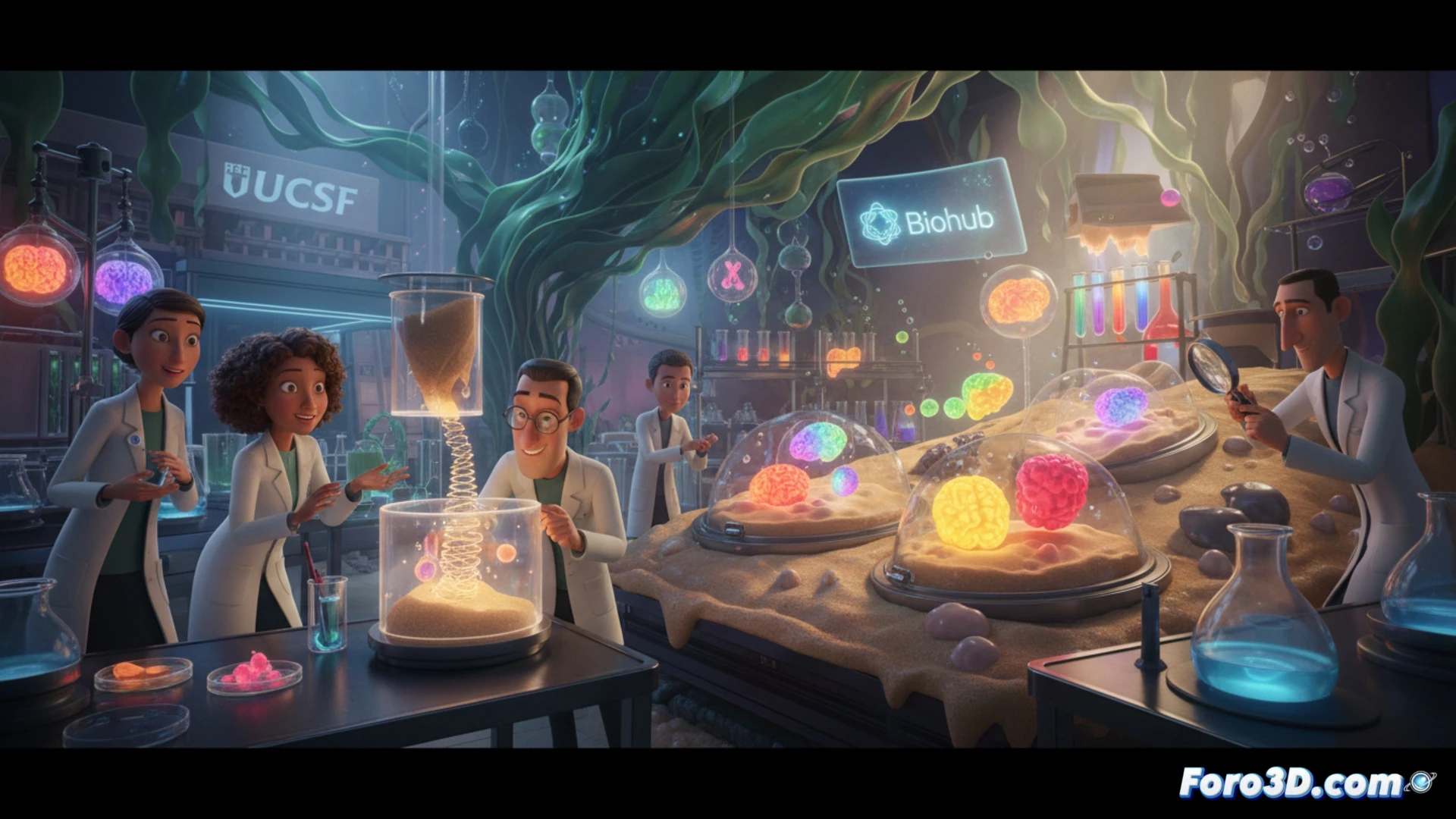
Reproducibility is one of the biggest obstacles in 3D bioprinting of organoids for research. Scientists from UCSF and Biohub present an innovative solution: a new bioprinted material that acts as a scaffold, combining microparticles of seaweed alginate with Matrigel. Its texture, similar to wet sand, allows printing defined cellular structures in 3D and, crucially, yields in a programmed manner to tissue growth, mimicking the natural embryonic environment and achieving unprecedented consistency.
The key is not rigidity, but stress relaxation 🔬
The technical breakthrough lies in the dynamic adaptability of the printed material. Traditionally, the focus was on the initial rigidity of the substrate. However, this new bio-scaffold introduces the concept of stress relaxation. As cells proliferate and reorganize to form the organoid, they exert forces on their environment. The material, thanks to its unique composition, yields progressively and at a rate that matches tissue growth. This ability to flow under pressure, without collapsing, is what enables more natural and reproducible morphogenesis in various cell types, overcoming the inconsistency of conventional gels.
A firm step toward reproducible regenerative medicine 🏥
This development brings the principles of additive manufacturing to the heart of biomedicine. By ensuring reliable organoid formation through 3D bioprinting, it lays the foundation for more precise disease models and more reliable drug testing. In the long term, control over the mechanics of the printed scaffold is a fundamental advance toward manufacturing replacement tissues with the quality and consistency needed for clinical applications, marking a milestone in the convergence between 3D engineering and developmental biology.
How does the new seaweed bio-scaffold developed by UCSF and Biohub solve the reproducibility problem in 3D bioprinting of organoids for biomedical applications?
(PS: If you print a heart in 3D, make sure it beats... or at least that it doesn't have copyright issues.)