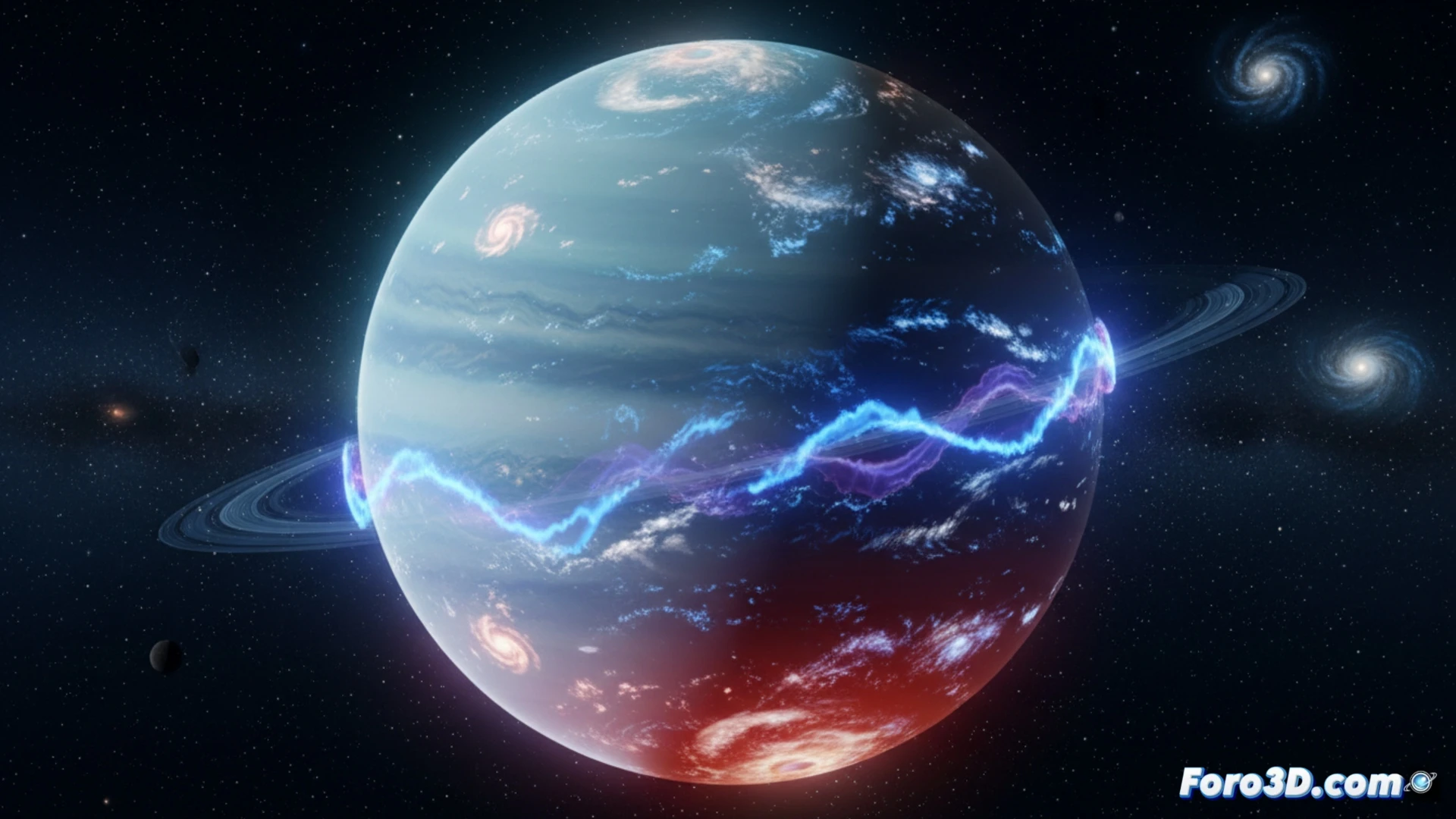
NASA has taken a step in the study of ice giants. Using data from the Hubble telescope, they have created the first three-dimensional map of Uranus's upper atmosphere. This work reveals a more dynamic gaseous layer than estimated, with auroras and precise measurements of temperature and density. The data help understand the evolution of planets like Uranus and Neptune.
Hubble's technique for mapping ultraviolet light 🛰️
The achievement is based on the analysis of ultraviolet light emitted by the planet, captured by the Space Telescope Imaging Spectrograph (STIS) of Hubble. By studying these emissions, scientists were able to determine the distribution and behavior of the components of the upper atmosphere, mainly hydrogen, helium, and methane. This methodology allows measuring the thermal structure and density without the need for an in situ probe.
Uranus stops being the boring planet of the solar system 😲
It was always considered the quiet giant, lying on its side with a monotonous paleness. But now, with its auroras and 3D atmosphere, it seems Uranus wanted the spotlight. It probably just needed a good cosmic scan to show its most lively side. A lesson: even the calmest planet holds its surprises.