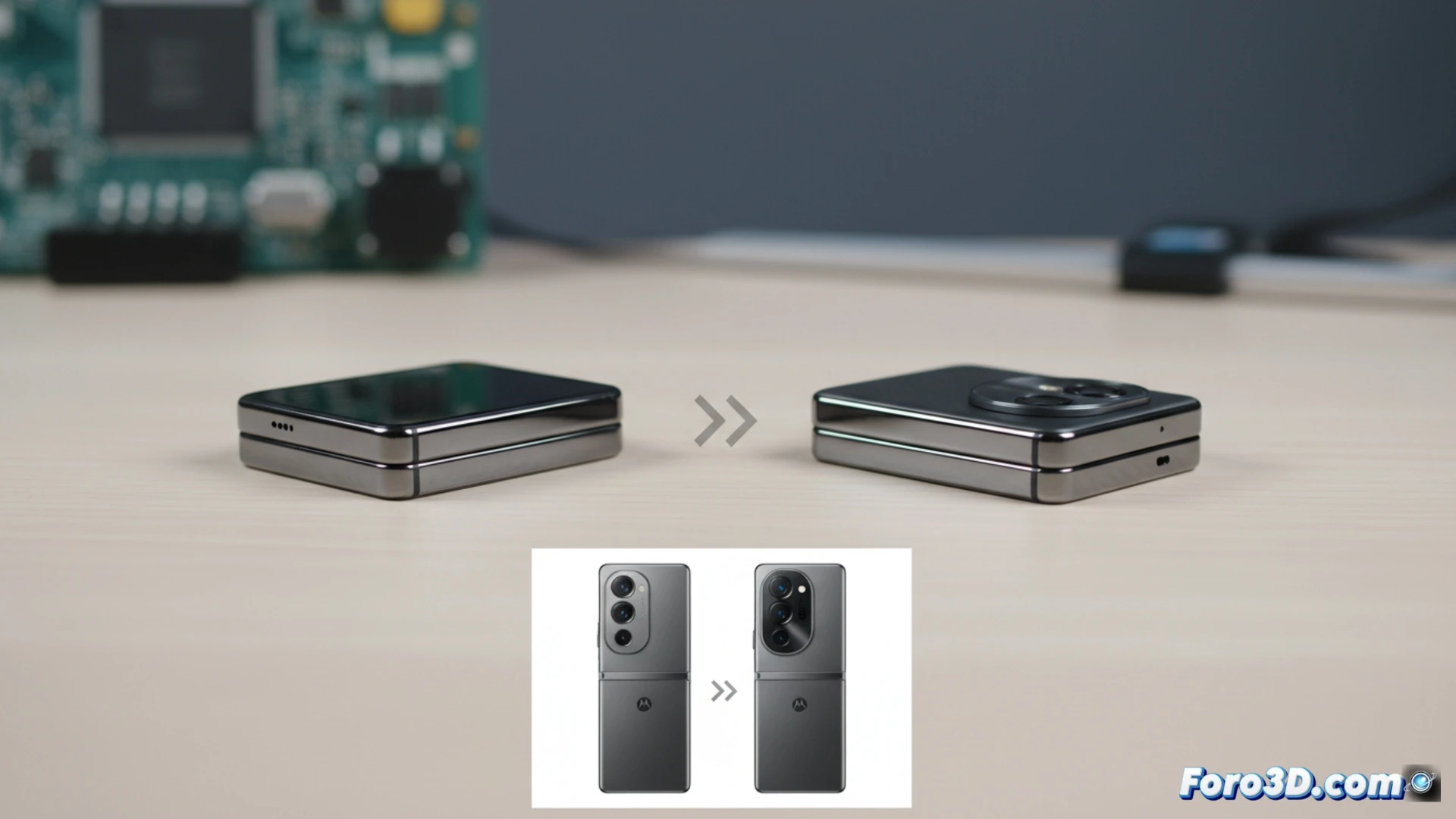
According to the latest leaks, the upcoming Motorola Razr Ultra 2026 would slightly increase its thickness compared to the 2025 model. This change, of just 0.1 mm folded and 0.6 mm unfolded, does not seem coincidental. In the world of high-performance hardware, design decisions have a purpose. This small increase in dimensions could be the key to accommodating significant internal improvements, especially in a weak point of the previous model: its camera system. Prioritizing capacity over extreme thinness is a philosophy that users of demanding hardware understand very well.
Thickness as an investment in technical capacity 📐
For a 3D professional or enthusiast, a phone is more than a communication device; it is a portable capture and visualization tool. A thickness increase, no matter how minimal, translates into valuable internal physical space. That space could be used for larger and higher-quality camera sensors, improved optics, or a more robust stabilization system. This would directly benefit workflows such as basic photogrammetry, high-resolution reference and texture capture, or detailed visualization of complex models on the go. A consistent and powerful camera system turns the mobile device into a more viable companion for preliminary stages of creative projects, where portability is crucial.
Performance over aesthetics: a lesson for mobile hardware ⚖️
Motorola's possible strategy reflects a constant debate in high-end hardware: the pursuit of extreme thinness versus the need for power and sustained cooling capacity. While manufacturers compete for millimeters, users of demanding applications often face limitations due to throttling or insufficient cameras. If the Razr Ultra 2026 uses that extra millimeter to offer notably superior photographic and thermal performance, it will be adopting the right philosophy for a device aspiring to be premium. For the Foro3D community, this design decision would be a positive signal, prioritizing technical utility over an aesthetic ideal that is often counterproductive to pure performance.
Can the slight thickness increase in the Motorola Razr Ultra 2026 translate into a significant improvement in cooling and sustained performance in 3D and augmented reality applications?
(P.S.: remember that a powerful GPU won't make you a better modeler, but at least you'll render your mistakes faster) 😉