A study in Royal Society Open Science reveals the strange ritual of the cockroach Salganea taiwanensis. They form lifelong pairs that eat each other's wings mutually, an irreversible act that seals their commitment. After that, they become a cooperative and aggressive unit to defend their nest. This complex behavior is an ideal candidate to be explored using 3D scientific visualization techniques.
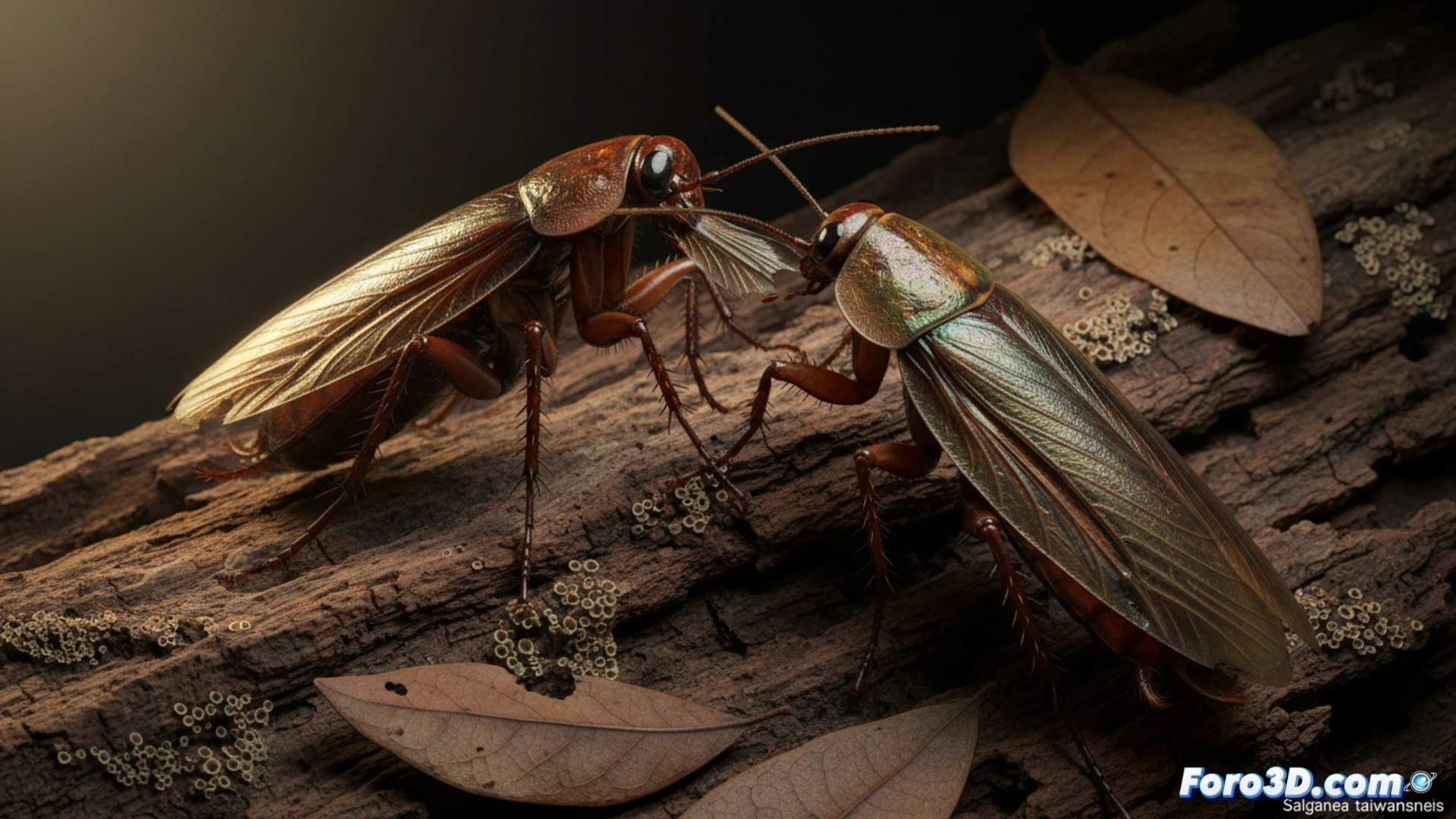
Modeling and simulation of an extreme bond 🐜
This finding calls for a deep visual representation. A detailed 3D anatomical model of the species could be developed, showing wing morphology before and after the ritual. A precise animation would illustrate the cannibalism process. The centerpiece would be an interactive simulation of the behavior: a nest environment where the now territorial pair coordinates attacks against intruders. This would allow visualizing ethological data in real time, transforming the scientific description into an immersive educational experience.
From data to visual understanding 🔬
3D visualization not only illustrates but helps to understand. An interactive model of this extreme social system would allow researchers and students to explore hypotheses, such as the importance of irreversible investment in cooperation. Turning this ritual into a visual simulation is the next step to disseminate and analyze how such a drastic act completely redefines the behavioral biology of an organism.
How can 3D visualization of ethological data and micro-CT scans help model and communicate complex social interactions and morphological adaptations in species with unique behaviors, such as lifelong monogamy in the cockroach Salganea taiwanensis?
(PS: if your manta ray animation doesn't excite, you can always add Channel 2 documentary music)