Beyond the blue flame, natural gas ignites a silent risk. Scientific studies link benzene, a volatile organic compound present in its composition, to the development of leukemia. In restaurant kitchens, where burners remain lit for hours, workers' chronic exposure becomes a hidden public health problem. Visual epidemiology emerges as a key tool to make this invisible threat tangible.
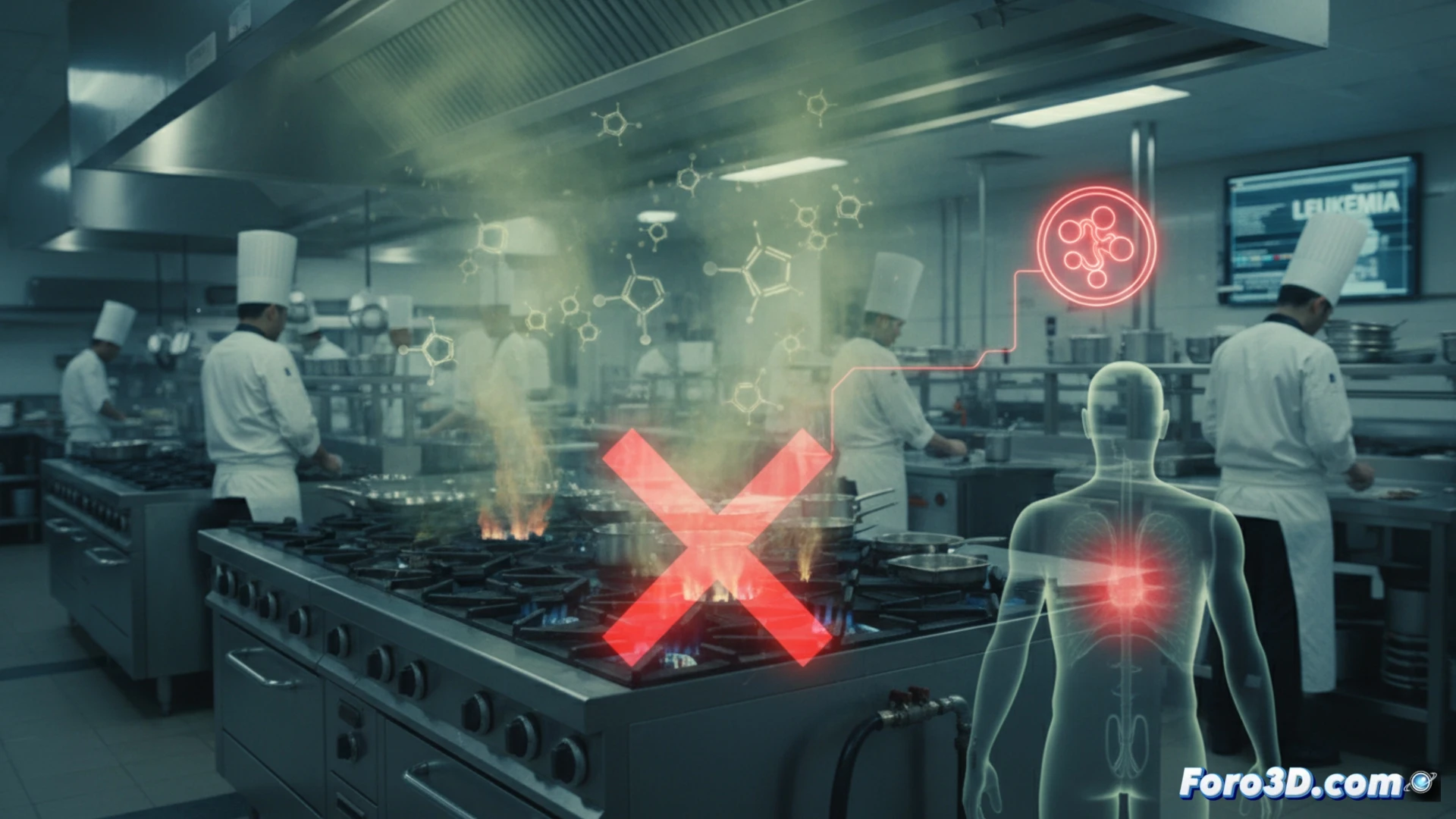
3D Visualization of Dispersion and Occupational Exposure 🔬
An interactive 3D model of a professional kitchen allows simulating contamination dynamics. This model would integrate benzene emission data by burner type, airflow from ventilation, and staff mobility. By running the simulation throughout a workday, concentration clouds accumulating would be visualized, especially in poorly ventilated areas. Overlaying the cooks' trajectories would reveal critical exposure points for direct inhalation, quantifying the dose received at different workstations. This tool transforms an abstract risk into a spatial and temporal map of danger.
From Simulation to Prevention: Data for Action 🛡️
This modeling is not a theoretical exercise. It provides irrefutable visual evidence to drive changes. The results can be correlated with epidemiological studies analyzing leukemia incidence in the hospitality sector. The visualization becomes a powerful argument for improving ventilation standards, adopting localized extraction systems, and promoting the switch to electric induction technologies. Modeling the risk is the first step to eliminate it and protect the health of thousands of professionals.
What tools would you use to visualize the temporal evolution of this epidemic?