The beverage industry faced a CO₂ supply crisis in 2022. The response from Almanac Beer and Aircapture was not just to find another supplier, but to redesign the process from scratch. Their innovation, Flow beer, uses carbon dioxide captured directly from the atmosphere. This case is a perfect example for process simulation, where a new technological module is integrated into an existing line, creating a closed and resilient cycle. 🍺
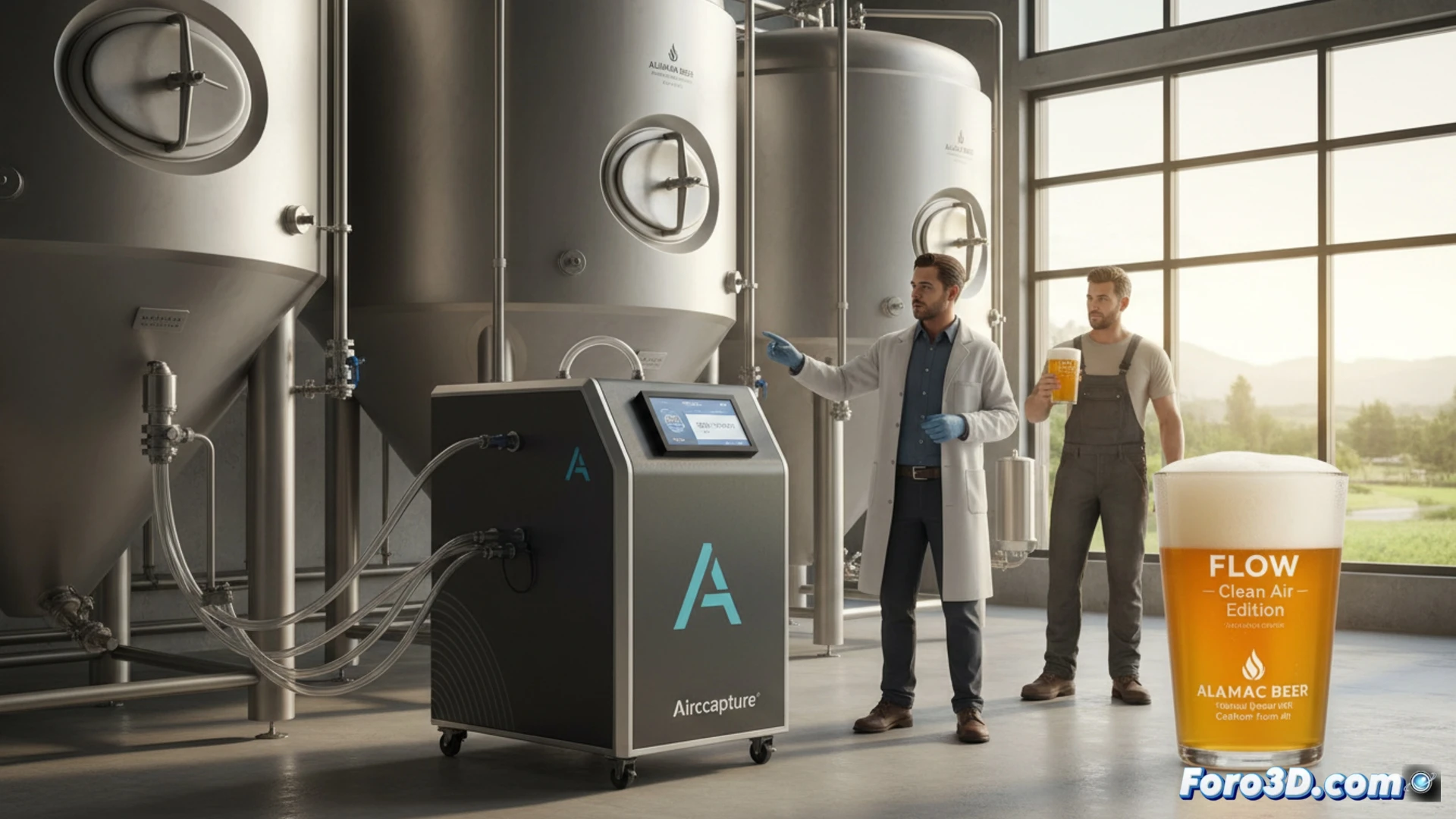
Integration of the DAC Module into the Carbonation Line: A Visual Flow 🔄
Modeling this process in 3D reveals its efficiency. The flow begins with the capture of ambient air by Aircapture's DAC system, a piece of equipment that can be visualized as an input node. The CO₂ is purified in situ to 99.999%, eliminating transportation and intermediate storage stages. In the simulation, this purified gas flow is integrated directly into the carbonation line, injected into the beer tank. The visualization highlights the optimization: a hyperlocal circuit where the raw material is air and the waste is zero, replacing a complex and vulnerable global supply chain with a compact circular process.
Operational Resilience through Circular Simulation ⚙️
Beyond sustainability, this model ensures resilience. Simulating this circular process allows quantifying its independence from external factors. The company ensures a stable supply, immune to geopolitical or market fluctuations. For process simulation, this case establishes a paradigm: optimization no longer seeks only efficiency in linear chains, but the design of self-sufficient loops where a problematic output, like atmospheric CO₂, becomes a critical and controlled input.
How can direct air capture (DAC) transform the dependence on fossil CO₂ in the brewing industry, ensuring sustainable supply and resilience to crises?
(PS: Simulating industrial processes is like watching an ant in a maze, but more expensive.)