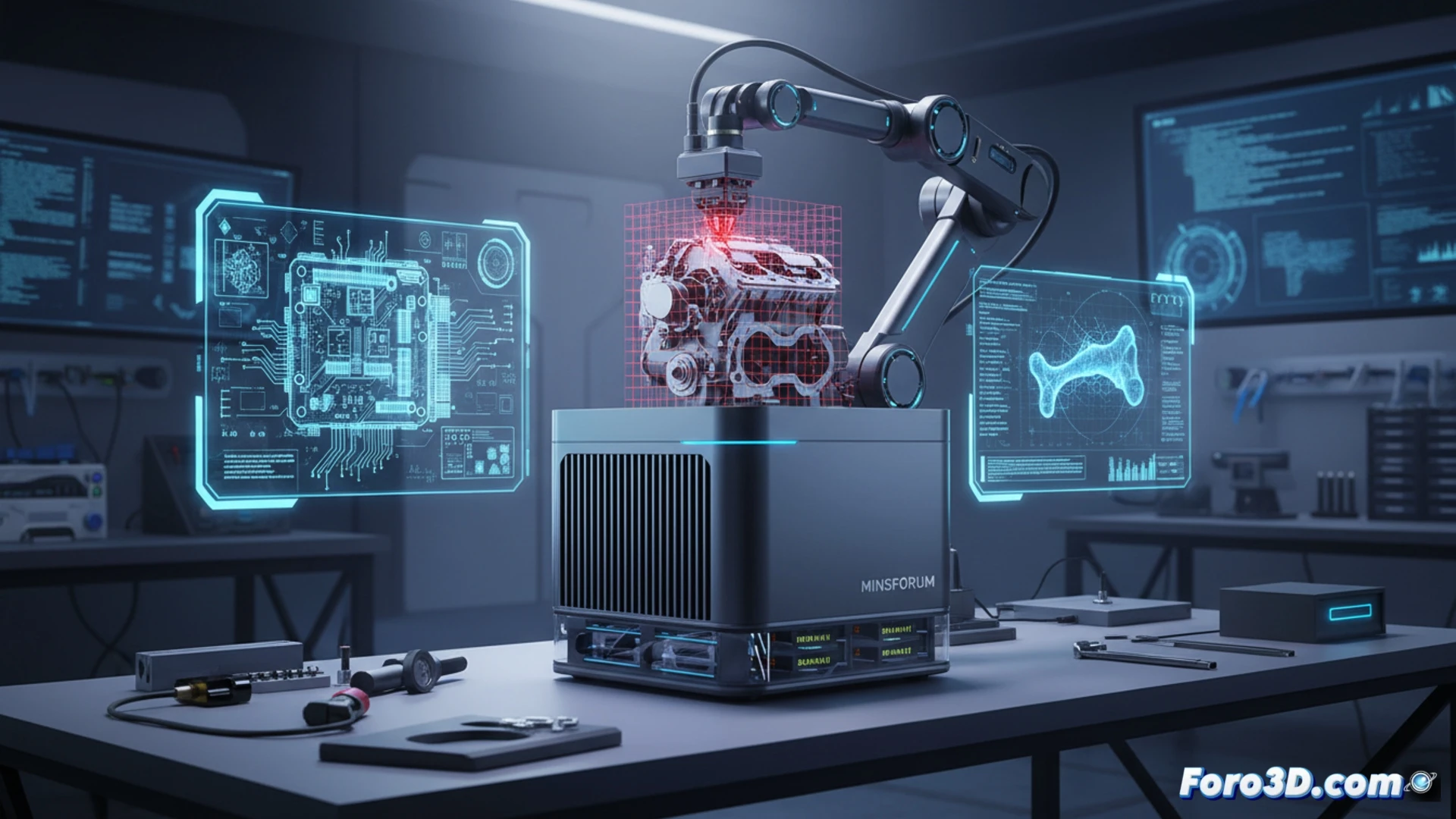
For the reverse engineering professional, the workflow is intensive: high-resolution 3D scanning, processing massive point clouds, mesh reconstruction, and visualization of complex models. This demands a unique balance of computing power, ultra-fast and high-capacity storage. The Minisforum N1 AI emerges as a revolutionary integrated solution, combining a high-performance mini PC with a professional-grade NAS in a single compact chassis. It is the answer for those who need to centralize the entire pipeline, from data acquisition to the final model, without sacrificing performance for space.
Technical Specifications for an Optimized Pipeline 🚀
The heart of the N1 AI is an AMD Ryzen 7 Pro 8845HS processor with integrated NPU, capable of handling the complex algorithms of 3D reconstruction software. Its ability to host a full-size graphics card is its great advantage, allowing the installation of a dedicated GPU for visualization and computation acceleration. Along with support for up to 96 GB of DDR5 RAM, it manages large datasets in memory. As a NAS, its 4 bays for 3.5" HDDs and 3 M.2 slots allow configuring a fast and secure RAID for terabytes of raw scans and projects. The dual 10 Gbit/s network connectivity accelerates data transfer from scanners or to client stations, eliminating bottlenecks.
Redefining the Engineer's Workspace 🛠️
This device transcends mere specifications. It consolidates into a single, compact unit with a front touchscreen for monitoring, what previously required a tower PC plus a separate storage server. For small studios, labs, or workshops with limited space, the N1 AI represents hardware rationalization without compromises. It centralizes the most valuable asset, 3D scan data, in a redundant and high-performance system, while providing the native power to process it. It is not just a powerful NAS or a mini PC with bays; it is the core of a modern and efficient reverse engineering workflow.
Can the Minisforum N1 AI become the definitive workstation for reverse engineering, handling everything from capturing dense point clouds to reconstructing complex meshes in a single integrated flow? 💡
(P.S.: Reverse engineering is like guessing a hard drive's password, but with calipers.)