A recent study has confirmed what many feared: plastic pollution has reached the deepest place in the ocean. Researchers found synthetic fibers in the digestive system of amphipods, small crustaceans, captured in the Mariana Trench at 11,000 meters. This finding evidences that no ecosystem is safe, posing an urgent need to understand and communicate this global problem effectively.
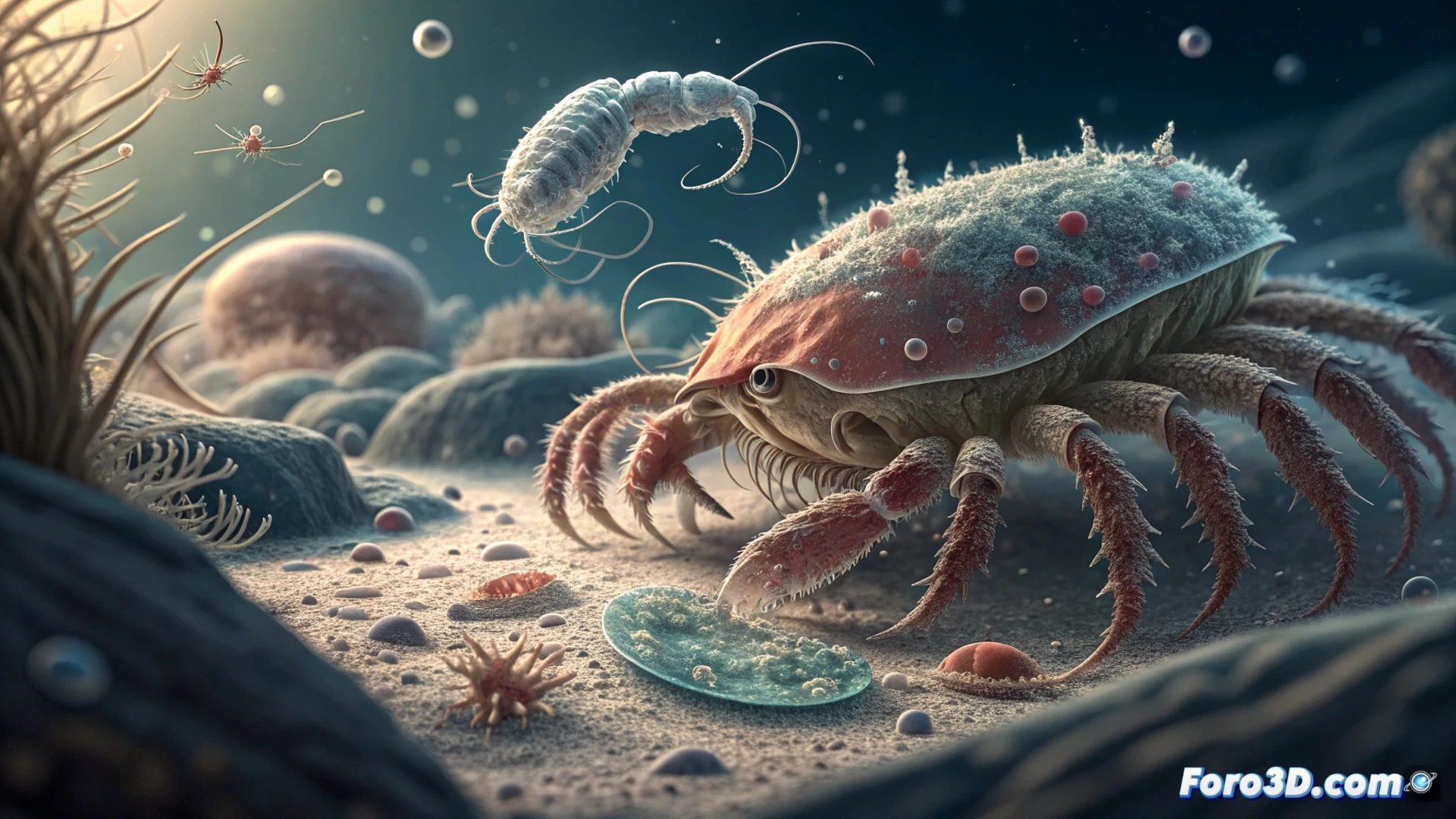
The power of 3D visualization for science and outreach 🎨
This is where our Scientific Visualization community can make a difference. We can transform this raw data into a striking visual narrative. Imagine an anatomically precise 3D model of an amphipod, where microplastic fibers in its digestive tract can be isolated and highlighted. Or a scaled representation of the Mariana Trench, showing the water column and the journey of particles from the surface to the bottom. An animated infographic could track the path of a plastic from its origin to inside an organism in the depths, making a distant and abstract process tangible.
From data to awareness: modeling to change 💡
These visualizations are not just illustrations; they are powerful tools. They allow scientists to analyze physical-biological interactions in a novel way and, most importantly, communicate the gravity of the problem to the public and decision-makers with a clarity that numerical data alone cannot achieve. By creating and sharing these models, we not only document a problem but build an essential visual bridge to foster understanding and, hopefully, drive the necessary action to protect the last corners of our planet.
How can we use advanced scientific visualization techniques, such as volumetric rendering or particle mapping, to represent in an impactful and comprehensible way the distribution and concentration of microplastics in the ocean's abyssal trenches?
(P.S.: at Foro3D we know that even manta rays have better social bonds than our polygons)