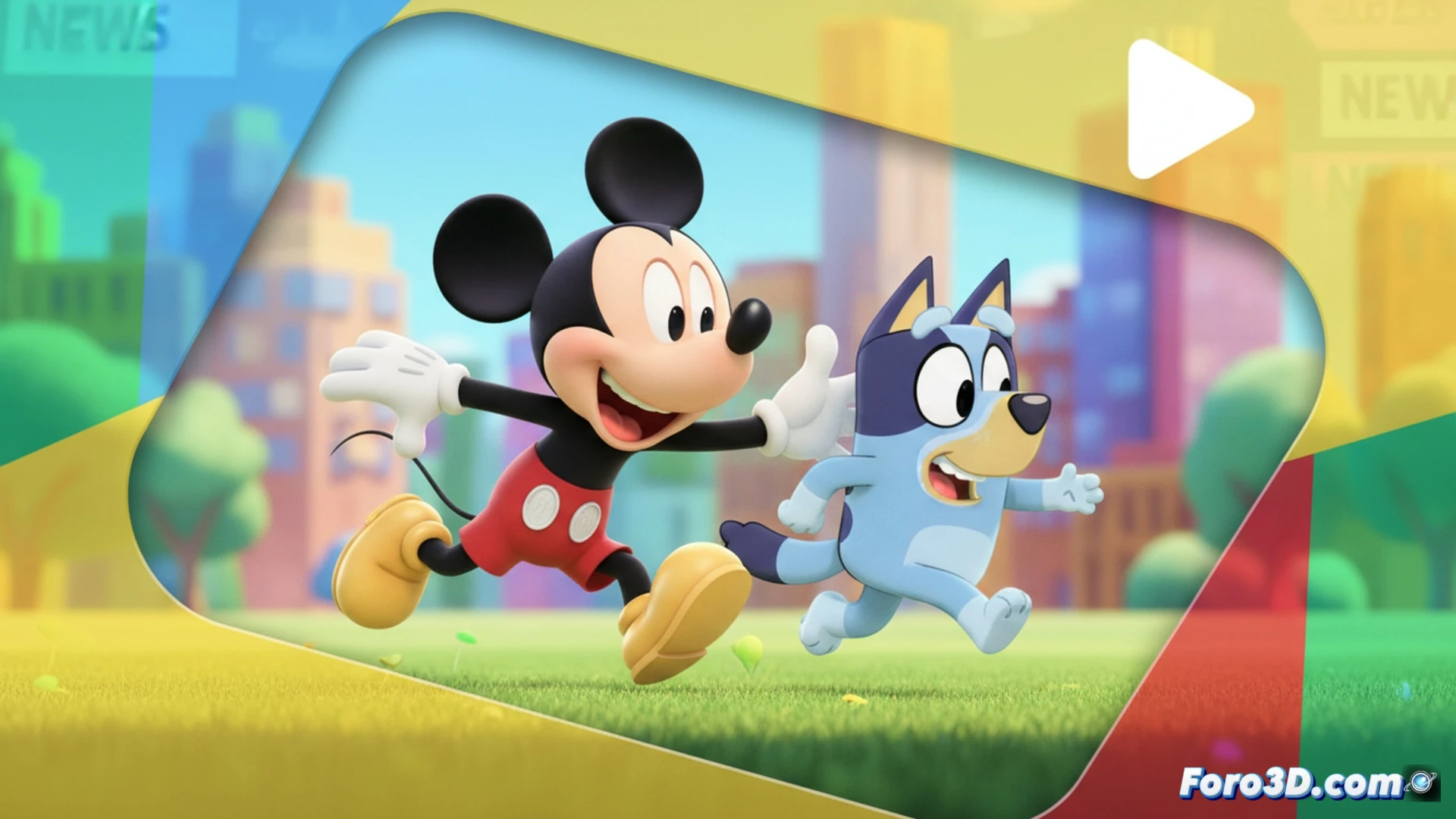
An exclusive Disney+ animated short has brought together two icons from different generations: the classic Mickey Mouse and the contemporary Bluey. This collaboration between Disney, Ludo Studio, and BBC Studios is more than a mere encounter of popular characters. It represents a fascinating exercise in animation, where two radically different aesthetic and technical universes converge on screen. The result is a piece that celebrates not only the legacy and current relevance, but also invites us to examine how the art of bringing characters to life has evolved, maintaining its emotional essence.
The Technical Challenge: Merging Traditional 2D and Expressive CGI 🎬
The technical core of this crossover lies in the integration of two opposing visual languages. Mickey Mouse, with his flat design, defined black lines, and movement based on the principles of traditional animation, clashes with Bluey's world, rendered in three-dimensional CGI but with a simplified aesthetic, soft textures, and exaggerated and elastic physics. The challenge for the animators was to create a coherent space where both could interact. The solution likely involved careful work on lighting and color to balance both styles, and an animation direction that respected Mickey's theatrical gesturing while adopting Bluey's fluidity and playful dynamism, seeking a common point of expressiveness.
Legacy and Future in a Single Frame ✨
This union is a powerful symbol of the constant dialogue in animation. Mickey embodies the heritage and fundamentals of movement. Bluey represents modern sensibility, where visual simplicity combines with deep emotional complexity. Their successful interaction demonstrates that, beyond the technique employed, the priority remains the clarity of acting and the connection with the viewer. The short is not just a homage; it is a statement that the art of animating characters, in essence, maintains an unchanging goal: to create believable and lovable beings, regardless of the tool.
How does the collaboration between Mickey Mouse and Bluey reflect the technical and narrative changes in character animation from traditional 2D to contemporary 3D?
(P.S.: Animating characters is easy: you just have to move 10,000 controls to make them blink.)