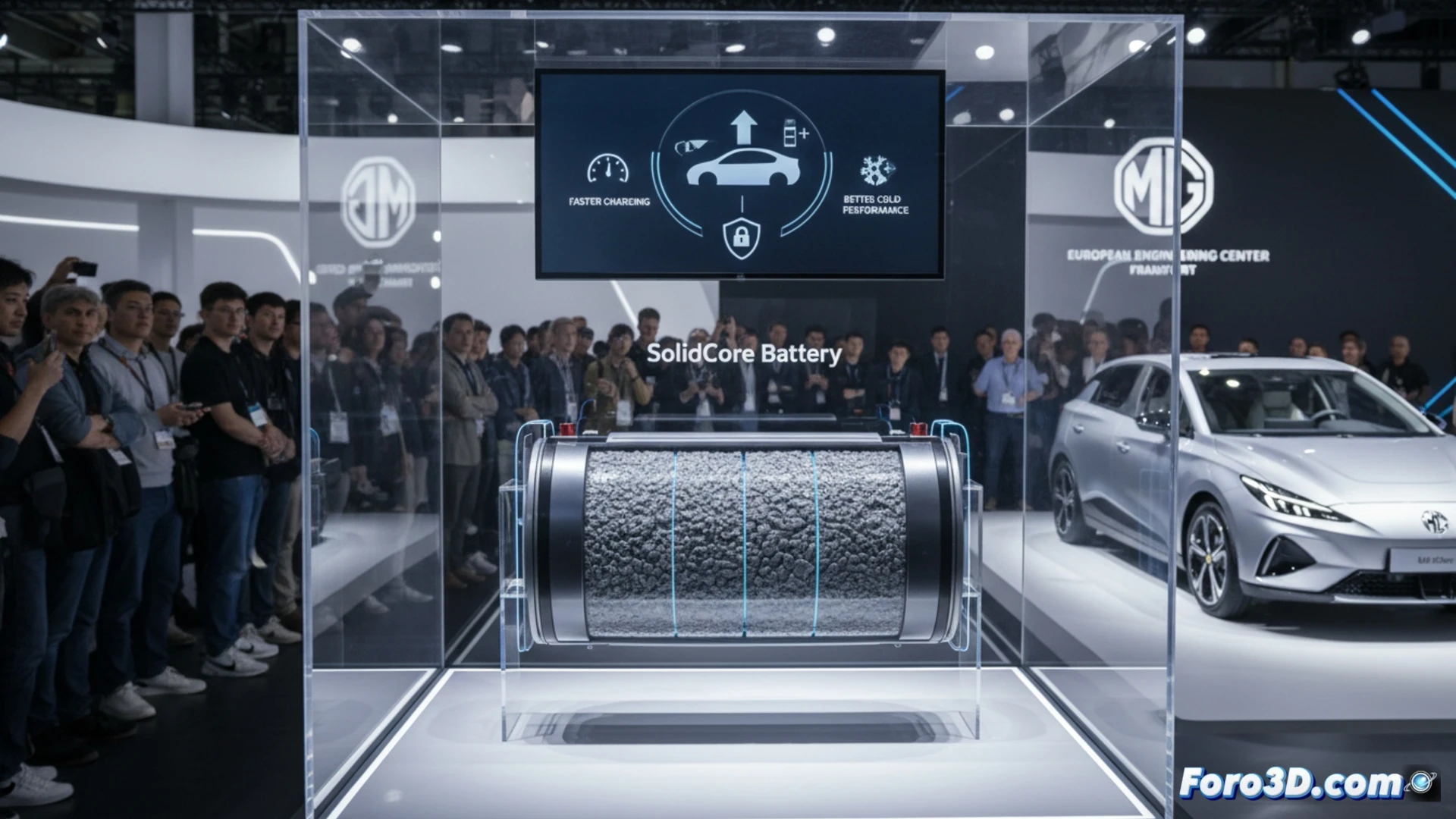
MG has presented the first semi-solid battery for mass production, the SolidCore. This technology replaces 95% of the liquid electrolyte with a solid one, achieving greater range, ultra-fast charging, and structural safety without a significant cost increase. Its arrival in the MG4 EV at the end of 2026 marks a milestone. Behind this advancement, 3D modeling and simulation tools have been fundamental to materialize and validate the innovation before manufacturing.
3D Modeling and CAE Simulation: the Pillars of SolidCore Design 🔋
Developing a semi-solid cell requires extreme precision. Using advanced CAD software, engineers model the cell's internal microstructure, defining the arrangement of electrodes and solid electrolyte to optimize the ion pathway. CAE simulation is crucial: it allows analyzing electrochemical behavior, predicting degradation, and above all, managing the thermodynamics of the entire pack. Simulating extreme charge, discharge, and mechanical stress scenarios in a digital environment ensures the announced safety and durability before creating a single physical prototype.
Integration and Digital Twin: Beyond the Cell 🧩
The innovation doesn't end with the cell. Integrating the battery pack into the vehicle's architecture is another challenge where 3D is key. Using a Digital Twin of the MG4, engineers optimize location, structural rigidity, and impact protection. This virtual integration allows validating the promise of greater safety and cold-weather performance, ensuring that the SolidCore is not just an advanced component, but a cohesive and efficient part of the complete electric vehicle system.
How is semi-solid battery technology, like the MG SolidCore, transforming 3D design and engineering processes in the automotive industry?
(P.S.: at Foro3D our cars have more polygons than horsepower)