George Russell's triumph and Mercedes' one-two finish at the Australian Grand Prix are not just the result of driving talent. Behind this initial success lies a universe of digital technology. In modern Formula 1, every decision, from the car's design to the race strategy, is backed by advanced 3D modeling and simulation tools. This article explores how these technologies were key to dominating the challenge of the Melbourne circuit.
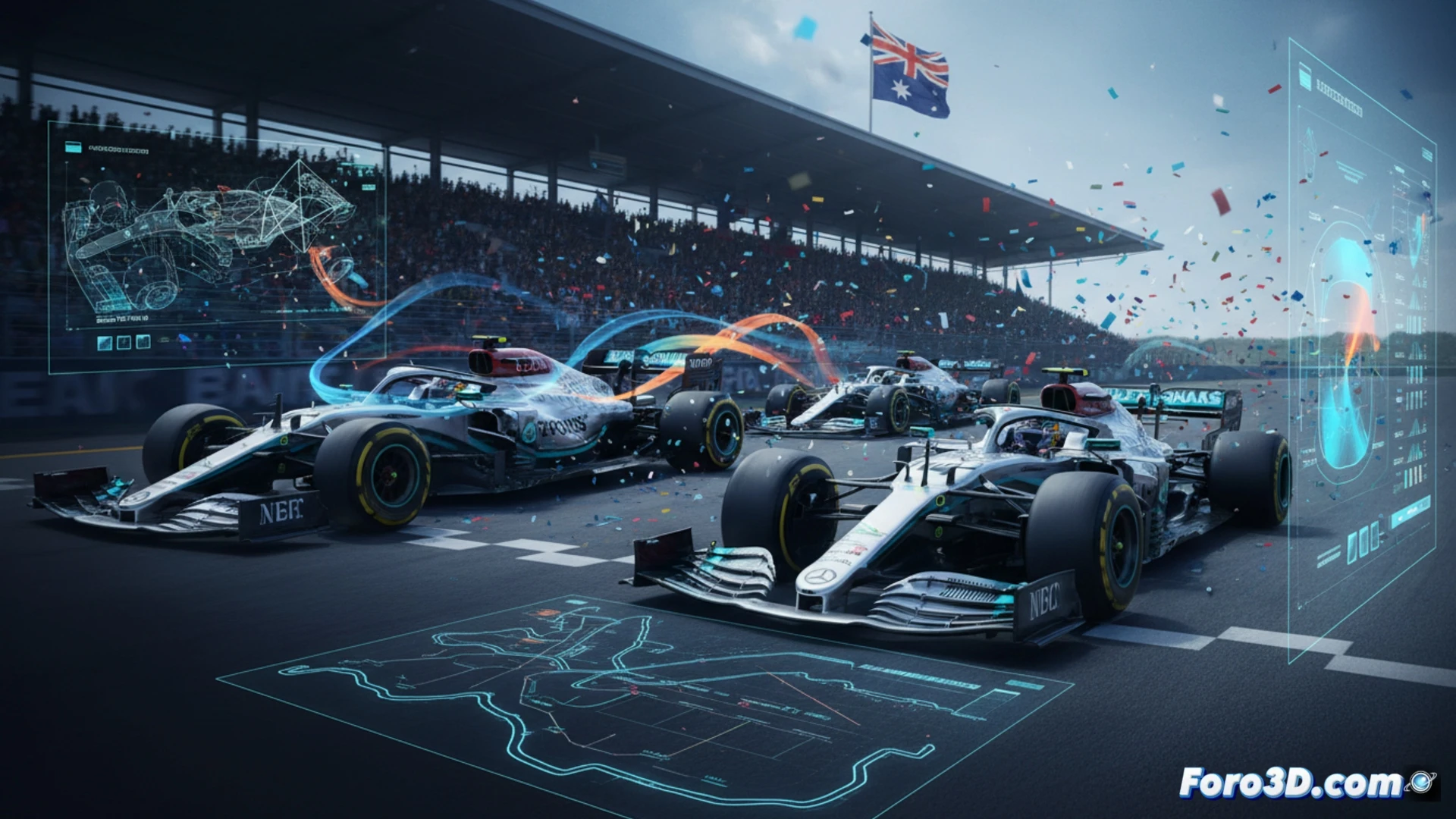
From CFD to Simulator: Preparing the Victory in Melbourne 🏆
Before the tires touched the asphalt, the race was won in the virtual world. Mercedes engineers used Computational Fluid Dynamics (CFD) and high-fidelity 3D modeling to optimize the W15's aerodynamics, seeking the balance between downforce and straight-line efficiency. In parallel, the drivers, including rookie Kimi Antonelli, covered thousands of virtual kilometers in simulators that recreate the Melbourne circuit with millimeter precision. These systems, based on 3D scans of the track, allow training on every corner, testing setups, and anticipating the car's behavior. Even Verstappen's comeback is analyzed with 3D telemetry maps that show the performance of each component in real time.
Beyond the Track: The Future of Simulation 🔮
What was seen in Australia is just the tip of the iceberg. F1 is advancing towards complete digital twins, where a 3D model of the car is updated in real time with telemetry data, predicting failures like those that affected Alonso. This philosophy, where the virtual and physical are inseparable, redefines the sport. Victory is no longer sought only in the workshop, but in the data processing cloud, proving that technological competition is as intense as the sporting one.
How did 3D modeling and computer simulation influence the development of Mercedes' chassis that allowed them to achieve the one-two finish at the Australian Grand Prix?
(P.S.: reconstructing a goal in 3D is easy, the hard part is making it not look like it was scored with the leg of a Lego doll)