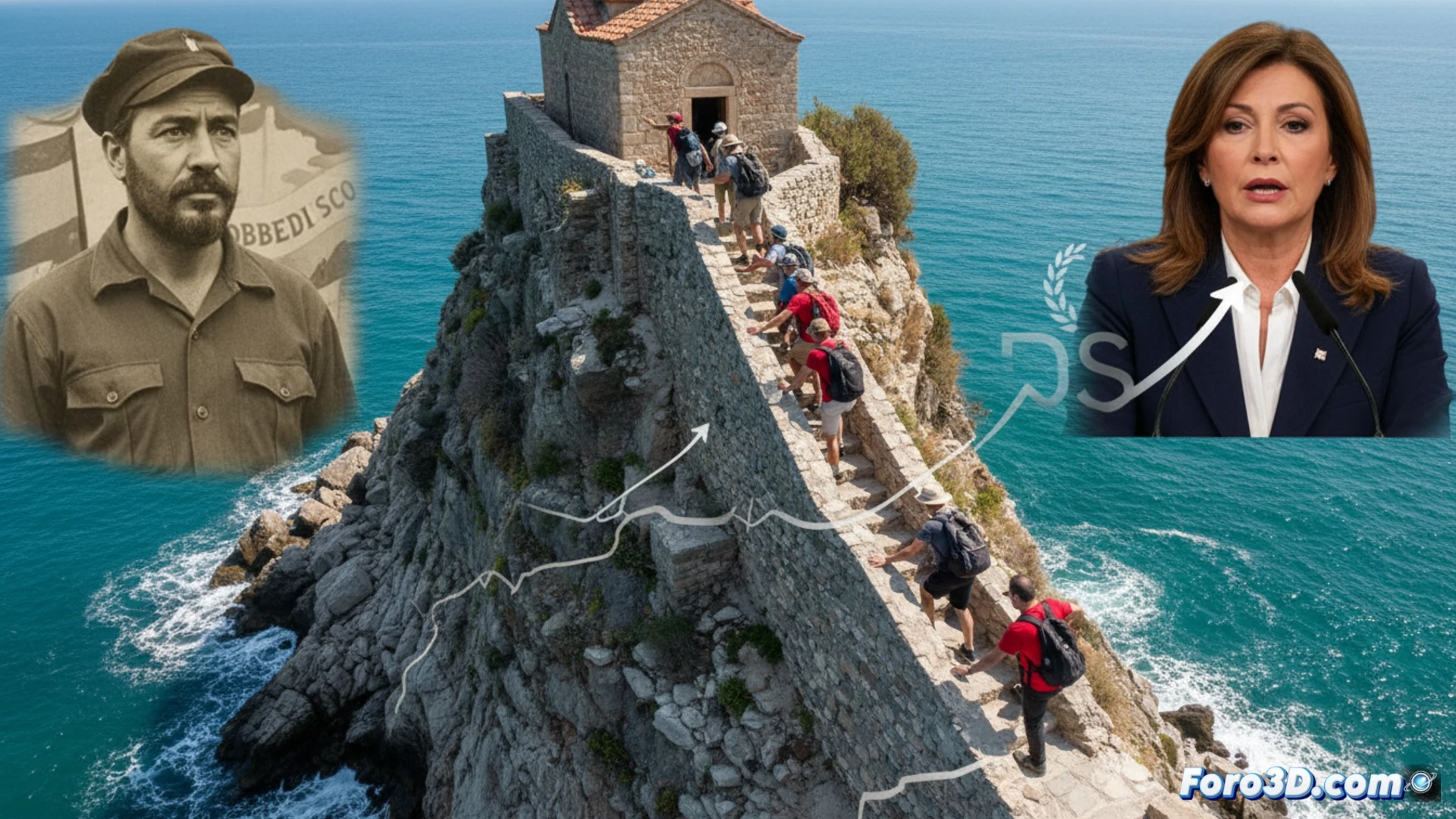
In Greece, a church built on a steep slope has become a viral attraction. Tourists, defying balance and common sense, climb its structure to take photographs, compromising its stability and their own safety. This case exemplifies a modern conflict: the pressure of mass tourism against the conservation of fragile historical monuments. The anecdote, symbolically linked to concepts of obedience and discipline, forces us to seek solutions that do not rely solely on public awareness, but on active and technological management of heritage. 🏛️
Laser scanning and digital twins: diagnosis and prevention 🔍
This is where 3D technology reveals itself as an indispensable tool. Through terrestrial laser scanning or high-precision photogrammetry, an exact digital model of the church and its terrain can be generated. This digital twin allows quantifying millimeter displacements, analyzing structural stress points, and simulating the impact of additional loads, such as the weight of groups of people. With this data, conservators can identify specific risks, establish safe load limits, and design protective barriers or alternative access routes that divert visitor flow, all tested virtually before physical implementation.
Beyond prohibition: awareness through interactive models 💡
3D technology also offers a powerful avenue for education and awareness. An interactive model accessible online, showing risk areas and simulated degradation effects, can be more effective than a simple prohibition sign. By visualizing the consequences, informed and responsible obedience is fostered. True discipline to preserve our heritage should not arise solely from an order, but from a clear understanding of the vulnerability of these structures, something a 3D model can convey powerfully and tangibly.
Can emergency 3D digitization safeguard fragile architectural heritage before mass tourism degrades it irreversibly?
(P.S.: Virtually restoring is like being a surgeon, but without blood stains.)