Apple has unveiled its new MacBook Pro models with the M5 Pro and M5 Max chips, positioning them as the ultimate evolution for creative professionals. For 3D artists, the question is clear: does this generational leap justify the investment? Although the external design remains the same, the internal improvements promise to revolutionize intensive workflows in modeling, rendering, and simulation, challenging the traditional dominance of workstations with dedicated GPUs.
Technical Breakdown: CPU, GPU, and Neural Engine for 3D Workloads 🔍
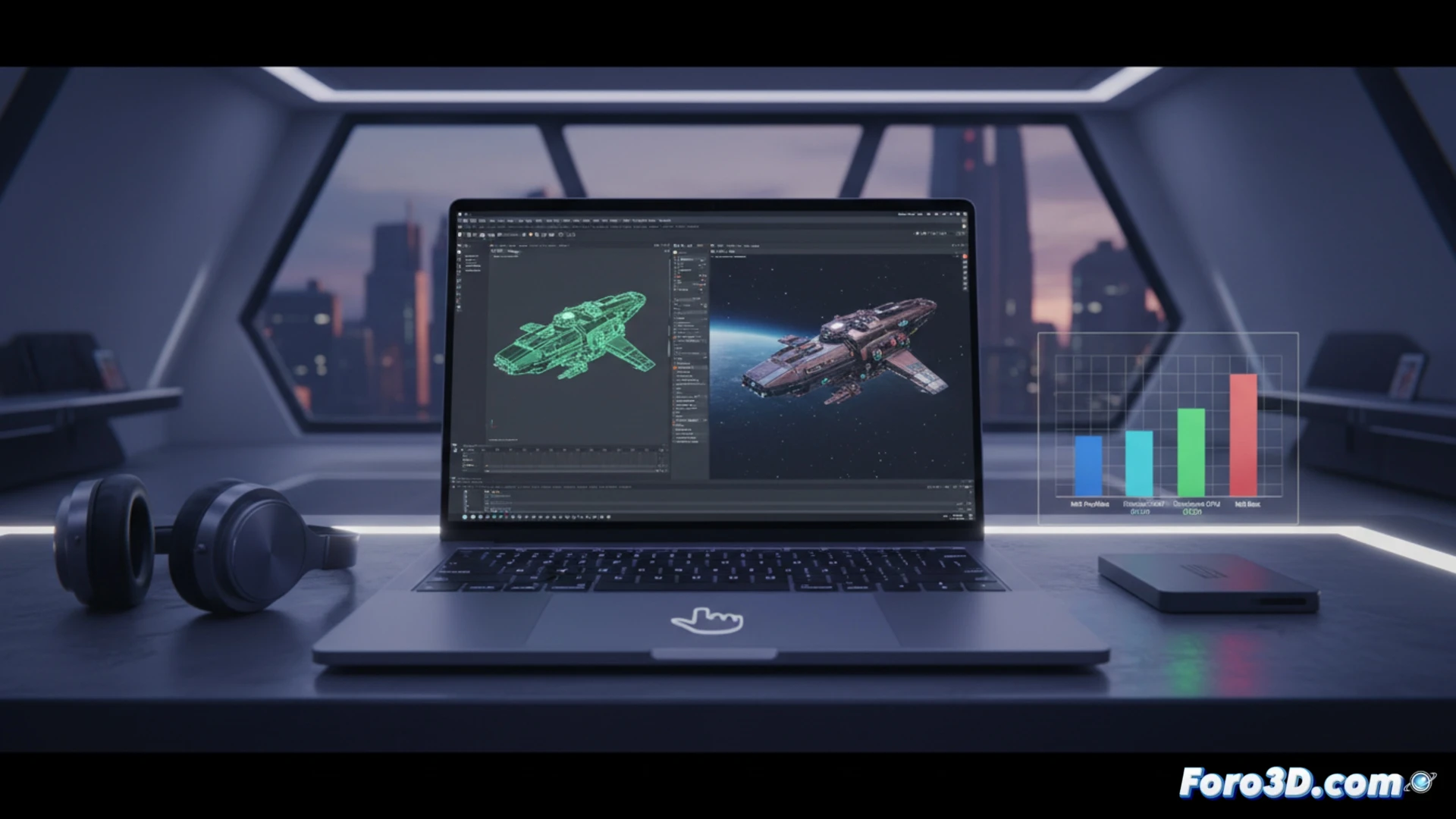
The specifications point to a substantial advancement. The CPU offers up to 30% better performance than the M4, crucial for simulation and computation tasks in applications like Houdini or Blender. The real revolution is in the GPU and neural accelerators. Apple claims that AI performance is 4x greater than the M4 and 8x that of the M1. This translates to near real-time denoisers and upscalers for rendering, acceleration of AI tools in suites like Adobe, and improvements in the viewport. The M5 Max, with its extra cores, is clearly aimed at complex rendering and handling heavy scenes.
Conclusion: For which 3D artist profile are they essential? 🎯
The investment is justified for mobile professionals with macOS-based pipelines who leverage Silicon-optimized render engines (like Octane) or tools with AI acceleration. For modeling and animation, the leap is notable. However, for studios that rely on specific CUDA renderers or large amounts of VRAM, Windows solutions with dedicated GPUs continue to offer more flexibility and raw power. These MacBook Pro models are not for everyone, but for the target user, they redefine the concept of a laptop for serious 3D production.
Can the new MacBook Pro with M5 Pro/Max chips truly compete with NVIDIA's dedicated workstations in 3D rendering and complex simulation?
(P.S.: remember that a powerful GPU won't make you a better modeler, but at least you'll render your mistakes faster)