The European energy crisis enters a critical phase. The conflict in the Middle East has blocked the Strait of Hormuz, a vital route for 20% of the world's LNG. At least four methane carriers, originally destined for Europe, have redirected their course toward Asia, attracted by higher prices. This immediate diversion of cargoes evidences the continent's vulnerability in a hypercompetitive global market.
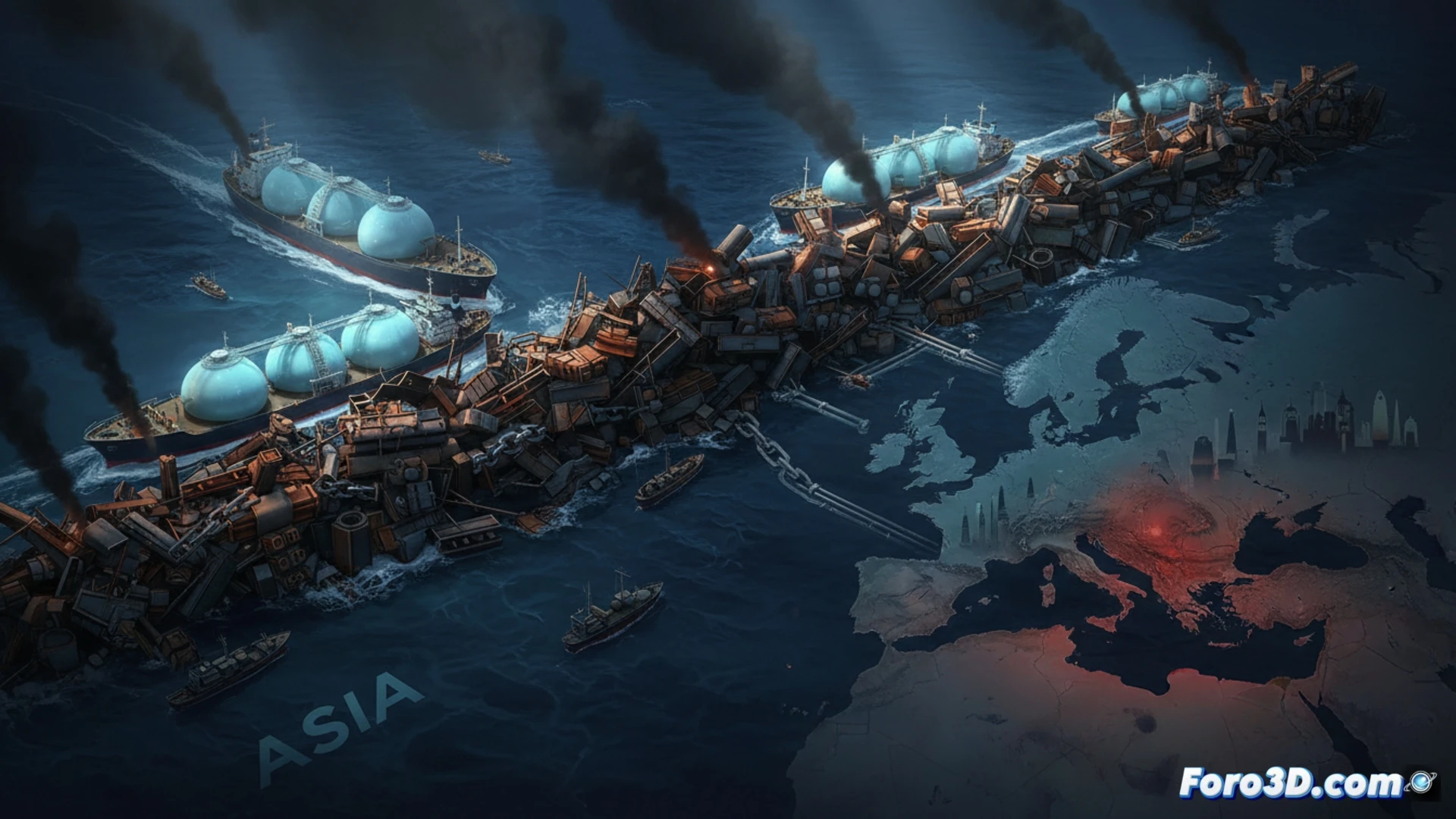
Visualizing the Bottleneck: Qatari-Europe Route and Diversions 🔍
A 3D model of this supply chain is revealing. The maritime route from Qatar's megaplants, crossing the Indian Ocean and the Strait of Hormuz toward the Suez Canal and Europe, is visualized as a constant flow. The blockage in Hormuz appears as a critical strangulation point. Overlaying traffic data, ships can be rendered deviating in real time, turning in the Indian Ocean eastward toward Asia. The shutdown of a Qatari plant, following an attack, is modeled as a disruption at the origin, reducing the total available volume and exacerbating competition.
Geopolitical Lesson: Energy Security in 3D ⚠️
This technical visualization narrates a compelling geopolitical lesson. Dependence on unstable maritime routes and competition with economies willing to pay high premiums leave Europe in a fragile position. The Qatari minister warned that normalization would take months, even after a ceasefire. The 3D simulation shows not only a logistical problem, but a strategic readjustment of the global LNG market, where supply chain resilience is as crucial as price.
What tool would you use to create an interactive geopolitical risk map?