Liqcreate revolutionizes the digital dental workflow with the commercial launch of its Separation Model, a specialized resin that eliminates the need to manually apply separating agents. Developed in collaboration with laboratories, this formulation integrates the separating agent into the photopolymer itself. This saves time, reduces inconsistencies, and avoids acrylic contamination, achieving cleaner and aesthetically uniform appliances from the printed model.
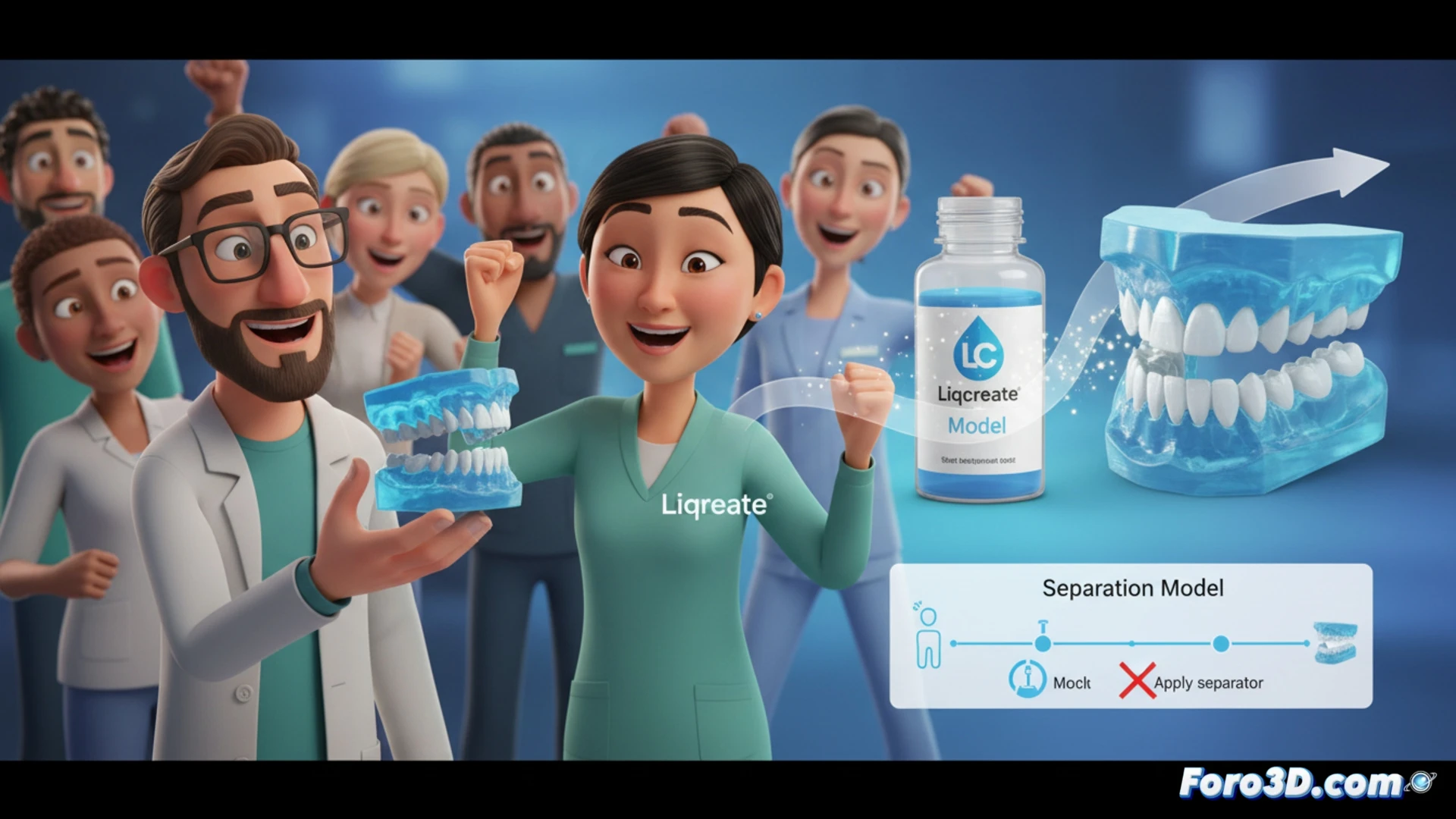
Technical features and impact on the process 🦷
The material offers a matte surface finish and high dimensional precision, crucial for the fit and aesthetics of prostheses and orthodontics. Its main technical advantage is compatibility with cold curing procedures for repairs or additions, where effective separation is critical. By polymerizing the acrylic directly onto the printed model with this resin, the traditional step of applying a separating medium is avoided, which can be irregular and generate defects. This not only speeds up production but also standardizes quality and improves the clinical predictability of the final result.
A key step toward comprehensive digital dentistry 🔬
The Separation Model represents more than a new material; it is the optimization of a bottleneck in digital dental manufacturing. By integrating the separation functionality, it brings laboratories closer to a truly automated and reliable process. This development underscores the trend toward personalization and efficiency, where each innovation in materials brings closer the promise of a completely seamless and consistent digital dentistry.
How can Liqcreate's dental resin with integrated separator transform the digital manufacturing of prostheses and surgical guides in the orthodontic and oral rehabilitation workflow?
(PS: 3D prostheses are so personalized that they even have a fingerprint.)