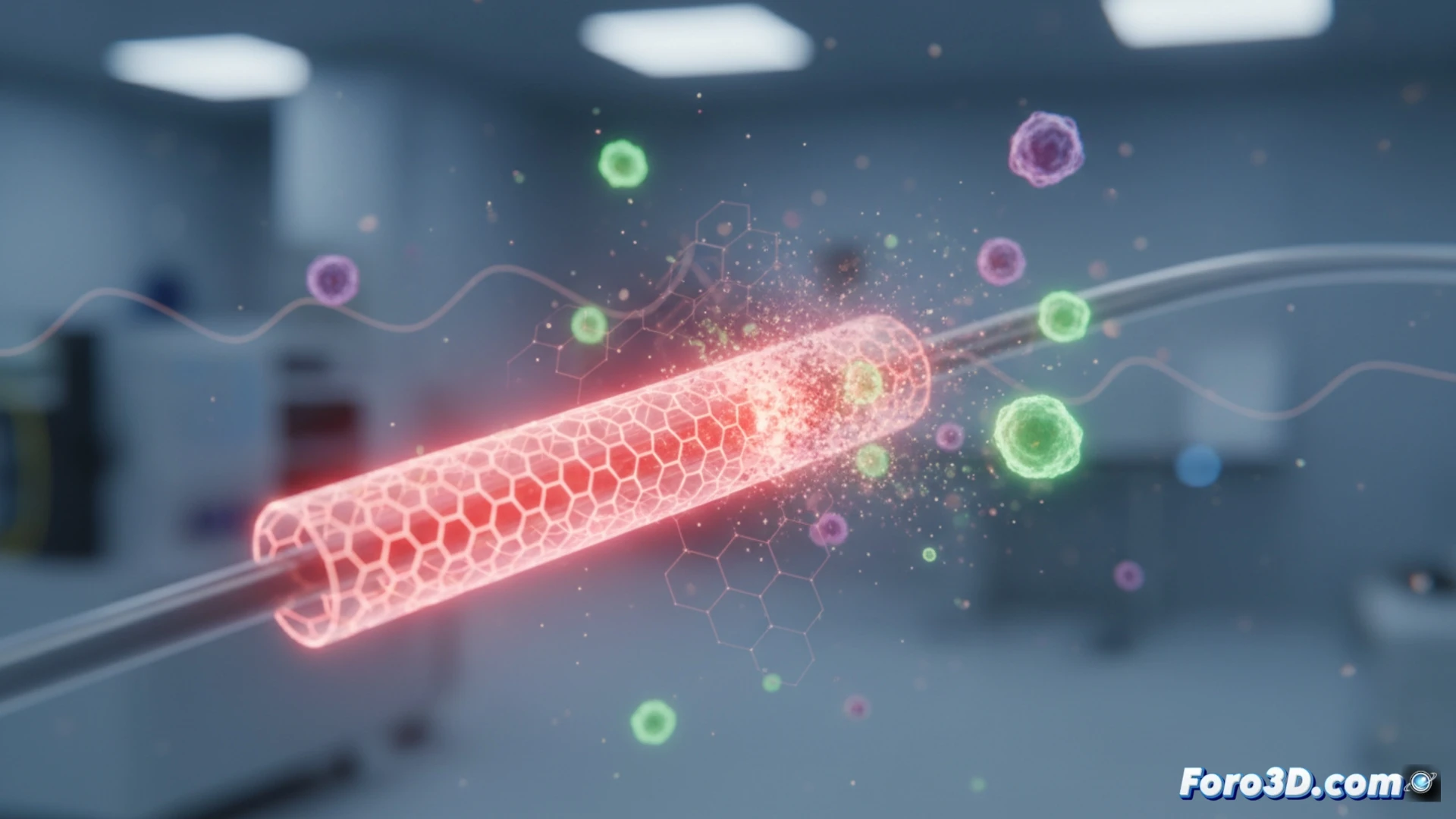
Antibiotic resistance is a growing global threat. To combat it, researchers at the Empa laboratory, such as chemist Giacomo Reina, are developing a new generation of nanomaterials. These are activated by infrared light to neutralize pathogens safely. Their application as ultrathin coatings on catheters or bandages could prevent infections, offering a promising alternative to traditional antibiotics and metal-based materials.
From the atom to the device: the crucial role of 3D modeling 🔬
The design of these nanomaterials and their integration into medical devices would be unthinkable without 3D technologies. Computational visualization and simulation in 3D allow modeling the atomic structure of the materials, predicting their behavior under infrared light, and optimizing their interaction with bacterial or viral membranes. Additionally, 3D modeling is essential for designing the devices themselves, such as customized catheters, ensuring that the nanometric coating is distributed uniformly and effectively over complex geometries.
A future designed layer by layer 🧩
This research symbolizes the convergence of disciplines: materials science, photonics, and biomedicine, united by the common language of 3D design. Visualizing and manipulating matter at the nanoscale to build antimicrobial shields brings us closer to a paradigm of preventive and personalized medicine. Each 3D simulation and each virtually deposited material layer are steps toward smarter and safer medical devices, designed to protect health from their most intimate surface.
How can light-activated nanomaterials, designed through 3D modeling and printing, create intelligent antimicrobial surfaces for customized implants and prostheses?
(P.S.: and if the printed organ doesn't beat, you can always add a little motor... just kidding!)