The recent publication of Catherine de Medici's political correspondence unveils an intricate game of strategies and religious tensions in 16th-century France. This historical archive, beyond its academic value, represents a unique opportunity for digital activist art. Through 3D technologies and data visualization, we can transform these letters into critical tools, mapping networks of influence and recreating contexts to reflect on current power dynamics.
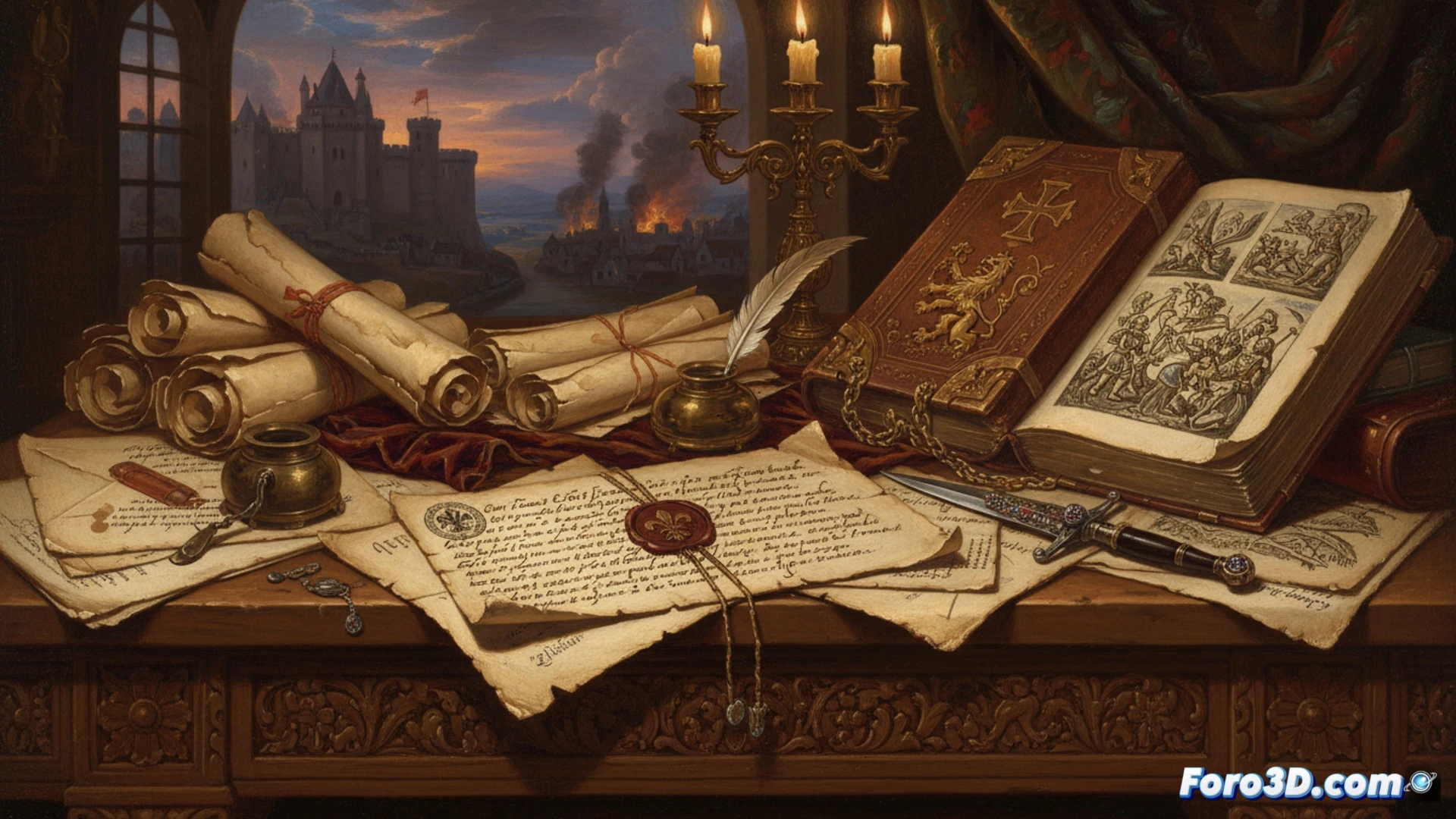
Digital tools for immersive and critical history 🔍
The technical proposal is based on three pillars. First, interactive 3D visualization of influence networks, where each node represents a character or court and the links show the flow and tone of the correspondence, revealing hidden alliances. Second, 4D geopolitical maps that show the territorial evolution of religious conflicts overlaid on messenger routes. Third, immersive VR/AR environments that reconstruct the Valois court, allowing to experience physical distance and the spaces where intrigues were woven, adding a sensory layer to textual analysis.
The past as a mirror: digital activism with historical archives ⚖️
This project is not just an archaeological reconstruction. It is an act of digital activism that uses the past to interrogate the present. By making the 16th-century political machinery tangible, we question how power networks, disinformation, and secret diplomacy are built and maintained today. 3D technology thus becomes a critical bridge, transforming historical archives into distorted but revealing mirrors of our own control and communication structures.
How can 3D modeling and interactive data visualization help us decipher and represent the complex power networks and hidden political strategies in Catherine de Medici's correspondence?
(P.S.: political digital art is like an NFT: everyone talks about it but no one really knows what it is)